


















Lesson 1 of 48 · Getting Started
Course Map: How This Circuit Analysis Course Works
Start here: who the course is for, what you need to know first, how the nine chapters fit together, and how to study circuit analysis effectively.
Every phone, laptop, car and hospital machine is, at heart, a collection of circuits. Circuit analysis is the skill of looking at a diagram of connected parts and predicting what every voltage, current and watt will be, using nothing more than a few laws and some careful algebra. It is the first real engineering skill in electronics, and it pays off in every later topic: power supplies, amplifiers, sensors, radio, even computer chips.
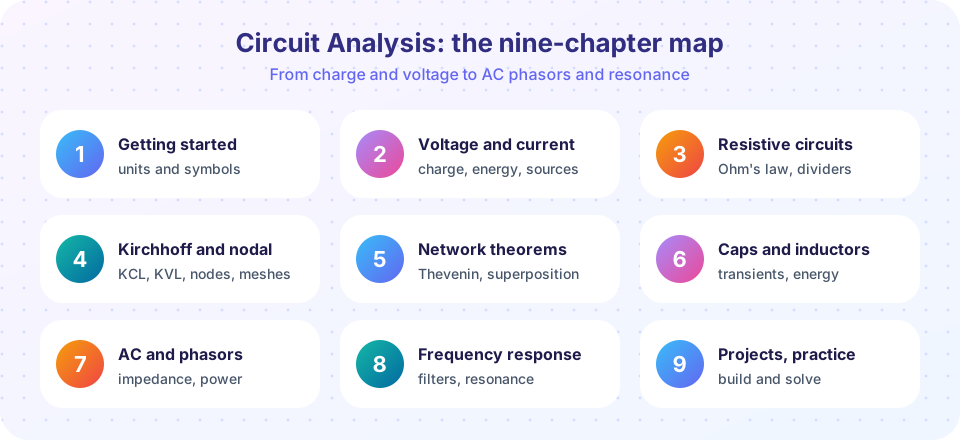
This course takes you from "what is a circuit?" to AC phasors and resonance, in nine chapters. You will not just read the formulas: you will run them, plot them and break them. Almost every lesson has a live widget or a short Python simulation, and every concept has a picture.
What you will learn
- What the nine chapters cover and how they depend on one another.
- What background you need, and what you can safely skip.
- A study routine that works for circuit analysis.
- How the live widgets and Python simulations in this course are meant to be used.
Key terms
Circuit: a closed path through which electric charge can flow.
Analysis: given the circuit, find the unknown voltages, currents and powers.
Component (or element): one part of a circuit, such as a resistor or a battery.
Model: a simplified description of a real part, such as "an ideal resistor obeys V = I·R".
Who this course is for
The course suits anyone aged about 14 and up who wants a solid grounding in electricity: school students meeting circuits in physics, first-year engineering and technology students, hobbyists who build with Arduino or Raspberry Pi and want to stop guessing, and adults refreshing a half-forgotten subject. It follows the common core of international physics and engineering curricula (Cambridge, IB and US introductory college courses), with SI units throughout.
What you need first
- Algebra. You must be comfortable rearranging equations such as V = I·R and solving two equations with two unknowns. Chapter 4 leans on this.
- Decimals, fractions and powers of ten. Lesson 3 revisits metric prefixes.
- Trigonometry and a first look at calculus help in Chapters 6 to 8 (sine waves, rates of change), but each idea is introduced when it is needed. If you have not met calculus, you can follow the ideas and skip the derivations.
- No electronics experience is assumed.
The nine chapters
Foundations
- Getting started
- Voltage and current
Resistive circuits
- Ohm's law
- Kirchhoff and nodal
Shortcuts for big circuits
- Network theorems
Time and AC
- Capacitors and inductors
- AC and phasors
Frequency and practice
- Frequency response
- Projects and practice
Chapters 1 and 2 give you the vocabulary. Chapters 3 and 4 give you the two big laws (Ohm and Kirchhoff) and the two systematic methods (nodal and mesh) that solve any resistive circuit. Chapter 5 gives shortcuts. Chapters 6 to 8 add parts that remember (capacitors and inductors) and signals that change (AC). Chapter 9 puts it together.
How to study
- Read with a pencil. Redo every worked example on paper before you look at the answer. Circuit analysis is a skill, like playing scales: you learn it by doing.
- Draw the circuit every time. Label every voltage and current with a name and an arrow before you write any equation. Most mistakes come from skipping this.
- Write units on every number. "3" means nothing; "3 mA" means a lot. Units catch errors: if your answer for a voltage comes out in amps, something is wrong.
- Estimate first. Before calculating, guess roughly what the answer should be. If 9 V drives current through 3 kΩ, you expect a few milliamps, not a few amps.
- Check by a second route. Verify power balance (Chapter 2) or solve by both nodal and mesh methods (Chapter 4).
Common misconceptions
"Electricity is used up in a circuit." Charge is not consumed: it flows around the loop and returns. What a component uses up is energy, which the charge carries.
"Circuit analysis is memorizing formulas." There are only a handful of laws. Everything else is those laws applied patiently.
Try it
Here is the first widget of the course. Drag the sliders and watch the current change. Notice that doubling the resistance halves the current: you have just rediscovered Ohm's law, which Chapter 3 explains fully. (The lamp brightness is a simple model, not a real lamp.)
The next program loops over five resistor values for a 9 V battery. Change the list and run it again.
Press Run (or Ctrl + Enter) to see the result here.
Program input · what you'd type while the program runs
Type the answers before you press Run, one per line. Each time the program reads a line (with input()), it gets the next line from this box.
Check your understanding
Quick check · 4 questions
of 4 answered You scored / 4 · perfect!
-
1. What does circuit analysis aim to find?
Analysis starts from a known circuit and predicts its voltages, currents and powers. -
2. Which habit prevents the most mistakes?
A labeled diagram fixes the sign conventions, which is where most errors begin. -
3. In the playground widget, you double the resistance and keep the voltage. What happens to the current?
I = V / R, so doubling R halves I. -
4. Which statement is correct?
Charge returns to the source. It is the energy carried by the charge that gets converted into heat, light or motion.
Summary
- Circuit analysis predicts voltages, currents and powers from a diagram.
- The course runs from basics (Ch. 1-2) through resistive circuits and methods (Ch. 3-5) to storage elements and AC (Ch. 6-8) and projects (Ch. 9).
- Label, estimate, use units, and check each answer a second way.
- You will use live widgets and Python to test ideas.
Track your progress
Create a free account to tick off lessons and pick up where you left off on any device.
of Circuit Analysis lessons completed