


















Lesson 9 of 48 · Charge, Voltage, Current and Elements
Sources, Passive Elements and the Sign Convention
Learn ideal voltage and current sources, dependent sources, the passive sign convention for absorbing or supplying power, and conservation of power in circuits.
Every circuit element does one of two things: it supplies energy to the circuit or it absorbs energy from it. Batteries and generators supply; resistors, lamps and motors absorb. To do the algebra without confusion, engineers use a single sign convention that tells you, from the sign of the power, which role a part is playing at any moment.
In this lesson you will meet the ideal elements we use to model real devices (voltage sources, current sources and dependent sources), learn the passive sign convention, and discover that in every circuit the power supplied exactly equals the power absorbed.
What you will learn
- The behaviour and symbols of ideal independent voltage and current sources.
- What dependent (controlled) sources are and why they model transistors and amplifiers.
- How to apply the passive sign convention to decide absorbing versus supplying.
- How to verify any solution with a power balance.
Key terms
Active element: an element that can supply energy to the circuit (sources).
Passive element: an element that only absorbs or stores energy (resistor, capacitor, inductor).
Ideal voltage source: holds a fixed voltage across its terminals no matter what current it supplies.
Ideal current source: forces a fixed current through its terminals no matter what voltage is across it.
Dependent source: a source whose value is controlled by a voltage or current elsewhere in the circuit.
The passive sign convention
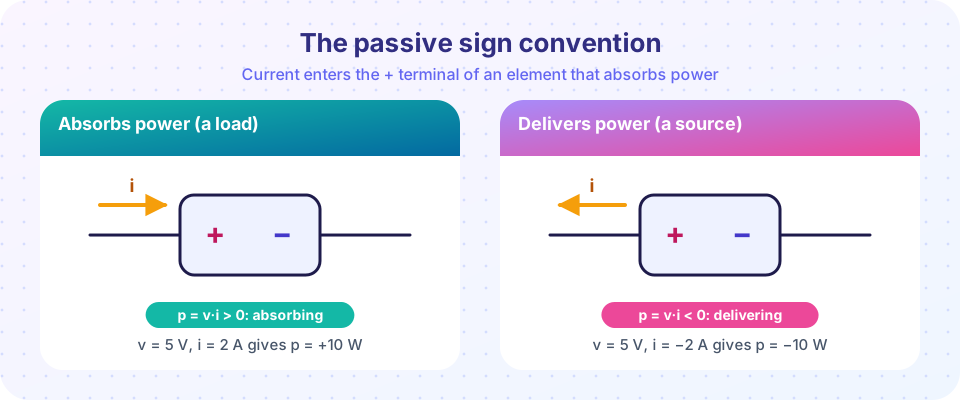
Pick an element and mark its voltage v with a + sign on one terminal and − on the other. Draw the current i entering the + terminal. That is the passive sign convention. With it:
p = v · i
- If p > 0, the element absorbs power (it behaves like a load).
- If p < 0, the element supplies power (it behaves like a source).
Example: with 5 V and current 2 A entering the + terminal, p = +10 W: absorbed. If the real current is 2 A leaving the + terminal, then with the convention direction (entering) i = −2 A, so p = 5 × (−2) = −10 W: the element supplies 10 W. The rule makes the arithmetic automatic: write every element with the convention, compute v·i with signs, and the sign tells the story.
When you analyze a circuit, you may choose the reference directions freely. Always label them first, then let the equations decide the signs. A negative answer simply means the real direction is opposite to the arrow you drew.
Ideal independent sources
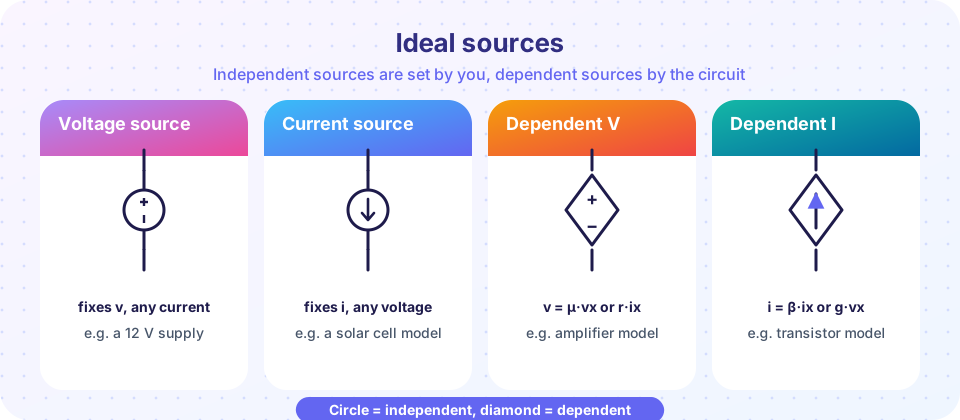
An ideal voltage source (circle with +/−, or the battery symbol) maintains a fixed voltage across its terminals. It will supply whatever current the circuit demands. A 12 V ideal source has 12 V across it whether it drives 1 mA or 1,000 A, which is not true of any real battery; real ones are modeled as an ideal source plus a small series resistance (Chapter 5).
An ideal current source (circle with an arrow) forces a fixed current in the direction of its arrow. It will develop whatever voltage is needed across itself to push that current. Real devices that approximate it include some sensors, and transistor stages in their working region.
Two special cases make a valuable memory pair:
| Element | Voltage across | Current through |
|---|---|---|
| Ideal voltage source | fixed (e.g. 12 V) | whatever the circuit demands |
| Ideal current source | whatever the circuit demands | fixed (e.g. 2 mA) |
| Open circuit | any | 0 |
| Short circuit | 0 | any |
An ideal voltage source of 0 V is a short circuit, and an ideal current source of 0 A is an open circuit. It is also forbidden to connect two ideal voltage sources of different values in parallel (they would demand contradictory voltages), or two ideal current sources of different values in series.
Dependent sources
A dependent (or controlled) source produces a voltage or current that depends on another voltage or current in the circuit. They are drawn as diamonds. There are four kinds:
- VCVS: voltage-controlled voltage source, v = μ · v_x
- CCVS: current-controlled voltage source, v = r · i_x
- VCCS: voltage-controlled current source, i = g · v_x
- CCCS: current-controlled current source, i = β · i_x
Dependent sources are not physical batteries; they are models. A transistor in its active region behaves roughly like a CCCS: the collector current is β times the base current. With β = 100 and a base current of 20 µA, the collector current is 100 × 20 µA = 2 mA. An op amp is modeled as a VCVS with a huge gain. You analyze circuits containing them just like others, with one extra equation that relates the controlled value to its control variable (Chapter 4 shows this).
Passive elements
The three passive elements are the resistor (dissipates energy as heat), the capacitor (stores energy in an electric field) and the inductor (stores energy in a magnetic field). A resistor always has p ≥ 0 under the passive convention: it never supplies power. Capacitors and inductors can return stored energy later, so their instantaneous power can be negative, but over a long time they never deliver more than they absorbed. Chapter 6 covers them.
Conservation of power
Energy cannot be created or destroyed in a circuit. At every instant, the power absorbed by all elements, counted with the passive sign convention, sums to zero:
Σ p = 0 or power supplied = power absorbed.
Worked example. A 12 V source drives a series loop of three resistors: 2 kΩ, 4 kΩ and 6 kΩ. Total R = 12 kΩ, so I = 1 mA. Resistor powers: 2 mW, 4 mW, 6 mW; sum = 12 mW. The source: the current leaves its + terminal, so with the passive convention i = −1 mA and p = 12 V × (−1 mA) = −12 mW (supplying). Sum of all: −12 + 2 + 4 + 6 = 0 ✓.
A power balance is the cheapest, most powerful check you have. If it does not sum to zero, there is an error somewhere.
Common misconceptions
"A battery always supplies power." A battery being charged absorbs power: current enters its + terminal, so p = v·i > 0.
"A current source has a fixed voltage." It has a fixed current; the voltage is set by the rest of the circuit.
"A dependent source is just a weak independent source." Its value changes whenever the control quantity changes.
"Negative power means something is wrong." It simply means the element is supplying power, which is normal for a source.
Try it
The first program checks conservation of power for the loop in the worked example. It applies the passive sign convention to every element and sums the powers.
Press Run (or Ctrl + Enter) to see the result here.
Program input · what you'd type while the program runs
Type the answers before you press Run, one per line. Each time the program reads a line (with input()), it gets the next line from this box.
The second widget plots the current-voltage characteristic of each ideal element. Choose an element and compare the shapes: a vertical line for a voltage source, a horizontal line for a current source, a sloped line through the origin for a resistor.
Check your understanding
Quick check · 5 questions
of 5 answered You scored / 5 · perfect!
-
1. With the passive sign convention, an element has v = 6 V and i = 3 A entering the + terminal. It
p = v·i = +18 W, positive, so the element absorbs 18 W. -
2. An ideal current source of 2 mA is connected to an open circuit. This is
A current source forces its current, while an open circuit permits zero current: a contradiction. -
3. A CCCS has i = β·i_x with β = 100 and i_x = 20 µA. The source current is
100 × 20 µA = 2,000 µA = 2 mA. -
4. In a power balance using the passive sign convention, the sum of all element powers is
Supplied power (negative terms) cancels absorbed power (positive terms). -
5. A battery that is being charged
Current entering the + terminal with v > 0 gives p > 0: it is absorbing.
Summary
- Passive sign convention: current enters the + terminal; p = v·i, positive means absorbing, negative means supplying.
- Ideal voltage sources fix v; ideal current sources fix i; dependent sources are controlled by another v or i.
- Resistors always absorb; capacitors and inductors store and may return energy.
- In every circuit the powers sum to zero; use it to check your work.
Next: Chapter 2 Review
Track your progress
Create a free account to tick off lessons and pick up where you left off on any device.
of Circuit Analysis lessons completed