


















Lesson 11 of 48 · Resistive Circuits and Ohm's Law
Chapter 3 Overview: Resistive Circuits and Ohm's Law
A map of Chapter 3: Ohm's law, series and parallel resistors, voltage and current dividers and series-parallel reduction, with a slide deck and hero illustration.
If you can do one thing after this course, let it be this: take a network of resistors and a battery, and find every voltage and current in it. Chapter 3 teaches that skill for the large and very useful family of circuits that can be simplified step by step.
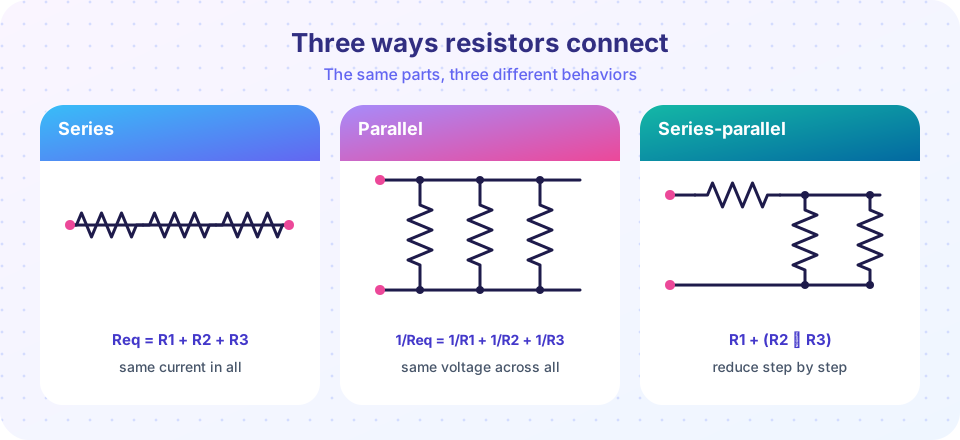
The key is a single law and two connection patterns. Ohm's law ties voltage and current together for one resistor. Series and parallel connections tell you how several resistors combine. Between them, they let you shrink a complicated-looking network into one equivalent resistor, find the source current, and then work back out to every branch.
What you will learn
- What the chapter's lessons cover and how they connect.
- The one-line rules for series and parallel.
- A strategy for solving any series-parallel network.
Key terms
Resistance (R): how strongly an element opposes current. Unit: ohm (Ω).
Equivalent resistance (Req): the single resistor that draws the same current as a whole network at the same voltage.
Series: elements that carry exactly the same current.
Parallel: elements connected across the same two nodes, so they share one voltage.
The chapter in slides
Ohm's law
Series
Parallel
Mixed circuits
What each lesson covers
- Ohm's Law: the relation between V, I and R, resistor values and color codes, resistivity, conductance, and non-ohmic parts.
- Series Resistors and the Voltage Divider: adding resistances, equal current, and dividing a voltage.
- Parallel Resistors and the Current Divider: adding conductances, equal voltage, and splitting a current.
- Series-Parallel Reduction: collapsing a mixed network step by step, and recognizing when it will not collapse.
- Chapter 3 Review: cheat sheet and quiz.
The five-step recipe
Most of this chapter's problems follow the same recipe:
- Redraw the circuit and label every voltage and current.
- Find a pair of resistors that are clearly in series or in parallel and replace them with their equivalent.
- Repeat until one resistor remains across the source.
- Use Ohm's law to find the source current.
- Work backward through the reductions with the divider rules or Ohm's law until you have every value, then check the power balance.
Some networks (a bridge with a central link, for example) will not reduce this way. Those need the systematic methods of Chapter 4.
Common misconceptions
"Parallel resistors have larger resistance, since there are more of them." More parallel paths give the current more ways to flow, so the equivalent resistance is smaller than the smallest branch.
"Series and parallel mean the same shape in every drawing." Look at what is shared: the same current (series) or the same two nodes (parallel), not how the picture is arranged.
Try it
How does the total resistance of N identical 1 kΩ resistors change as you add more in series versus parallel? Run the plot and note how differently they behave.
Press Run (or Ctrl + Enter) to see the result here.
Program input · what you'd type while the program runs
Type the answers before you press Run, one per line. Each time the program reads a line (with input()), it gets the next line from this box.
Then a console warm-up. Predict each equivalent resistance before you run it.
Press Run (or Ctrl + Enter) to see the console output here.
No output.
Check your understanding
Quick check · 4 questions
of 4 answered You scored / 4 · perfect!
-
1. Which statement describes resistors in series?
Series elements form a single path, so the same current flows through each. -
2. Three 3 kΩ resistors are in parallel. The equivalent resistance is
R/N = 3 kΩ / 3 = 1 kΩ. -
3. The equivalent resistance of parallel resistors is always
Extra paths make it easier for current to flow, so the equivalent is below the smallest branch. -
4. What is the first step in solving a circuit problem?
A labeled diagram fixes the reference directions that every equation uses.
Summary
- Ohm's law links V, I and R for a resistor; series and parallel rules combine several resistors.
- Series: Req = R1 + R2 + ...; Parallel: 1/Req = 1/R1 + 1/R2 + ...
- Reduce a mixed network to one resistor, find the source current, then expand back out.
- Networks that do not reduce (such as bridges) use the methods of Chapter 4.
Next: Ohm's Law
Track your progress
Create a free account to tick off lessons and pick up where you left off on any device.
of Circuit Analysis lessons completed