


















Lesson 31 of 48 · Capacitors, Inductors and Transients
RC and RL Transients
Solve first-order circuits with the three-number method: initial value, final value and time constant. Worked RC and RL examples and charging plots.
Every first-order circuit, no matter how many resistors it has, behaves the same way after a switch: the voltage or current slides from its starting value to its final value along an exponential curve. You do not need to solve a differential equation each time. You need three numbers: where it starts, where it ends and how fast it moves. This lesson shows how to find them for RC and RL circuits.
What you will learn
- The general first-order formula and the meaning of each term.
- How to find the initial value, final value and time constant for RC and RL circuits.
- How to use a Thévenin resistance when the circuit has more than one resistor.
- How long a circuit takes to reach a given level.
Key terms
Initial value x(0⁺): the value just after the switch operates, found from continuity (capacitor voltage and inductor current are unchanged).
Final value x(∞): the value after a long time, found with C open and L short.
Time constant τ: RC for an RC circuit and L/R for an RL circuit, where R is the Thévenin resistance seen by the storage element.
Step response: the transient after a sudden change of a source.
The universal formula
For a quantity x(t) in a first-order circuit:
x(t) = x(∞) + [x(0⁺) − x(∞)] e^(−t/τ)
At t = 0 the exponent is zero, so x = x(0⁺). As t grows, the exponential dies out and x → x(∞). At t = τ the gap between the value and its final value has shrunk to 36.8 % (e⁻¹) of its start. So 63.2 % of the journey is done after one τ:
| Time | Fraction of the way |
|---|---|
1τ |
63.2 % |
2τ |
86.5 % |
3τ |
95.0 % |
4τ |
98.2 % |
5τ |
99.3 % |
The time to reach a given level is found by inverting: t = τ ln[(x(0⁺) − x(∞)) / (x − x(∞))].
The three-number recipe
- Initial value. Use continuity:
v_C(0⁺) = v_C(0⁻)andi_L(0⁺) = i_L(0⁻). If you need another variable (like a resistor voltage), solve the circuit att = 0⁺with the capacitor replaced by a voltage source of its initial voltage and the inductor by a current source of its initial current. - Final value. Replace C by an open circuit and L by a short, and solve for the steady state with the new source values.
- Time constant. Find the Thévenin resistance
Rthseen by the capacitor or inductor. Thenτ = Rth Corτ = L / Rth. - Substitute into the universal formula.
Example 1: the basic RC charge
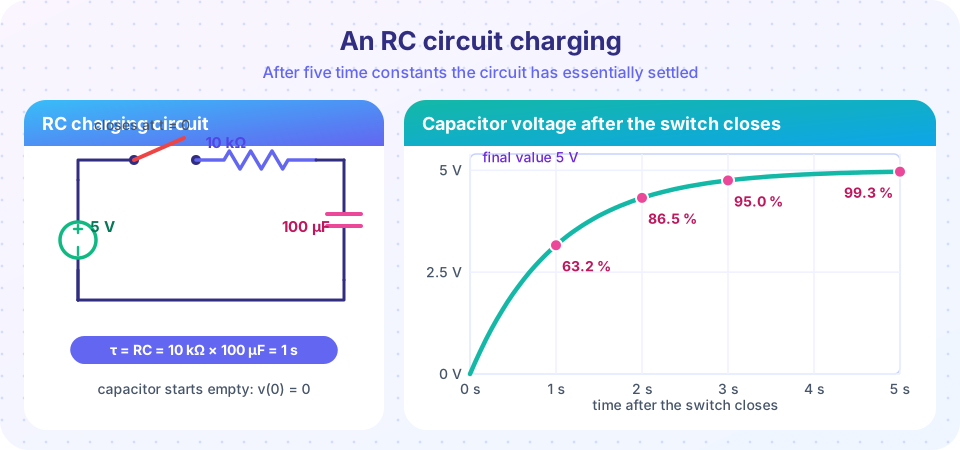
The picture shows a 5 V source connected through a switch and a 10 kΩ resistor to a 100 µF capacitor, initially empty. Close the switch at t = 0.
- Initial:
v(0⁺) = 0. - Final: capacitor open, no current, no drop in R:
v(∞) = 5 V. - Time constant:
τ = RC = 10 000 × 100×10⁻⁶ = 1 s.
v(t) = 5 (1 − e^(−t)) volts. At t = 1 s: 3.16 V; at t = 3 s: 4.75 V. The current i = (5 − v)/R = 0.5 e^(−t) mA starts at 0.5 mA and fades away.
If we now open the switch and connect the capacitor to a discharge resistor, the same formula applies with x(∞) = 0: v(t) = V0 e^(−t/τ).
Example 2: a network with two resistors
A 12 V source is switched at t = 0 through a 2 kΩ resistor to a node. A 4 kΩ resistor connects the node to ground and a 10 µF capacitor (initially uncharged) is in parallel with it.
- Initial:
v(0⁺) = 0. - Final: capacitor open:
v(∞) = 12 × 4/(2 + 4) = 8 V. - Thévenin resistance seen by the capacitor (source off):
2k ∥ 4k = 1.333 kΩ. Soτ = 1333 × 10×10⁻⁶ = 13.33 ms.
v(t) = 8 (1 − e^(−t/13.33 ms)). At 20 ms: 8 (1 − e^(−1.5)) = 6.22 V. To reach 6 V: t = −τ ln(1 − 6/8) = 13.33 × 1.386 = 18.5 ms.
Notice how the Thévenin idea from the previous chapter simplified the task: any single capacitor in a resistive network sees one equivalent source and one equivalent resistor.
Example 3: an RL circuit
A 12 V source is switched onto a 6 Ω resistor in series with a 30 mH inductor.
- Initial:
i(0⁺) = 0. - Final: inductor shorted:
i(∞) = 12 / 6 = 2 A. τ = L/R = 0.03 / 6 = 5 ms.
i(t) = 2 (1 − e^(−t/5 ms)) A. At the start the inductor voltage is the whole 12 V (v_L = L di/dt, and the current is rising fastest at t = 0); it decays as v_L = 12 e^(−t/5 ms) volts. At t = 5 ms, i = 1.264 A.
Opening the switch. If you try to interrupt 2 A in an inductive circuit instantly, di/dt becomes huge and so does the induced voltage. This is why relays and motors have a flyback diode: it gives the current a path to decay along while the voltage stays small. Spark plugs and ignition coils use this effect on purpose.
Common misconceptions
"The time constant is the time to finish." One τ is only 63 % done; practical settling takes about 5 τ.
"Resistor R in τ = RC is the resistor in series." It is the Thévenin resistance seen by the capacitor, which in networks can combine several resistors.
"Bigger L means faster." For RL, τ = L/R: a larger L makes the response slower; a larger R makes it faster.
Try it
This program implements the universal formula and solves the two RC examples and the RL example. Try changing the capacitor or resistor values and watch how τ and the time to reach a level change.
Press Run (or Ctrl + Enter) to see the result here.
Program input · what you'd type while the program runs
Type the answers before you press Run, one per line. Each time the program reads a line (with input()), it gets the next line from this box.
The second program charges the capacitor from Example 1 for five seconds, then discharges it through the same resistor, and marks each time constant.
Press Run (or Ctrl + Enter) to see the result here.
Program input · what you'd type while the program runs
Type the answers before you press Run, one per line. Each time the program reads a line (with input()), it gets the next line from this box.
Check your understanding
Quick check · 6 questions
of 6 answered You scored / 6 · perfect!
-
1. What is the time constant of a 2 kΩ resistor charging a 50 µF capacitor?
τ = RC = 2000 × 50×10⁻⁶ = 0.1 s = 100 ms. -
2. An uncharged capacitor charges toward 10 V. How much of 10 V is reached after exactly one time constant?
1 − e⁻¹ = 0.632, so 6.32 V. -
3. For an RL circuit the time constant is
τ = L / R: more inductance means slower; more resistance means faster. -
4. A 6 Ω resistor and a 30 mH inductor are switched onto 12 V. What is the final current?
In steady state the inductor is a short, so i = 12 / 6 = 2 A. -
5. A capacitor with initial voltage 8 V discharges through a resistor with τ = 2 s. What is v after 2 s?
v = 8 e⁻¹ = 8 × 0.3679 = 2.94 V. -
6. Why do relay coils usually have a diode across them?
Interrupting inductor current abruptly produces a very high voltage; a flyback diode lets the current decay safely.
Summary
- First-order response:
x(t) = x(∞) + [x(0⁺) − x(∞)] e^(−t/τ). - Initial value from continuity, final value from C open / L short,
τ = Rth CorL / Rth. - 63.2 % after
1τ, about 99 % after5τ. - Opening an inductor's circuit abruptly creates a voltage spike.
Next: Series RLC circuits
Track your progress
Create a free account to tick off lessons and pick up where you left off on any device.
of Circuit Analysis lessons completed