


















Lesson 26 of 48 · Network Theorems
Norton's Theorem and Source Transformation
Norton's theorem replaces a network with a current source and a parallel resistor. Learn the conversion to Thévenin form and the source-transformation trick.
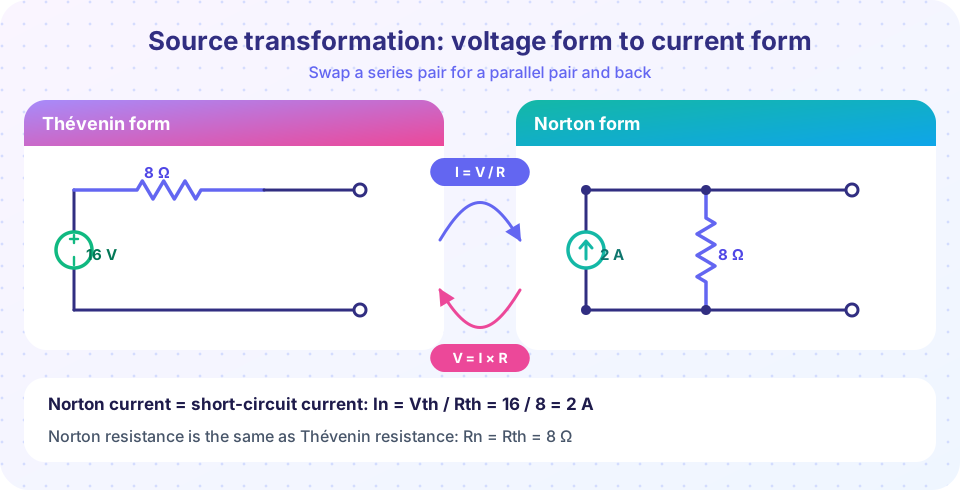
Thévenin's theorem describes a network as a battery with a series resistor. There is a twin description: a current source with a parallel resistor. This is Norton's theorem, and the two forms convert into each other with one line of Ohm's law. That conversion, called source transformation, also gives you a hands-on way to simplify circuits step by step, without writing any equations.
What you will learn
- The statement of Norton's theorem and how to find
InandRn. - The conversion rules between Thévenin and Norton forms.
- How to simplify a circuit by repeated source transformations.
- A clear picture: terminal voltage-current lines.
Key terms
Norton current In: the current that flows if the terminals are shorted (Isc).
Norton resistance Rn: the same number as Rth, now placed in parallel with the current source.
Source transformation: swapping a voltage source in series with a resistor for a current source in parallel with the same resistor (or the reverse).
Terminal characteristic: the relationship between the voltage across the terminals and the current out of them.
Norton's theorem
A linear two-terminal network with independent sources behaves, seen from its terminals, like a current source In in parallel with a resistor Rn.
Inis the short-circuit current between the terminals.Rnis the resistance seen with the independent sources turned off; it is equal toRth.
The conversion between the two forms is one line each:
In = Vth / Rth and Vth = In × Rn, with Rn = Rth.
Why do they match? Compare the open-circuit and short-circuit tests. The Thévenin form has Voc = Vth and Isc = Vth / Rth. The Norton form has Isc = In and Voc = In × Rn. The two descriptions give identical results for both tests, and a linear two-terminal circuit is fully determined by those two tests, so they are the same circuit as far as the terminals can tell.
The terminal characteristic
Plot the terminal voltage v against the current i that leaves the positive terminal. For the equivalent of the last lesson (Vth = 16 V, Rth = 8 Ω) we get a straight line:
v = 16 − 8 i
It crosses the voltage axis at 16 V (open circuit, i = 0) and the current axis at 2 A (short circuit, v = 0). A load resistor RL adds its own line v = RL i, and the circuit operates where the two lines intersect. This "load line" picture is used all the time in electronics.
Source transformation in practice
A voltage source Vs with series resistor R can be traded for a current source Vs / R with the same R in parallel, and back. Two cautions:
- The arrow direction matters. The current source arrow points toward the terminal that is positive for the voltage source.
- The resistor must be directly in series with the source (or in parallel with the current source). A resistor placed elsewhere in the circuit is not part of the transformation.
Let us redo the previous lesson's network by transformations only.
- Start: 24 V source with 6 Ω in series. Transform:
24 / 6 = 4 Asource in parallel with 6 Ω. - That 6 Ω is now in parallel with the 12 Ω to ground:
6 ∥ 12 = 4 Ω. We have a 4 A source in parallel with 4 Ω. - Transform back:
4 A × 4 Ω = 16 Vin series with 4 Ω. - The 4 Ω in series with the terminal adds:
Rth = 4 + 4 = 8 Ω.
Result: 16 V in series with 8 Ω, matching the Thévenin analysis exactly. Norton form: In = 16 / 8 = 2 A in parallel with 8 Ω.
A second example: adding parallel sources
Two batteries (12 V with 2 Ω internal resistance, and 6 V with 3 Ω) are connected in parallel to a 4 Ω load. Convert each to a current source: 12/2 = 6 A in parallel with 2 Ω, and 6/3 = 2 A in parallel with 3 Ω. Currents add when sources are in parallel (both arrows pointing the same way): 8 A. Resistors in parallel: 2 ∥ 3 = 1.2 Ω. Converting back: 8 × 1.2 = 9.6 V in series with 1.2 Ω. The load receives 9.6 / (1.2 + 4) = 1.846 A.
This is much quicker than writing two simultaneous equations, and it exposes the structure: batteries in parallel behave like one battery whose voltage is a weighted average of the originals.
When transformation does not apply
An ideal voltage source with no series resistor cannot be turned into a current source (it would need infinite current). The same holds for an ideal current source with no parallel resistor. In such cases use the other methods of this chapter. Real sources always have some resistance, but a textbook circuit may omit it.
Common misconceptions
"The Norton resistor goes in series." The Norton resistor is in parallel with the current source. The Thévenin resistor is the series one.
"The current source inside the Norton box is delivering In to the load." The load gets only part of In; the rest flows through Rn. All of In flows to the load only when the terminals are shorted.
"A 0 Ω resistor can be transformed." Dividing by zero resistance gives an infinite current, so transform needs a nonzero resistor.
Try it
The first program performs the chain of transformations from this lesson and double-checks the result by a direct nodal calculation.
Press Run (or Ctrl + Enter) to see the result here.
Program input · what you'd type while the program runs
Type the answers before you press Run, one per line. Each time the program reads a line (with input()), it gets the next line from this box.
The second program draws the terminal characteristic and three load lines. Where each load line crosses the source line is the operating point.
Press Run (or Ctrl + Enter) to see the result here.
Program input · what you'd type while the program runs
Type the answers before you press Run, one per line. Each time the program reads a line (with input()), it gets the next line from this box.
Check your understanding
Quick check · 5 questions
of 5 answered You scored / 5 · perfect!
-
1. A network has Vth = 30 V and Rth = 6 Ω. What is its Norton current?
In = Vth / Rth = 30 / 6 = 5 A, the short-circuit current. -
2. Where is the Norton resistor placed?
Norton form is a current source with a parallel resistor; the series arrangement is Thévenin's. -
3. A 10 V source in series with 5 Ω is transformed. What do you get?
The current is V / R = 10 / 5 = 2 A, and the resistor moves to the parallel position. -
4. Two current sources of 6 A and 2 A, both pointing the same way, sit in parallel. They act as one source of
Parallel current sources with the same direction add: 6 + 2 = 8 A. -
5. An ideal voltage source with no series resistance
The conversion needs Vs / R, which would be infinite for R = 0.
Summary
- Norton form: current source
In = Iscin parallel withRn = Rth. - Convert with
In = Vth / RthandVth = In Rn. - Source transformation simplifies a circuit step by step; the resistor must be directly in series or parallel with the source.
- The terminal characteristic is a straight line from
Vocon the voltage axis toIscon the current axis.
Next: Maximum power transfer
Track your progress
Create a free account to tick off lessons and pick up where you left off on any device.
of Circuit Analysis lessons completed