


















Lesson 47 of 48 · Projects and Practice
Circuit Analysis Cheat Sheet
A one-page recap of circuit analysis formulas: DC laws, theorems, transients, AC, power and frequency response, with a poster, a method checklist and tools.
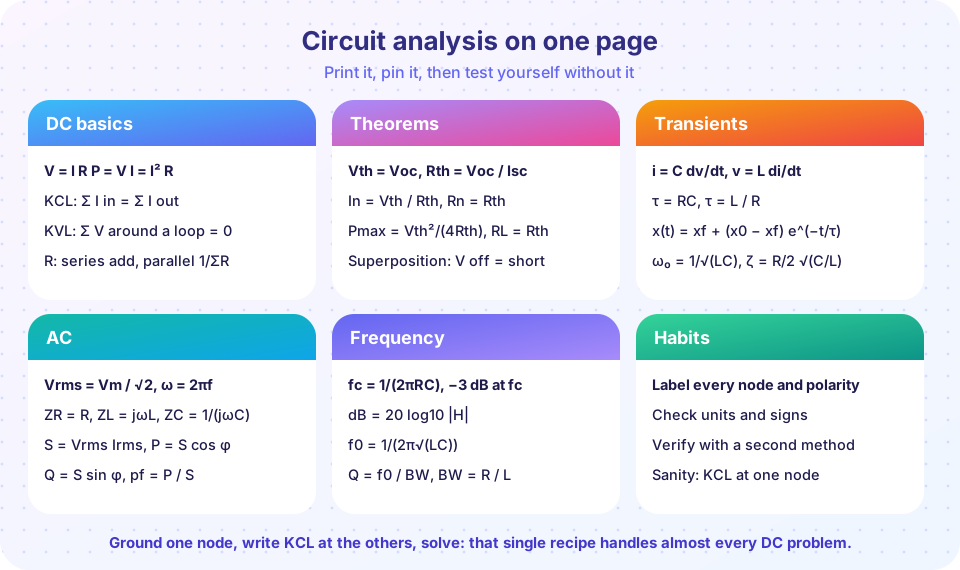
Here is the whole course on one page. Use it the night before an exam, in the lab when you cannot remember whether the capacitor's impedance has a minus sign, or as a way to test yourself: cover a panel and see how much you can rebuild from memory. Formulas are here without proofs, so if one looks unfamiliar, follow the pointer to the lesson.
What you will learn
- The most important formulas in one place, grouped by topic.
- A method checklist for choosing and checking an approach.
- Quick calculators for the formulas that people most often get wrong.
Key terms
Method: the strategy you choose (nodal, mesh, superposition, Thévenin) before calculating.
Sanity check: a fast test of plausibility using units, limits and signs.
Rule of thumb: a memorable approximation, such as five time constants to settle.
DC fundamentals
| Topic | Formula |
|---|---|
| Ohm's law | V = I R |
| Power | P = V I = I² R = V²/R |
| Series resistors | R = R1 + R2 + … |
| Parallel resistors | 1/R = 1/R1 + 1/R2 + …; two: R1R2/(R1 + R2) |
| Voltage divider | V1 = V R1/(R1 + R2) |
| Current divider | I1 = I R2/(R1 + R2) |
| KCL / KVL | ΣI at a node = 0; ΣV around a loop = 0 |
| Nodal analysis | G v = i |
Network theorems
| Theorem | Rule |
|---|---|
| Superposition | One source at a time; V off = short, I off = open; never add powers |
| Thévenin | Vth = Voc; Rth = sources off, or Voc/Isc, or Vt/It |
| Norton | In = Isc = Vth/Rth; Rn = Rth in parallel |
| Source transformation | V + R in series ↔ V/R + R in parallel |
| Maximum power | RL = Rth; Pmax = Vth²/(4Rth); efficiency 50 % |
Capacitors, inductors, transients
| Topic | Formula |
|---|---|
| Capacitor | i = C dv/dt; E = ½Cv²; DC: open circuit |
| Inductor | v = L di/dt; E = ½Li²; DC: short circuit |
| Continuity | v_C and i_L do not jump |
| First-order step | x = x(∞) + [x(0⁺) − x(∞)] e^(−t/τ) |
| Time constants | τ = RC, τ = L/R; 63.2 % at τ, 99.3 % at 5τ |
| Series RLC | α = R/2L, ω₀ = 1/√(LC), ζ = α/ω₀, R_crit = 2√(L/C) |
AC and power
| Topic | Formula |
|---|---|
| Sinusoid | v = Vm cos(ωt + φ); ω = 2πf; Vrms = Vm/√2 |
| Impedances | R; jωL; 1/(jωC) |
| Ohm's law (AC) | V = I Z (phasors) |
| Power | P = V I cos φ; Q = V I sin φ; S = V I; S = V I* |
| Power factor | pf = P/S = cos φ |
| Correction capacitor | C = (Q − Q_target)/(ω V²) |
Frequency response
| Topic | Formula |
|---|---|
| Decibels | dB = 20 log₁₀(voltage ratio); ×2 = +6 dB; ×10 = +20 dB |
| RC corner | f_c = 1/(2πRC); −3 dB and −45° at f_c |
| Roll-off | −20 dB/decade per pole |
| Resonance | f₀ = 1/(2π√(LC)); Z = R |
| Quality factor | Q = ω₀L/R = f₀/B; B = R/(2πL) Hz |
| Magnification | V_L = V_C = Q Vs at resonance |
Method checklist
- Redraw, label nodes, mark polarities, choose a ground.
- DC and resistive? Use nodal (many nodes, current sources) or mesh (many loops, voltage sources).
- One load changing? Thévenin or Norton.
- Several sources? Superposition (separate frequencies for AC).
- Switch operates? Initial values by continuity, final values by C open / L short,
τfromRth. - Sinusoidal steady state? Phasors, impedances, then power.
- Frequency dependence? Write
H(jω), find corners, sketch the Bode plot. - Check: units, sign, a limiting case, a second method.
Common misconceptions
"A cheat sheet replaces understanding." It reminds you of formulas you already understand. If you cannot explain why τ = RC, work through the lesson again.
"Formulas are interchangeable between DC and AC." P = V²/R holds for RMS values; Z_C has a minus sign; superposition of powers still fails.
"Peak and RMS can be mixed." State the convention once and keep it.
Try it
This calculator collects the formulas people most often need. Edit the inputs at the bottom and run.
Press Run (or Ctrl + Enter) to see the result here.
Program input · what you'd type while the program runs
Type the answers before you press Run, one per line. Each time the program reads a line (with input()), it gets the next line from this box.
The second tool converts between a voltage ratio and decibels in both directions with sliders. Drag one and read the other.
Check your understanding
Quick check · 5 questions
of 5 answered You scored / 5 · perfect!
-
1. Which pair is correct?
Each element law relates one quantity to the rate of change of the other. -
2. The impedance of a capacitor is
Z_C = 1/(jωC) = −j/(ωC). -
3. To find Rth quickly from measurements you use
Rth = Voc / Isc. -
4. How many time constants until a first-order circuit has settled to within about 1 %?
e^(−4.6) ≈ 0.01. -
5. At resonance in a series RLC the voltage across the inductor is
V_L = I ω₀ L = Q Vs.
Summary
- DC: Ohm, Kirchhoff, dividers, nodal and mesh; theorems for shortcuts.
- Transients: continuity, initial and final values,
τ, and damping for RLC. - AC: phasors,
Z_L = jωL,Z_C = 1/(jωC),P,Q,Sand power factor. - Frequency response: dB, corners, filters,
f₀,Qand bandwidth. - Always check units, signs, a limit case and a second method.
Next: Further study
Track your progress
Create a free account to tick off lessons and pick up where you left off on any device.
of Circuit Analysis lessons completed