


















Lesson 35 of 48 · AC Circuits and Phasors
Sinusoids and Phasors
Describe AC signals with amplitude, frequency and phase, compute RMS values, and convert between time-domain sinusoids and phasors with worked examples.
An AC signal looks complicated: it changes every instant. Yet a sinusoid is completely described by just three numbers. Once you can read those numbers off an equation and convert them into a phasor, the rest of AC analysis is arithmetic with complex numbers. This lesson builds that skill carefully, because everything in this chapter rests on it.
What you will learn
- How amplitude, frequency, period, angular frequency and phase are defined.
- How to compute the RMS value of a sinusoid and why it matters.
- What "leads" and "lags" mean.
- How to convert between a sinusoid and its phasor, and between rectangular and polar forms.
Key terms
Amplitude Vm: the peak value of the sinusoid.
Frequency f and period T: cycles per second (hertz) and the time for one cycle, T = 1/f.
Angular frequency ω: 2πf, in radians per second.
Phase φ: the angle that shifts the wave in time; positive φ means the wave is ahead.
RMS value: the DC value that would deliver the same average power to a resistor.
Anatomy of a sinusoid
The standard form is
v(t) = Vm cos(ωt + φ)
Vmis the amplitude.ω = 2πfis the angular frequency. Mains at 50 Hz haveω = 314.2 rad/s; at 60 Hz,ω = 377.0 rad/s.φis the phase in radians or degrees. It tells you where the wave is att = 0.
A sine is just a cosine shifted: sin(x) = cos(x − 90°). In this course we express everything as a cosine; convert sines first. For example 10 sin(1000t + 20°) = 10 cos(1000t − 70°).
Example. v(t) = 170 cos(377t + 30°) has amplitude 170 V, ω = 377 rad/s so f = 60 Hz, T = 16.67 ms, and phase +30°. The wave reaches its first peak when 377t + 30° = 0, i.e. 30° before t = 0 (about 1.39 ms earlier), because the phase is positive.
Lead and lag
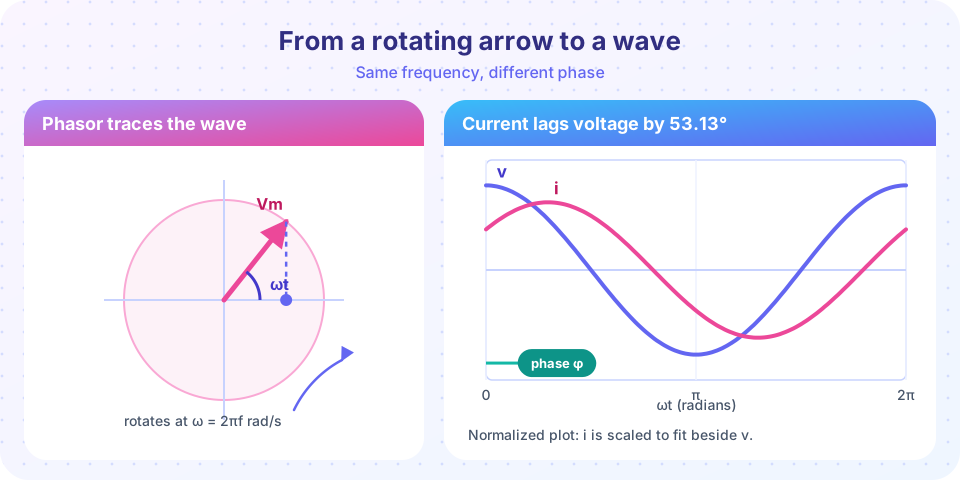
Compare two waves of the same frequency. If one reaches its peak earlier, it leads the other; if later, it lags. The angle between them is the phase difference. In the picture, the current peaks 53.13° after the voltage, so the current lags the voltage by 53.13° (equivalently, the voltage leads the current).
A handy memory aid for the next lessons: ELI the ICE man. In an inductive circuit (L), voltage (E) leads current (I): ELI. In a capacitive circuit (C), current leads voltage: ICE.
RMS value
A sinusoid's average is zero over a cycle, which says nothing about the heating effect. We want a single number representing the effective value. The root-mean-square value does that:
Vrms = √( (1/T) ∫₀ᵀ v² dt )
For v = Vm cos(ωt), the mean of cos² over a cycle is ½, so Vrms = Vm / √2 ≈ 0.7071 Vm. A resistor connected to a 120 V RMS AC supply gets the same average power as with 120 V DC. This is why mains voltages are quoted as RMS: 120 V RMS has a peak of 169.7 V (about 170 V), and 230 V RMS has a peak of 325.3 V.
The phasor transform
Euler's identity says e^(jθ) = cos θ + j sin θ. Therefore
Vm cos(ωt + φ) = Re{ Vm e^(jφ) e^(jωt) }
Drop the common factor e^(jωt) and the phasor remains:
V = Vm ∠ φ (peak convention) or V = Vrms ∠ φ (RMS convention)
In most power work phasors are written with RMS magnitudes; this course states the convention each time. Phasors let you handle derivatives easily. Since d/dt of e^(jωt) is jω e^(jωt):
d/dtbecomes multiplication byjω.∫ dtbecomes division byjω.
Example. The derivative of 10 cos(1000t + 20°) is −10 000 sin(1000t + 20°) = 10 000 cos(1000t + 110°). By phasors: 10 ∠ 20° × (j 1000) = 10 ∠ 20° × 1000 ∠ 90° = 10 000 ∠ 110°. Same answer with no trigonometry.
Rectangular and polar forms
A phasor can be written as a + jb (rectangular) or r ∠ θ (polar), with
r = √(a² + b²), θ = atan2(b, a), a = r cos θ, b = r sin θ.
Use rectangular for addition and subtraction, polar for multiplication and division:
(r₁ ∠ θ₁)(r₂ ∠ θ₂) = r₁r₂ ∠ (θ₁ + θ₂)(r₁ ∠ θ₁)/(r₂ ∠ θ₂) = (r₁/r₂) ∠ (θ₁ − θ₂)
Example. 30 ∠ 53.13° = 30 cos 53.13° + j 30 sin 53.13° = 18 + j24. Conversely 18 + j24 has magnitude √(324 + 576) = 30.
Adding sinusoids. 3 cos(ωt) + 4 cos(ωt + 90°). Phasors: 3 + j4 = 5 ∠ 53.13°, so the sum is 5 cos(ωt + 53.13°). A famous 3-4-5 triangle hides in this sum.
The complex plane
Phasors live in the complex plane. The real axis is the cosine component and the imaginary axis is the negative sine component. Rotating a phasor by 90° counterclockwise multiplies it by j. This is why j appears in the impedance of an inductor: it shifts the phase by +90°.
Common misconceptions
"A positive phase delays the wave." A positive phase advances it: the peak occurs earlier.
"RMS is the average." The average of a full sine is zero. RMS is the square root of the mean square.
"Phasors of different frequencies can be added." They cannot; the phasor method assumes one common ω.
Try it
The first program converts between forms, evaluates RMS numerically, and checks that Vm/√2 is right.
Press Run (or Ctrl + Enter) to see the result here.
Program input · what you'd type while the program runs
Type the answers before you press Run, one per line. Each time the program reads a line (with input()), it gets the next line from this box.
The second program draws a voltage wave and a current wave that lags it by 53.13°, the case from the picture. Change phi to see lead and lag.
Press Run (or Ctrl + Enter) to see the result here.
Program input · what you'd type while the program runs
Type the answers before you press Run, one per line. Each time the program reads a line (with input()), it gets the next line from this box.
Check your understanding
Quick check · 6 questions
of 6 answered You scored / 6 · perfect!
-
1. What is the angular frequency of a 60 Hz supply?
ω = 2πf = 2π × 60 ≈ 377 rad/s. -
2. The RMS value of a 10 V peak sinusoid is
Vrms = Vm / √2 = 10 / 1.414 = 7.07 V. -
3. Which is the phasor of v = 20 cos(ωt − 40°) (peak convention)?
The magnitude is the amplitude and the angle is the phase, −40°. -
4. Write 10 sin(ωt) as a cosine.
sin x = cos(x − 90°). -
5. The product (5 ∠ 20°)(2 ∠ 30°) equals
Multiply magnitudes (10) and add angles (50°). -
6. The phasor sum 3 + j4 corresponds to a wave with amplitude
|3 + j4| = √(9 + 16) = 5.
Summary
- A sinusoid is
Vm cos(ωt + φ)withω = 2πf; convert sines to cosines before making phasors. - RMS value is
Vm/√2and gives the equivalent DC heating effect. - Phasor
V = Vm ∠ φ;d/dt → ×jω,∫ dt → ÷jω. - Add in rectangular form, multiply and divide in polar form.
Track your progress
Create a free account to tick off lessons and pick up where you left off on any device.
of Circuit Analysis lessons completed