


















Lesson 19 of 48 · Kirchhoff's Laws and Nodal Analysis
Kirchhoff's Voltage Law (KVL)
Learn Kirchhoff's voltage law: voltages around a closed loop sum to zero. Walk a loop, handle signs, find unknown voltages and see why voltage is path independent.
Hike up a hill and back down a different path to where you began: your total change in height is zero, no matter which path you took. Electric potential works the same way. Walk around any closed loop in a circuit, adding the rises and drops in potential as you pass each element, and you must end where you began: zero net change. That statement is Kirchhoff's voltage law.
KVL is the energy partner of KCL's charge conservation. With it you can find any unknown voltage in a loop in a few lines.
What you will learn
- The statement of KVL and why it holds.
- A step-by-step way to write a KVL equation with correct signs.
- How to use KVL to find unknown voltages and the voltage between any two nodes.
- Why voltage is independent of the path.
Key terms
Loop: a closed path through the circuit, visiting each node at most once.
KVL: the algebraic sum of voltages around any closed loop is zero.
Voltage rise: going from the − terminal to the + terminal of an element.
Voltage drop: going from the + terminal to the − terminal.
The law
For any closed loop in a lumped circuit:
Σ v = 0
Energy per charge is a property of position. A charge that completes a loop returns to the same position, so its net energy change per unit charge is zero. Rises (such as across a source) and drops (such as across resistors carrying current) must cancel.
Writing a KVL equation
- Mark polarity (+ and −) on every element. Mark the current direction too, and for passive elements (resistors) put the + sign at the end where the current enters.
- Choose a starting point and a direction (clockwise is conventional) and stay with it.
- Walk around the loop. For each element, note the sign you meet first. If you enter at −, you are going up (a rise): write +v. If you enter at +, you are going down (a drop): write −v.
- Set the sum to zero and solve.
(An equivalent habit uses the first sign encountered as the sign of the term, with drops counted +: it gives the same equation multiplied by −1.)
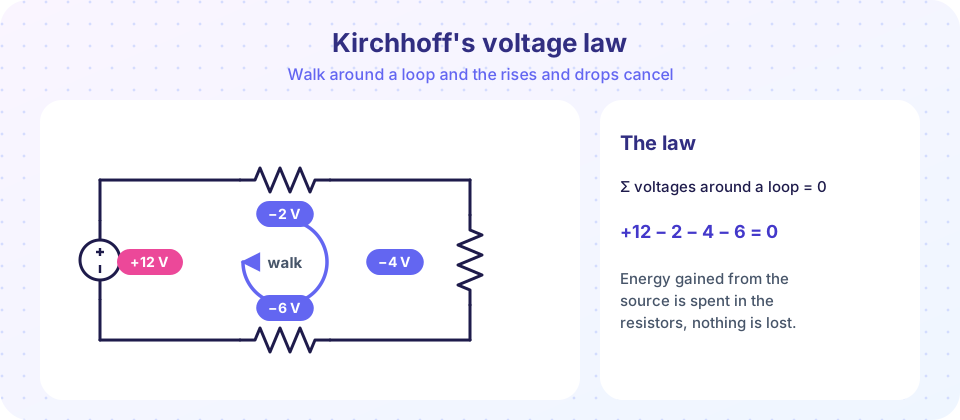
Worked example 1. The loop in the picture: 12 V source, resistors with 2 V, 4 V and 6 V drops. Clockwise from the source: +12 − 2 − 4 − 6 = 0 ✓. In a real problem you would not know the drops; you would write them as I·R: +12 − I·1k − I·2k − I·3k = 0, so I = 12 / 6k = 2 mA.
Worked example 2: unknown element voltage. A loop has a 20 V source, a resistor with 5 V across it, another resistor with 8 V across it, and a mystery element X. KVL: +20 − 5 − 8 − v_X = 0, so v_X = 7 V (a drop in the direction of travel).
Worked example 3: two loops. Two meshes share a 4 kΩ resistor carrying 1.8 mA downward (Lesson 4.5), so it has 7.2 V across it. In the left loop: +12 − (2 kΩ)(2.4 mA) − 7.2 = 12 − 4.8 − 7.2 = 0 ✓. Each loop must balance separately.
Voltage between two nodes: path independence
Because of KVL, the voltage between two nodes does not depend on the route you use to compute it. Suppose nodes a and b are connected by two different paths. Going from a to b along path 1, you accumulate V_ab; going along path 2, you must accumulate the same V_ab, or the loop formed by both paths would violate KVL. This lets you choose the easiest path.
Example. Node a is at the top of a 6 V source whose bottom is ground; node b is the junction between two resistors of the loop at 2 V. v_ab = 6 − 2 = 4 V by either route.
You can also write KVL for an open loop where a gap sits between two points: include the gap voltage as a term. This is the standard trick for finding the open-circuit voltage between two terminals, used heavily in Chapter 5.
Sources, resistors and sign discipline
- A source's sign depends on which terminal you meet first, not on whether it is a "battery". A battery being charged is a drop in your direction of travel.
- A resistor's voltage is +I·R at the end where the current enters, as the passive convention says. If your travel direction is against the current arrow, you meet the − end first and the term changes sign.
- Do not mix "I traveled up" intuition with the sign convention; follow the rule mechanically.
Common misconceptions
"KVL says the voltage around the loop is zero, so no energy is used." The algebraic sum is zero because the source supplies exactly what the loads absorb.
"Each element in a loop has the same voltage." Different elements have different voltages; they add up to zero with signs.
"KVL only holds for loops with a source." It holds for every loop, including a loop of resistors with no source (the voltages there simply sum to zero).
Try it
This program plots the potential as you walk around the series loop, and checks that it returns to zero. The plot makes KVL visible: up 12 V, then three steps down.
Press Run (or Ctrl + Enter) to see the result here.
Program input · what you'd type while the program runs
Type the answers before you press Run, one per line. Each time the program reads a line (with input()), it gets the next line from this box.
Now a loop-walker that applies the sign rule mechanically. For every element give its voltage magnitude and the terminal you meet first; the code sums the loop and, if one element is unknown, solves for it.
Press Run (or Ctrl + Enter) to see the console output here.
No output.
Check your understanding
Quick check · 5 questions
of 5 answered You scored / 5 · perfect!
-
1. A loop contains a 9 V source and two resistors with 4 V and an unknown drop. The unknown drop is
+9 − 4 − v = 0, so v = 5 V. -
2. KVL expresses conservation of
A charge returns to the same potential after a closed loop, so net energy change per charge is zero. -
3. You walk through a resistor and meet its + terminal first. The term in your KVL equation (rises positive) is
Entering at + means going down in potential: a drop, written −v. -
4. A 12 V source drives 1 kΩ, 2 kΩ and 3 kΩ in series. The current is
KVL: 12 = I(1k + 2k + 3k) so I = 2 mA. -
5. The voltage between two nodes is the same along any path because
Two different values would make the sum around the combined loop nonzero.
Summary
- KVL: the algebraic sum of voltages around any closed loop is zero (rises = drops).
- Write it by walking the loop in a fixed direction; entering at − is a rise (+v), entering at + is a drop (−v).
- It lets you find unknown voltages and implies that voltage between two nodes is path independent.
- KVL gives the equations for mesh analysis; with KCL it supports nodal analysis too.
Next: Nodal Analysis
Track your progress
Create a free account to tick off lessons and pick up where you left off on any device.
of Circuit Analysis lessons completed