


















Lesson 28 of 48 · Network Theorems
Chapter 5 Review: Network Theorems
Review superposition, Thévenin, Norton and maximum power transfer with a summary picture, a recap table, a toolkit script and a ten-question quiz.
You now own four powerful shortcuts. This review puts them side by side so you can see when each one fits, and then tests you with questions that mix all the lessons in the chapter.
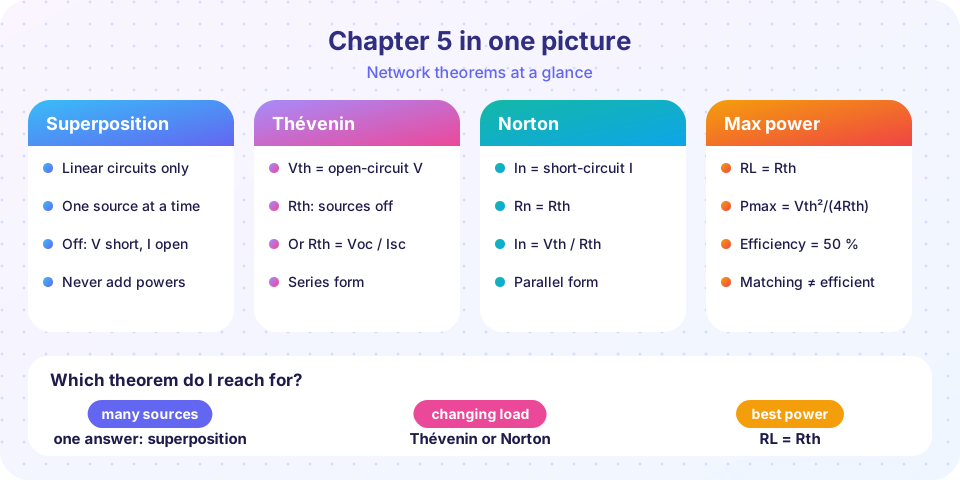
What you will learn
- A single table of rules to check yourself against.
- How the theorems combine in one problem.
- Where you are likely to slip, and how to spot it.
Key terms
Linearity: scaling and adding sources scales and adds all responses.
Open-circuit voltage / short-circuit current: the two terminal tests that define a Thévenin or Norton equivalent.
Matched load: RL = Rth, giving the maximum load power at 50 % efficiency.
Recap table
| Tool | Use it when | Key steps | Watch out for |
|---|---|---|---|
| Superposition | Several independent sources, or sources of different types | One source on, others off: V → short, I → open; add | Never add powers; keep dependent sources |
| Thévenin | One load changes, or you need the behavior at two terminals | Vth = Voc; Rth from sources off, Voc/Isc, or a test source |
Remove the load first |
| Norton | Parallel structures, current sources | In = Isc; Rn = Rth |
The resistor is in parallel |
| Source transformation | Reducing a ladder by hand | V → V/R in parallel, I → IR in series |
Resistor must be directly attached |
| Max power | Choosing a load for a fixed source | RL = Rth; Pmax = Vth²/(4Rth) |
Efficiency is only 50 % |
A combined example
A sensor network measures Voc = 20 V and Isc = 4 A at its output terminals. Then:
Rth = Voc / Isc = 5 Ω.- The best load for power is
5 Ω, deliveringPmax = 20² / (4 × 5) = 20 W. - A 15 Ω load draws
I = 20 / 20 = 1 Aand gets15 W; its efficiency is15 / 20 = 75 %. - The Norton form is
4 Ain parallel with5 Ω.
Notice that no information about the network's inside was used. Two measurements were enough.
Common misconceptions
"I can mix up the two forms." A series resistor with a voltage source is Thévenin; a parallel resistor with a current source is Norton.
"Superposition works for a diode circuit." It does not: diodes are nonlinear.
"Maximum power means maximum efficiency." They are different goals; at the match the efficiency is 50 %.
Try it
This toolkit script converts two measurements into every number you might need. Replace the measurements with your own and read off the Thévenin and Norton forms, the best load and the power for any load.
Press Run (or Ctrl + Enter) to see the result here.
Program input · what you'd type while the program runs
Type the answers before you press Run, one per line. Each time the program reads a line (with input()), it gets the next line from this box.
The second demo is a drag-the-load board for a Thévenin source. Try to hit the highest power with the slider.
Check your understanding
Quick check · 9 questions
of 9 answered You scored / 9 · perfect!
-
1. To switch off a current source in superposition you
A current source of zero amps passes no current, i.e. an open circuit. -
2. A network has Voc = 36 V and Isc = 6 A. Its Thévenin resistance is
Rth = Voc / Isc = 36 / 6 = 6 Ω. -
3. Its Norton equivalent is
In = Isc = 6 A, and the resistor of 6 Ω goes in parallel with the current source. -
4. The maximum power this network can deliver to a load is
Pmax = Vth² / (4 Rth) = 1296 / 24 = 54 W, at RL = 6 Ω. -
5. Which statement about superposition is false?
Power is a squared quantity, so the partial powers do not add. -
6. A 20 V source with 4 Ω in series is transformed. The Norton source is
I = V / R = 20 / 4 = 5 A, with the 4 Ω in parallel. -
7. At the matched load the efficiency is
The load and the source resistance dissipate equal power, so η = 50 %. -
8. A Thévenin equivalent reproduces the original network's
Only the terminal voltage-current relationship is preserved. -
9. Using the test-source method, you apply 2 V and measure 0.5 A. Rth is
Rth = Vt / It = 2 / 0.5 = 4 Ω.
Summary
- Superposition adds partial responses; Thévenin and Norton replace a network by two numbers; maximum power occurs at
RL = Rth. VocandIscare all you need to know about a linear two-terminal network.- Power needs squares, so compute it from the total voltage or current.
- Next chapter: circuits that remember, with capacitors and inductors.
Next: Chapter 6 overview: capacitors, inductors and transients
Track your progress
Create a free account to tick off lessons and pick up where you left off on any device.
of Circuit Analysis lessons completed