


















Lesson 8 of 48 · Charge, Voltage, Current and Elements
Voltage, Energy and Power
Learn voltage as energy per charge, how node voltages and ground work, and how to calculate electrical power and energy in watts, joules and kilowatt-hours.
A battery labeled 9 V does not hold "9 volts of something". The label tells you how much energy the battery gives to every coulomb of charge it pushes around the circuit: 9 joules per coulomb. Voltage is the "push", and understanding it as energy per charge makes the rest of circuit analysis feel natural: sources raise the energy, loads lower it, and the numbers must balance.
This lesson defines voltage precisely, shows how node voltages and ground work, and then combines voltage and current into power and energy: the quantities that decide your electricity bill and whether a resistor survives.
What you will learn
- The definition of voltage and potential difference.
- How to read node voltages and element voltages, and what ground means.
- Power p = v·i and energy w = ∫ p dt, with P = I²R and P = V²/R for resistors.
- How to convert between joules, watt-hours and kilowatt-hours.
Key terms
Voltage (potential difference): the energy per unit charge needed to move charge between two points. 1 V = 1 J/C.
Node voltage: the voltage of a node measured relative to the reference (ground) node.
Power: the rate of energy transfer, 1 W = 1 J/s.
Energy: the capacity to do work, measured in joules (J) or kilowatt-hours (kWh).
Voltage
When a charge Q moves between two points, the energy it gains or loses is W. The voltage between those points is
v = dW / dQ so W = V · Q for a constant voltage.
A 12 V car battery giving 5 C of charge to the circuit supplies W = 12 V × 5 C = 60 J. A 9 V battery that sends 0.5 C around its circuit gives 4.5 J.
Voltage is always between two points. We write v_ab = v_a − v_b for "the voltage at a relative to b". The sign tells you which point is at the higher potential: v_ab = +9 V means a is 9 V above b. Reversing the order flips the sign: v_ba = −9 V. In diagrams we mark the reference polarity with + and − signs on an element.
Node voltages and ground
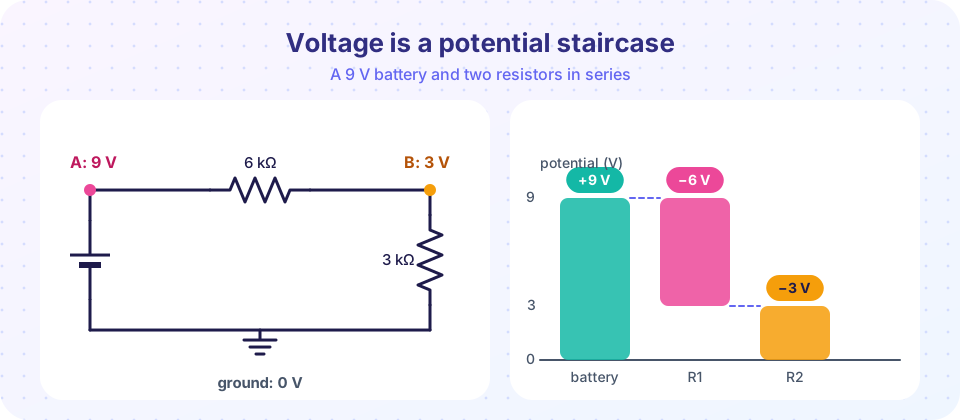
Because voltage is a difference, we pick one node as the zero reference (ground, 0 V). Every other node's voltage is measured against it. In the picture above, ground is the bottom wire. Node A (above the battery) is at 9 V, node B (between the resistors) at 3 V, and ground at 0 V. The voltage across a resistor is the difference between its end nodes: across R1, v = 9 − 3 = 6 V; across R2, v = 3 − 0 = 3 V.
Choosing ground is a free choice. Move the ground symbol to node B and every node voltage shifts by 3 V, but the voltage across each element, and every current, stays exactly the same. Only differences have physical meaning.
Energy view of a loop
Follow one coulomb around the loop of the picture. The battery gives it 9 J (a rise of 9 V). In R1 it loses 6 J. In R2 it loses 3 J. It arrives back at the battery with the same energy it began with, ready for another 9 J. That bookkeeping (total rises equal total drops) is Kirchhoff's voltage law (Chapter 4).
Measuring voltage and current
A voltmeter is connected across (in parallel with) the element to read the voltage; an ideal voltmeter draws no current. An ammeter is connected in series so the current passes through it; an ideal ammeter has no voltage drop. Connecting an ammeter across a source is a classic way to blow a fuse, because an ammeter is nearly a short circuit.
Power and energy
Power is energy per second. Since energy is W = V · Q and current is Q per second:
p = dW/dt = v · i
Voltage (J/C) × current (C/s) gives J/s, which is the watt. If the voltage and current are constant, P = V · I.
For a resistor, substitute Ohm's law V = I·R (Chapter 3) to get two more forms:
P = I² · R = V² / R
These show why doubling the current through a wire quadruples the heating, which is why thick cables carry heavy currents.
Energy is the accumulated power: w = ∫ p dt, or W = P · t when P is constant. Electricity companies bill in kilowatt-hours: 1 kWh = 1,000 W × 3,600 s = 3.6 × 10⁶ J.
| Example | Power | Time | Energy |
|---|---|---|---|
| LED bulb | 8 W | 5 h | 40 Wh = 0.04 kWh |
| Kettle | 2,000 W | 3 min | 0.1 kWh |
| Phone charge | 5 W | 2 h | 10 Wh |
Worked example. In the staircase circuit the battery is 9 V and the resistors are 6 kΩ and 3 kΩ in series. The current is I = 9 V / 9 kΩ = 1 mA. The power absorbed: R1: P = 6 V × 1 mA = 6 mW; R2: 3 V × 1 mA = 3 mW. The battery delivers 9 V × 1 mA = 9 mW. Supplied equals absorbed: 9 mW = 6 mW + 3 mW. This power balance is a powerful check on any answer.
Power ratings. A resistor converts its power into heat; each has a maximum rating (¼ W and ½ W are common for small ones). Exceeding the rating overheats and may destroy it. In the example above, 6 mW is far below ¼ W, so nothing is in danger. The same 6 kΩ resistor would have to dissipate 4 W if connected across 155 V (P = V²/R), far beyond its rating.
Electron-volts
On the atomic scale, joules are inconvenient. The electron-volt is the energy gained by one elementary charge moving through 1 V: 1 eV = 1.602 × 10⁻¹⁹ J. Photons of visible light carry 1.6 to 3.1 eV.
Common misconceptions
"Voltage is used up." Energy per charge falls as charge passes through loads, but no charge is lost. Each coulomb returns to the source.
"A higher-voltage battery is always more powerful." Power is V × I. A 12 V battery connected to a high resistance delivers little power.
"Ground is where current goes to disappear." In circuit analysis, ground is simply the chosen 0 V reference node.
"A 2,000 mAh battery holds 2,000 Wh." mAh is charge. Energy needs the voltage: 2 Ah × 3.7 V = 7.4 Wh.
Try it
This program walks around the loop of the picture and prints the potential after every element. You can add resistors to the dictionary to see the staircase grow.
Press Run (or Ctrl + Enter) to see the result here.
Program input · what you'd type while the program runs
Type the answers before you press Run, one per line. Each time the program reads a line (with input()), it gets the next line from this box.
The second example turns a battery rating into hours of use. It is a pure energy calculation: watt-hours of the battery divided by the device power.
Press Run (or Ctrl + Enter) to see the result here.
Program input · what you'd type while the program runs
Type the answers before you press Run, one per line. Each time the program reads a line (with input()), it gets the next line from this box.
Check your understanding
Quick check · 6 questions
of 6 answered You scored / 6 · perfect!
-
1. A 12 V battery moves 5 C of charge through a circuit. How much energy does it supply?
W = V × Q = 12 V × 5 C = 60 J. -
2. Node A is at 9 V and node B at 3 V relative to ground. The voltage v_AB is
v_AB = v_A − v_B = 9 − 3 = 6 V. -
3. If you move the ground symbol to a different node, what changes?
Only differences matter, so currents and element voltages are unchanged; node voltages all shift by the same amount. -
4. A resistor carries 20 mA and has 1 kΩ. Its power is
P = I²R = (0.02)² × 1000 = 0.4 W. -
5. A 1,500 W heater runs for 2 hours. Energy used is
1.5 kW × 2 h = 3 kWh. -
6. How is an ammeter connected?
An ammeter measures the current passing through it, so it must be in series.
Summary
- Voltage is energy per charge: v = dW/dQ, 1 V = 1 J/C. It is always measured between two points.
- Ground is a chosen 0 V reference; only voltage differences are physical.
- Power p = v·i; for resistors P = I²R = V²/R. Energy W = P·t; 1 kWh = 3.6 MJ.
- In any circuit the power supplied equals the power absorbed.
Track your progress
Create a free account to tick off lessons and pick up where you left off on any device.
of Circuit Analysis lessons completed