


















Lesson 18 of 48 · Kirchhoff's Laws and Nodal Analysis
Kirchhoff's Current Law (KCL)
Learn Kirchhoff's current law: the sum of currents at a node is zero. Practice sign conventions, find unknown currents and solve a one-node problem.
Imagine a pipe junction where three pipes meet. If 5 liters per second flow in through one pipe and 2 liters per second through another, and 4 liters per second leave through a third, the fourth pipe must carry away the remaining 3. Water cannot disappear or build up at the junction. Electric charge behaves the same way, and that observation is Kirchhoff's current law.
KCL is the first of the two laws that make circuit analysis systematic. It is simple enough to state in one line, yet it is the engine behind nodal analysis and countless quick estimates.
What you will learn
- The statement of KCL in its two equivalent forms.
- A sign convention that prevents errors.
- How to find an unknown branch current.
- How to apply KCL to a whole region (a supernode) and to resistor networks.
Key terms
Node: a point where two or more elements connect (all ideal wires joined to it count as one node).
KCL: the algebraic sum of currents at any node is zero.
Supernode (or closed surface): any region treated as a single node for KCL.
Branch current: the current through one element between two nodes.
The law
For any node in a lumped circuit, at every instant:
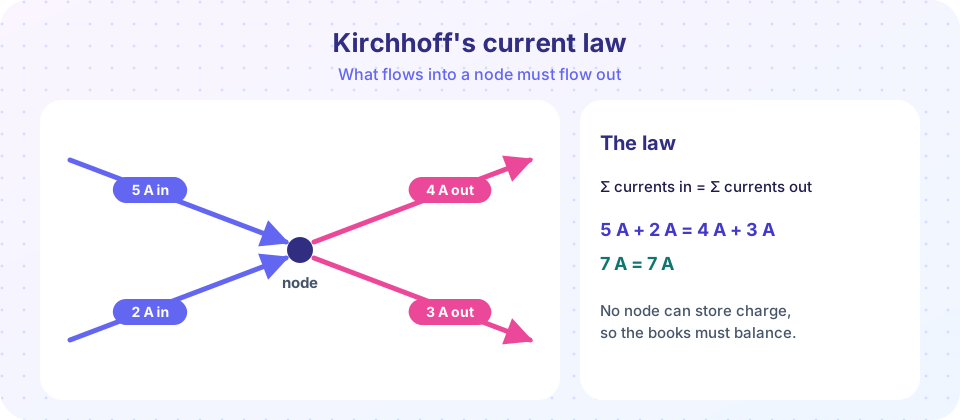
Σ i_in = Σ i_out or equivalently Σ i = 0 (counting currents entering as + and leaving as −)
Pick one form and stick to it for a whole problem. In the picture, 5 A + 2 A enter and 4 A + 3 A leave: 7 A = 7 A ✓.
Why it is true. Charge is conserved, and a node (an ideal wire joint) has no volume in which charge could accumulate. If current in exceeded current out, charge would pile up and the node's voltage would climb without bound; in real circuits the voltage rapidly adjusts so that the books balance.
Reference directions and signs
You do not have to know the real current direction in advance. Draw an arrow on every branch, any way you like (the reference direction). Write KCL using those arrows. Solve. If a current comes out negative, the real flow is opposite to your arrow. The arithmetic takes care of everything, as long as you stay consistent.
Worked example 1: unknown current. At a node, 6 mA enters through branch a, 2 mA leaves through branch b and 5 mA leaves through branch c. Branch d is drawn entering. KCL (in = out): 6 + i_d = 2 + 5, so i_d = +1 mA (entering). If instead d is drawn leaving: 6 = 2 + 5 + i_d gives i_d = −1 mA, which means 1 mA actually flows in. Both answers agree.
Worked example 2: resistors at a node. A node X connects to a 12 V source through 2 kΩ, to a 6 V source through 3 kΩ, and to ground through 6 kΩ. What is the voltage Vx at X? Draw all three currents leaving the node: (Vx − 12)/2 + (Vx − 6)/3 + Vx/6 = 0 (in mA, kΩ, V). Multiply by 6: 3(Vx − 12) + 2(Vx − 6) + Vx = 0, so 6Vx = 48 and Vx = 8 V. Check by current: from the 12 V source 4 V/2 kΩ = 2 mA enters; to the 6 V source (8 − 6)/3 = 0.667 mA leaves; to ground 8/6 = 1.333 mA leaves. 2 = 0.667 + 1.333 ✓. This one-node method (sometimes called Millman's theorem) shows that KCL plus Ohm's law is already enough to solve a circuit.
Supernodes: KCL for a region
KCL holds not just for single nodes but for any closed surface drawn around part of a circuit. Wrap a surface around several nodes and elements; the net current entering through the surface is zero. This is useful when a voltage source connects two nodes (Lesson 4.3) or when you want a quick answer without solving the inside.
For example, if a box contains an unknown network and three wires enter carrying 2 A, 3 A and an unknown I, then 2 + 3 + I = 0 gives I = −5 A: five amps leave.
KCL also shows why a single wire connecting two parts of a circuit that is otherwise separate carries no current: the surface around one part has only that wire crossing, so its current must be zero.
Common misconceptions
"KCL requires me to guess the true direction of each current." You may choose any reference directions; negative results are fine.
"Current in a series loop is used up bit by bit." Applying KCL at each junction of a series chain shows the current is the same in every element.
"KCL needs all branches to be resistors." It holds for any element, including sources, capacitors and diodes.
"The incoming current is divided equally among outgoing branches." KCL only says the totals match. How the current splits depends on the elements (the divider rule).
Try it
First, a calculator for the unknown current at a node. Enter the known currents (positive = entering, negative = leaving) and it returns the missing one.
Press Run (or Ctrl + Enter) to see the result here.
Program input · what you'd type while the program runs
Type the answers before you press Run, one per line. Each time the program reads a line (with input()), it gets the next line from this box.
Now play with a junction yourself. Set three currents (entering the node) and the widget computes the fourth so that KCL holds.
Check your understanding
Quick check · 4 questions
of 4 answered You scored / 4 · perfect!
-
1. At a node, 4 A enters and 1 A leaves in two branches, and a third branch is drawn leaving. What is the third current?
In = out: 4 = 1 + i, so i = 3 A leaving. -
2. A computed branch current is −2 mA. This means
The sign only compares the real direction with your reference arrow. -
3. A wire is the only connection between two otherwise separate circuits. The current in it is
Applying KCL to a surface around one circuit shows the net current through the single wire must be 0. -
4. In Worked example 2, which statement is correct?
Vx = 8 V: 2 mA arrives from the 12 V source and splits into 0.667 mA (to the 6 V source) and 1.333 mA (to ground).
Summary
- KCL: the sum of currents entering a node equals the sum leaving; algebraically Σ i = 0.
- It expresses conservation of charge and holds for any element type.
- Choose arbitrary reference directions, be consistent, and interpret signs at the end.
- It applies to any closed surface (supernode), not just a single node.
- KCL plus Ohm's law solves one-node problems directly and is the basis of nodal analysis.
Track your progress
Create a free account to tick off lessons and pick up where you left off on any device.
of Circuit Analysis lessons completed