


















Lesson 7 of 48 · Charge, Voltage, Current and Elements
Charge and Current
Understand electric charge, the coulomb, the ampere, conventional current direction, why electrons drift slowly, and how charge is the area under a current graph.
Rub a balloon on your hair and it sticks to the wall: that is electric charge at work. Charge is one of the fundamental properties of matter, and when it moves in an organized stream, we call the flow an electric current. Almost all of electronics is the careful control of that flow.
This lesson builds the two basic definitions of the course: what charge is, and what current is. You will also learn a counterintuitive fact: in a copper wire the charge carriers drift along at about the speed of a snail, yet the lamp lights instantly.
What you will learn
- What electric charge is and how the coulomb relates to the electron.
- The definition I = dQ/dt and why a current of 1 A means 1 C per second.
- Conventional current direction versus electron flow.
- How to find charge from a current graph.
Key terms
Elementary charge (e): the magnitude of the electron charge, exactly 1.602176634 × 10⁻¹⁹ C.
Coulomb (C): the SI unit of charge; about 6.24 × 10¹⁸ elementary charges.
Ampere (A): one coulomb of charge per second passing a point.
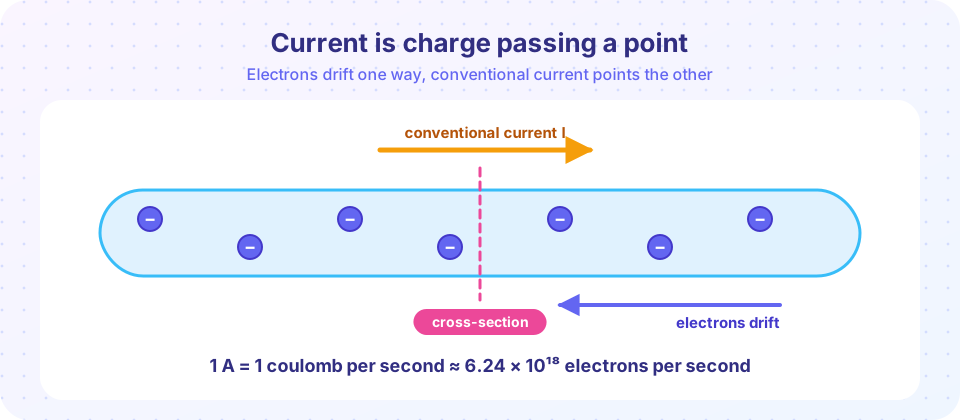
Conventional current: the direction positive charge would move, from + toward −.
Drift velocity: the average slow speed of the charge carriers along a wire.
Charge
Matter contains positive protons and negative electrons. There are two kinds of charge and like charges repel while opposite charges attract. Charge is conserved: it can move from place to place but is never created or destroyed in a closed system. It is also quantized: free charge comes in whole multiples of the elementary charge e = 1.602 × 10⁻¹⁹ C. The electron has charge −e and the proton +e.
One coulomb is a lot of charge: 1 C = 1 / (1.602 × 10⁻¹⁹) ≈ 6.24 × 10¹⁸ elementary charges. A static spark moves only nanocoulombs, a lightning flash carries a few tens of coulombs, and a 3,000 mAh phone battery holds about 10,800 C of charge.
Current
Electric current is the rate at which charge crosses a surface. If charge ΔQ passes a point in time Δt, the average current is I = ΔQ / Δt. For a changing flow we use the instantaneous form:
i(t) = dQ/dt and conversely Q = ∫ i(t) dt
Using lowercase i(t) means the current may vary with time; uppercase I means a constant (DC) value. One ampere is one coulomb per second:
| Current | Electrons passing per second |
|---|---|
| 1 µA | 6.24 × 10¹² |
| 1 mA | 6.24 × 10¹⁵ |
| 1 A | 6.24 × 10¹⁸ |
Worked example 1. A phone charger delivers 2 A for 30 minutes. Charge: Q = I · t = 2 A × 1,800 s = 3,600 C. That is 1 Ah, the number printed on battery labels (a "1,000 mAh" battery carries the same amount of charge).
Worked example 2. A sensor passes 0.4 µC in 8 ms. Current = 0.4 × 10⁻⁶ C / 0.008 s = 5 × 10⁻⁵ A = 50 µA.
Conventional current
Benjamin Franklin guessed that charge flows from the "positive" object to the "negative" one. In metals we now know the moving charges are actually electrons, which are negative and travel the opposite way. The convention stuck. Conventional current always points the way positive charge would move, from the + terminal of a source around the external circuit to the − terminal. Moving a negative charge one way is electrically equivalent to moving a positive charge the other way, so every equation works with the convention, and you can ignore electrons in all circuit analysis. (In semiconductors, both electrons and positive "holes" carry current, which makes the convention even more convenient.)
Why drift is slow
The current in a wire is I = n · q · A · v, where n is the number of free electrons per cubic metre, q the electron charge, A the cross-sectional area and v the drift velocity. For copper, n is about 8.5 × 10²⁸ m⁻³. A 1 A current through a 1 mm² wire gives v ≈ 7 × 10⁻⁵ m/s, about 0.07 mm per second: far slower than a walking snail. The lamp lights at once because the electric field sets every electron in the wire moving nearly simultaneously, like pushing one end of a tube already full of marbles.
Charge as the area under a graph
Since Q = ∫ i dt, the charge delivered between two times is the area under the i(t) curve.
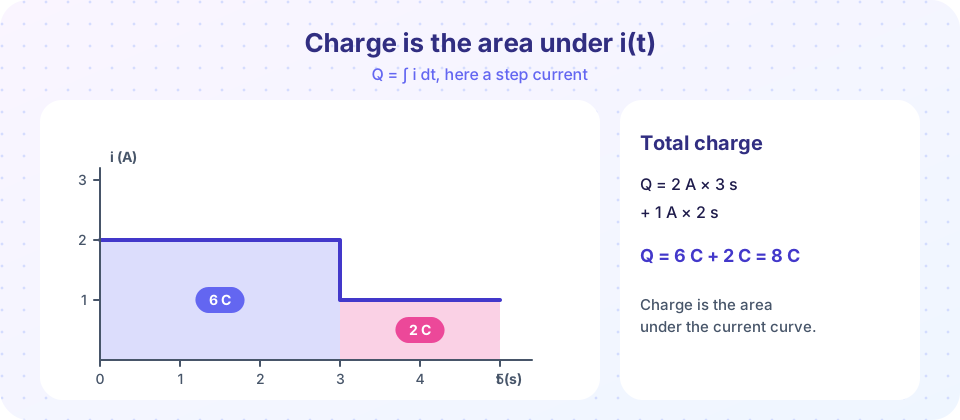
For steps, the area is a sum of rectangles: 2 A × 3 s + 1 A × 2 s = 8 C. For a triangle or a curve, use triangle formulas or integration.
Direct current and alternating current
If the current keeps the same direction, it is direct current (DC), the kind batteries supply. If it periodically reverses, it is alternating current (AC), the kind in wall outlets (50 or 60 Hz depending on country). Chapters 1 to 6 are mostly DC; Chapter 7 is about AC.
Common misconceptions
"Electrons move at nearly the speed of light in a wire." The electric signal travels fast; the electrons drift at a fraction of a millimeter per second.
"Current is used up in the load." The same current leaves a load that enters it. Energy is converted, charge is not.
"The arrow on the current is the direction electrons go." It is the direction positive charge would go, opposite the electron flow.
Try it
First, calculate how many electrons per second flow for several currents, and the drift velocity in a copper wire. The numbers are real physics: change the wire area and watch how the drift speed responds.
Press Run (or Ctrl + Enter) to see the result here.
Program input · what you'd type while the program runs
Type the answers before you press Run, one per line. Each time the program reads a line (with input()), it gets the next line from this box.
Now move a slider. The animation shows electrons drifting left while the current arrow points right. The speed is exaggerated so you can see it.
Finally, compute charge from a step current with NumPy, the same way as the graph above.
Press Run (or Ctrl + Enter) to see the result here.
Program input · what you'd type while the program runs
Type the answers before you press Run, one per line. Each time the program reads a line (with input()), it gets the next line from this box.
Check your understanding
Quick check · 5 questions
of 5 answered You scored / 5 · perfect!
-
1. A current of 3 A flows for 10 s. How much charge passes?
Q = I × t = 3 A × 10 s = 30 C. -
2. The conventional current in a wire points
By convention current points the way positive charge would flow, opposite the electron motion. -
3. A charge of 0.4 µC passes in 8 ms. The average current is
I = 0.4×10⁻⁶ / 0.008 = 5×10⁻⁵ A = 50 µA. -
4. Why does a lamp light almost instantly although electrons drift slowly?
The wire is already full of free electrons. The field travels very fast and moves them all together. -
5. The area under a current-time graph represents
Q = ∫ i dt, which is the area under the curve.
Summary
- Charge is conserved and quantized; one coulomb is about 6.24 × 10¹⁸ elementary charges.
- Current is the rate of charge flow: i = dQ/dt; 1 A = 1 C/s. Charge is the area under i(t).
- Conventional current points from + to −, opposite the electron flow.
- Electrons drift slowly (about 0.07 mm/s for 1 A in 1 mm² copper) but the field acts almost instantly.
Track your progress
Create a free account to tick off lessons and pick up where you left off on any device.
of Circuit Analysis lessons completed