


















Lesson 34 of 48 · AC Circuits and Phasors
Chapter 7 Overview: AC Circuits and Phasors
A map of AC circuit analysis: why sinusoids matter, how phasors turn calculus into algebra, and how impedance extends Ohm's law to capacitors and inductors.
The electricity in a wall socket does not flow steadily in one direction. It swings back and forth fifty or sixty times every second, tracing a smooth wave. Radio signals, audio, and the output of every generator do the same. Almost all of the world's electrical power is alternating current (AC), and the tools for analyzing it are the most useful in the whole course. The good news: they turn the differential equations of the last chapter into ordinary algebra with complex numbers.
What you will learn
- Why sinusoids are the natural signal for linear circuits.
- The idea behind a phasor and why it saves work.
- How impedance generalizes resistance to capacitors and inductors.
- The map of this chapter.
Key terms
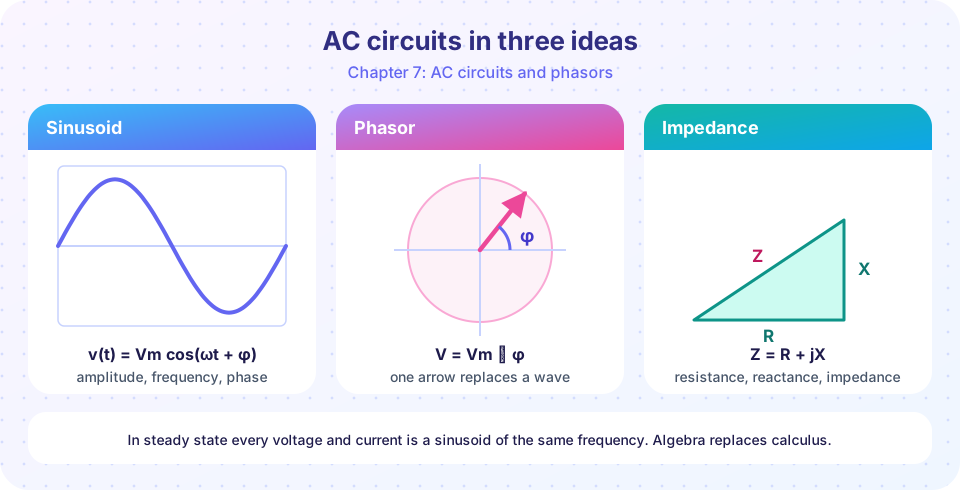
Sinusoid: a signal shaped like a sine or cosine, Vm cos(ωt + φ).
Phasor: a complex number holding the amplitude and phase of a sinusoid of known frequency.
Impedance Z: the complex ratio V / I; resistance plus reactance.
Steady state (AC): the situation after transients have died, when every signal is a sinusoid at the source frequency.
Why sinusoids?
Differentiate or integrate cos(ωt + φ) and you get another sinusoid of the same frequency, only shifted and scaled. Add two sinusoids of equal frequency and you get a third sinusoid at that frequency. A linear circuit built of resistors, capacitors and inductors does nothing else to a signal: it can scale it and shift its phase, but it can never create a new frequency. So if the source is a sinusoid, every voltage and current in steady state is a sinusoid at the same frequency. Only two numbers per signal remain unknown: amplitude and phase.
There are two more reasons. First, generators naturally produce sinusoids because a coil rotating in a magnetic field produces Vm sin ωt. Second, the Fourier idea says that any reasonable periodic signal is a sum of sinusoids, so a circuit analysis for sinusoids tells you how it handles any signal, one frequency at a time. We return to this in the frequency-response chapter.
From waves to numbers
Impedance
V = I Z still works.
Same old rules
Power in AC
The phasor idea in one paragraph
Write v(t) = Vm cos(ωt + φ) as the real part of a rotating complex number: Vm e^(j(ωt + φ)). Every voltage and current in the circuit rotates at the same speed ω, so the rotation factor e^(jωt) is common to all of them and can be dropped. What is left, V = Vm ∠ φ, is a fixed complex number: the phasor. Differentiation in time becomes multiplication by jω, so the circuit equations become algebraic. Nothing about the physics changes; we have simply chosen a smarter notation.
Chapter map
| Lesson | What it covers |
|---|---|
| Sinusoids and phasors | Amplitude, frequency, phase, RMS and the phasor transform |
| Impedance and AC analysis | Z for R, L, C, series and parallel combinations, nodal and mesh with complex numbers |
| AC power | Real, reactive and apparent power; power factor and its correction |
| Chapter review | Mixed problems and a recap |
Common misconceptions
"A phasor is a vector in space." It is a complex number representing a time-varying signal. The arrow lives in the complex plane, not in physical space.
"Phasors work for any signal." Only for sinusoids at one known frequency in steady state. Other waveforms need Fourier analysis or time-domain methods.
"The AC voltage of 230 V is the peak." Household voltages are quoted as RMS values; the peak of a 230 V supply is about 325 V.
Try it
This program adds two sinusoids twice: once by brute force in the time domain and once with phasors. The results are the same, but the phasor route is a single complex addition.
Press Run (or Ctrl + Enter) to see the result here.
Program input · what you'd type while the program runs
Type the answers before you press Run, one per line. Each time the program reads a line (with input()), it gets the next line from this box.
The second demo shows a phasor rotating and its horizontal projection drawing the cosine wave. Change the frequency with the slider.
Check your understanding
Quick check · 5 questions
of 5 answered You scored / 5 · perfect!
-
1. Why is every voltage in a linear AC circuit (steady state) a sinusoid at the source frequency?
Derivatives, integrals and sums of equal-frequency sinusoids are again sinusoids of that frequency. -
2. A phasor contains
The frequency is common to the whole circuit and is dropped; the phasor stores amplitude and phase. -
3. The impedance of an inductor is
An inductor has Z = jωL; a capacitor has Z = 1/(jωC). -
4. A 230 V RMS mains supply has a peak voltage near
Vpeak = √2 × 230 ≈ 325 V. -
5. Phasor analysis applies to
Phasors assume a single known frequency and steady-state sinusoidal operation.
Summary
- Linear circuits turn sinusoids into sinusoids of the same frequency.
- A phasor
V = Vm ∠ φcaptures amplitude and phase; derivatives become multiplication byjω. - Impedance extends Ohm's law:
V = I Z. - Household voltages are RMS; the peak is √2 times larger.
Next: Sinusoids and phasors
Track your progress
Create a free account to tick off lessons and pick up where you left off on any device.
of Circuit Analysis lessons completed