


















Lesson 5 of 48 · Getting Started
Chapter 1 Review: Getting Started
Review circuits, units and prefixes, and schematic symbols with a one-picture summary, a recap table and a ten-question quiz before moving on to voltage and current.
You now have the vocabulary of circuits: what a circuit is, which units describe it, and how to read the drawing. This review ties the three lessons together and checks you are ready for Chapter 2, where we define charge, current and voltage precisely.
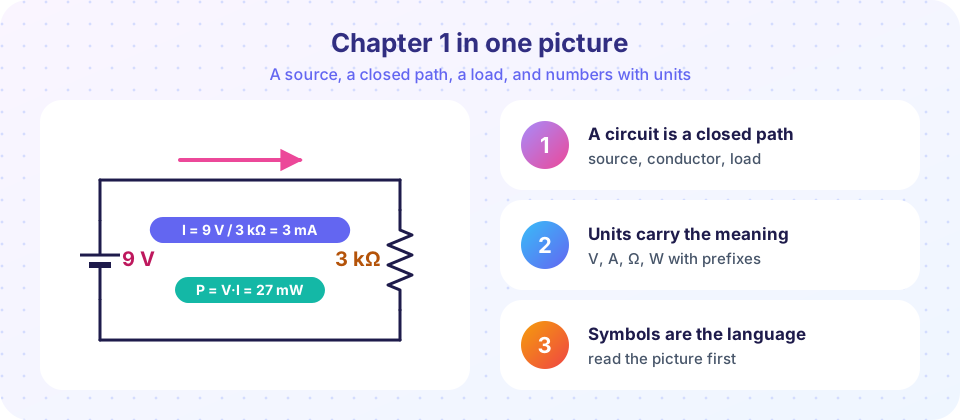
What you will learn
- A compact recap of the whole chapter.
- A worked example that uses every idea at once.
- Where your weak spots are, from a ten-question quiz.
Recap table
| Lesson | Big idea | Remember |
|---|---|---|
| What is a circuit? | Source + closed path + load | Open: I = 0. Short: R ≈ 0, huge I |
| Units and prefixes | SI units, prefixes in steps of 1,000 | mV / kΩ = µA; m is not M |
| Reading schematics | Symbols, dots, ground, netlists | Dot joins wires; ground is a chosen 0 V |
One worked example
A 9 V battery is connected to a 3 kΩ resistor through a closed switch. Find the current and the power in the resistor.
- Circuit check. Source (9 V battery), closed path (switch closed), load (3 kΩ resistor): a working loop.
- Convert units. 3 kΩ = 3,000 Ω.
- Current. I = V / R = 9 V / 3,000 Ω = 0.003 A = 3 mA.
- Power. P = V · I = 9 V × 0.003 A = 0.027 W = 27 mW.
- Sanity check. A few milliamps through a few kilohms from a few volts: plausible. Power in milliwatts: a small resistor can handle it (a quarter-watt resistor is rated 250 mW).
Open the switch and the same circuit has I = 0 and P = 0, though the battery voltage is still 9 V across the open switch.
If you could not write each line of that example from memory, return to the matching lesson. Ch. 1 is the base for everything after.
Common misconceptions
"If the switch is open, there is no voltage in the circuit." The battery still has 9 V across its terminals, and the open switch has 9 V across the gap. What is missing is current.
"I can ignore units until the end." Convert to base units (ohms, amperes, volts) before calculating, or use matching prefix pairs such as V and kΩ giving mA.
Try it
The calculator below solves the Ohm's law loop for any battery and resistor, printing in engineering notation. Predict the output before you run it.
Press Run (or Ctrl + Enter) to see the result here.
Program input · what you'd type while the program runs
Type the answers before you press Run, one per line. Each time the program reads a line (with input()), it gets the next line from this box.
Try this short console exercise as well: a prefix drill. Fill in the blank conversions and compare with the printed answers.
Press Run (or Ctrl + Enter) to see the console output here.
No output.
Check your understanding
Quick check · 10 questions
of 10 answered You scored / 10 · perfect!
-
1. Which is NOT one of the three ingredients of a working circuit?
Earthing is a safety feature of mains wiring. A battery circuit works without any connection to the soil. -
2. A 100 kΩ resistor connected to 5 V draws
5 V / 100,000 Ω = 0.00005 A = 50 µA. -
3. Two wires cross with a dot on the crossing. They are
A dot marks a connection. -
4. How many megohms is 4,700 kΩ?
k to M is one step up, so divide by 1,000. -
5. An open switch in a series loop makes the current
One break stops the flow around the entire loop. -
6. The unit of resistance is the
The ohm (Ω) is one volt per ampere. -
7. A device's power is 27 mW. In watts this is
milli means 10⁻³, so 27 mW = 0.027 W. -
8. In SPICE, the line R5 4 0 1meg describes
SPICE uses meg for mega because m already means milli. Node 0 is ground. -
9. Short circuit means
With R near 0, I = V / R becomes very large. -
10. Which pair is correct?
Capacitance is in farads, inductance in henries, power in watts. Frequency is in hertz.
Summary
- A circuit is a source, a closed path and a load; open circuits stop the current and short circuits invite huge currents.
- SI units and prefixes (steps of 1,000) keep numbers readable; carry units through every step.
- Schematics show connections with standard symbols; dots join wires; ground is a chosen 0 V reference.
- Ohm's law preview: I = V / R, and power P = V · I.
Track your progress
Create a free account to tick off lessons and pick up where you left off on any device.
of Circuit Analysis lessons completed