


















Lesson 16 of 48 · Resistive Circuits and Ohm's Law
Chapter 3 Review: Resistive Circuits and Ohm's Law
Review Ohm's law, series and parallel resistors, voltage and current dividers and series-parallel reduction with a cheat sheet, worked example and ten-question quiz.
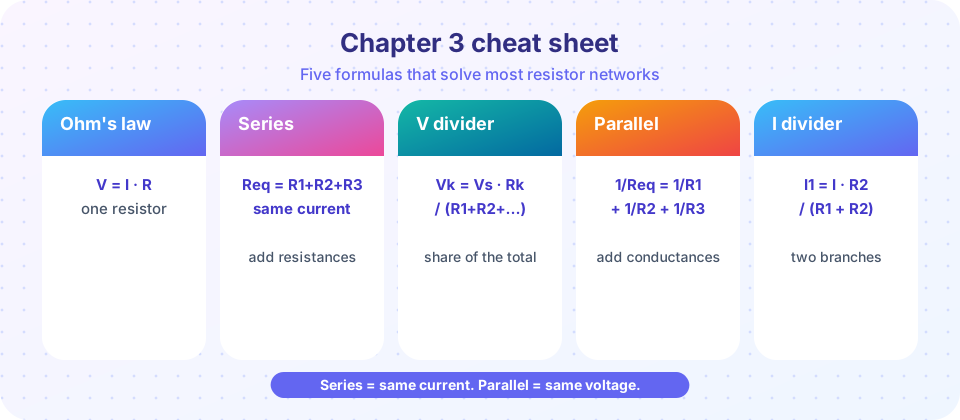
You can now solve a large and practical family of circuits: any network that reduces to series and parallel pieces. This review collects the formulas, tests your fluency with a mixed example, and checks for the common slips before you move on to the systematic methods of Chapter 4.
What you will learn
- A one-page summary of every resistor-network formula.
- How to solve a full problem from source to branch values.
- Which mistakes to look out for.
Recap table
| Topic | Rule | Memory hook |
|---|---|---|
| Ohm's law | V = I·R, G = 1/R | cover the unknown in the triangle |
| Power | P = VI = I²R = V²/R | always ≥ 0 for a resistor |
| Series | same I; Req = ΣR | add resistances |
| Voltage divider | Vk = Vin·Rk / ΣR | bigger R, bigger voltage |
| Parallel | same V; Geq = ΣG | add conductances; Req < smallest |
| Current divider | Ik = I·Gk / ΣG | bigger R, smaller current |
| Reduction | collapse, find I, expand | check Σp |
| Bridge | R1/R3 = R2/R4 | balanced: no middle current |
A full worked example
A 15 V source is connected to R1 = 3 kΩ in series with the parallel combination of R2 = 6 kΩ and R3 = 3 kΩ, and then in series with R4 = 1 kΩ. Find all voltages, currents and the source power.
- Parallel pair: 6 kΩ ‖ 3 kΩ = 18 / 9 = 2 kΩ.
- Series total: Req = 3 + 2 + 1 = 6 kΩ.
- Source current: I = 15 V / 6 kΩ = 2.5 mA, flowing through R1, the pair and R4.
- Voltages: V1 = 2.5 mA × 3 kΩ = 7.5 V; V_pair = 2.5 mA × 2 kΩ = 5 V; V4 = 2.5 mA × 1 kΩ = 2.5 V. Sum = 15 V ✓.
- Pair currents (divider): I2 = 5 V / 6 kΩ = 0.833 mA; I3 = 5 V / 3 kΩ = 1.667 mA; sum = 2.5 mA ✓.
- Power: P1 = 18.75 mW, P2 = 4.17 mW, P3 = 8.33 mW, P4 = 6.25 mW: total 37.5 mW = 15 V × 2.5 mA ✓.
Common misconceptions
"Req is a physical resistor in the circuit." It is a model of the network's terminal behavior only; the real resistors still carry their own voltages and currents.
"I can skip the check." The power balance and the sum of drops each take half a minute and catch most arithmetic mistakes.
Try it
Solve the worked example with code to confirm the numbers. The reduction functions are the same as in the previous lesson.
Press Run (or Ctrl + Enter) to see the result here.
Program input · what you'd type while the program runs
Type the answers before you press Run, one per line. Each time the program reads a line (with input()), it gets the next line from this box.
Then take a short console quiz on the chapter's rules: the program prints each answer so you can compare with your own working.
Press Run (or Ctrl + Enter) to see the console output here.
No output.
Check your understanding
Quick check · 10 questions
of 10 answered You scored / 10 · perfect!
-
1. Which circuit element rule is correct for resistors in parallel?
Parallel: common voltage, and Geq = G1 + G2 + … -
2. A 9 V battery drives a series chain of 1 kΩ and 2 kΩ. The voltage across the 2 kΩ is
9 × 2 / 3 = 6 V. -
3. 10 kΩ ‖ 10 kΩ ‖ 10 kΩ is
10 / 3 = 3.33 kΩ. -
4. A 6 mA current enters 1 kΩ ‖ 2 kΩ. The current in the 1 kΩ is
I1 = 6 × 2 / 3 = 4 mA. -
5. A resistor carries 50 mA and has 100 Ω. Its power is
P = I²R = 0.0025 × 100 = 0.25 W = 250 mW. -
6. In the chapter's worked example (15 V, 3 kΩ + (6 kΩ ‖ 3 kΩ) + 1 kΩ), Req is
3 + 2 + 1 = 6 kΩ. -
7. Which describes a balanced Wheatstone bridge?
R1/R3 = R2/R4 makes both midpoint voltages equal. -
8. Adding one more resistor in parallel to a network
Each extra path lowers Req. -
9. R = 330 Ω and the supply is 5 V. The power in R is about
P = V²/R = 25/330 = 0.0758 W ≈ 76 mW. -
10. The first step of any circuit solution is
Clear labels prevent sign errors.
Summary
- Ohm's law plus the series and parallel rules solve every network that reduces.
- Voltage divides in series (bigger R gets more); current divides in parallel (bigger R gets less).
- Reduce, find the source current, expand, and check with Σp = 0.
- Bridges need the systematic methods of Chapter 4.
Next: Chapter 4 Overview: Kirchhoff's Laws and Nodal Analysis
Track your progress
Create a free account to tick off lessons and pick up where you left off on any device.
of Circuit Analysis lessons completed