


















Lesson 45 of 45 · Projects and Practice
Further Study: Where to Go Next
Your next steps after the orbital mechanics, rocket and spacecraft chapters: advanced topics, connected tutorials on this site, free software and project ideas.
You can now explain how satellites stay up, how much speed a rocket buys with its propellant, what a spacecraft needs to survive, and how missions are planned. That is a solid foundation, and it also marks the edge of what a first course can show. Aerospace engineering is a family of disciplines, each deep on its own. This lesson maps where to go next, which tutorials on this site connect to this one, and how to keep practicing with projects.
What you will learn
- See which advanced topics extend each chapter of this course.
- Choose a next tutorial on this site that matches your interest.
- Find free tools for orbit and mission analysis.
- Pick a practice project at the right level.
Key terms
Prerequisite: knowledge you need before a new topic makes sense. Perturbation theory: the study of how small extra forces change an ideal orbit. Lambert problem: finding the orbit that connects two positions in a given time. Simulation: a computer model that steps a system through time. Portfolio project: a finished, documented project that shows what you can do.
Beyond each chapter
Orbital mechanics. The two-body model is the beginning. Next come the orbital elements and coordinate frames in full, perturbations (the Earth's equatorial bulge, atmospheric drag, solar radiation pressure, third-body effects), the Lambert problem for interplanetary targeting, rendezvous and proximity operations (the Clohessy-Wiltshire equations), and the three-body problem that describes Lagrange points and halo orbits. For these you need linear algebra, differential equations and some numerical integration.
Rocket propulsion. Go into combustion and thermodynamics, turbomachinery (pumps and turbines), engine cycles, solid motor grain design, electric propulsion physics (ion, Hall and plasma thrusters) and ascent trajectory optimization with drag and a rotating atmosphere.
Spacecraft systems. Three-axis attitude control with quaternions, thermal network modelling, radiation effects, reliability and fault-tolerance, flight software and spacecraft testing (vibration, thermal vacuum, electromagnetic compatibility).
Mission design. Low-thrust trajectories, multi-gravity-assist tours, aerocapture and entry, descent and landing, constellation design, space debris and sustainability, and systems engineering as a discipline.
Tutorials on this site that connect to this one
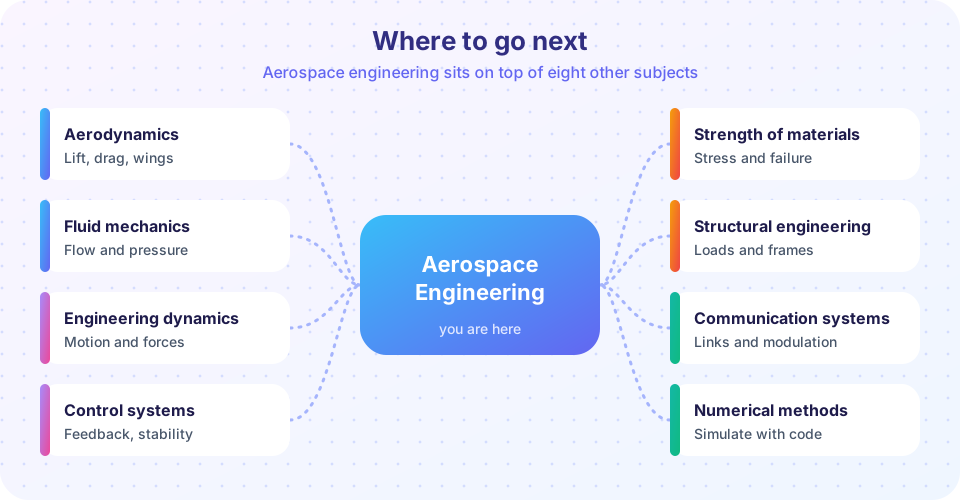
- Aerodynamics: lift, drag, wings and compressible flow, for everything that flies in an atmosphere.
- Fluid mechanics: the flow of liquids and gases, the base for nozzles, tanks and pipes.
- Engineering dynamics: motion and forces on rigid bodies, the base of attitude dynamics.
- Control systems: feedback and stability, the formal version of the PD controller from lesson 730.
- Strength of materials and Structural engineering: stresses, loads and frames, essential for tanks and airframes.
- Communication systems and RF and antennas: modulation, coding, link design and antennas.
- Numerical methods: integrating orbits, root finding and error control.
- Astronomy and Classical mechanics: the physical context and the underlying laws.
Free software to explore
- GMAT (the General Mission Analysis Tool from NASA) is an open-source tool for designing trajectories.
- Orekit is an open-source Java library for orbit determination and propagation.
- Python with NumPy and SciPy: integrating orbits with
scipy.integrate.solve_ivpis one of the best exercises you can do, and everything in this course can be reproduced there. - OpenRocket is a free simulator for model rockets.
Projects to try
- Beginner: reproduce every number of the Mars project for Venus and for Jupiter; plot the results.
- Intermediate: write a numerical orbit propagator (Runge-Kutta) and compare it with Kepler's equation. Add drag and the
J2term to watch the orbit drift. - Intermediate: design a three-stage rocket for a 5-tonne payload and plot its trajectory with gravity turn, including drag.
- Advanced: build a CubeSat power and link budget for a 3U satellite in a sun-synchronous orbit, with thermal analysis.
- Anywhere: build and fly a model rocket with a simulation first, then compare the measured altitude with the prediction.
Document each project clearly: the problem, the assumptions, the equations, the results and what you would do next. That is the habit of professional engineers, and the best record of what you can do.
Common misconceptions
"I must master every subject before I start building." Build small things early; the gaps you find tell you what to study.
"Software replaces understanding." Mission-analysis tools are only as good as the person who checks their output against simple benchmarks, as this course practiced.
"Aerospace is only for rocket scientists." Aerospace needs mechanical, electrical, software, materials and systems engineers, as well as analysts and operators.
Try it
Press Run (or Ctrl + Enter) to see the result here.
Program input · what you'd type while the program runs
Type the answers before you press Run, one per line. Each time the program reads a line (with input()), it gets the next line from this box.
Check your understanding
Quick check · 4 questions
of 4 answered You scored / 4 · perfect!
-
1. Which topic would you study to model how Earth's equatorial bulge slowly rotates an orbit plane?
The J2 effect is a classic orbital perturbation. -
2. Which tutorial formalizes the feedback ideas behind the PD attitude controller?
Control systems covers feedback, stability, damping and PID design. -
3. A good practice project documents
Clear documentation is the habit of professional engineers and makes the project useful later. -
4. Which free tool from NASA is used to design trajectories?
GMAT, the General Mission Analysis Tool, is open-source trajectory design software; OpenRocket targets model rockets and Orekit is a Java library.
Summary
- Each chapter extends into deeper topics: perturbations and Lambert targeting, combustion and electric propulsion, quaternion attitude control, low-thrust and tour design.
- Eight connected subjects on this site feed aerospace engineering: aerodynamics, fluids, dynamics, control, materials, structures, communications and numerical methods.
- Free tools (GMAT, Orekit, Python, OpenRocket) let you check and extend everything in this course.
- Finish projects and document them; that is the best way to learn.
Back to the course overview: Aerospace Engineering
Track your progress
Create a free account to tick off lessons and pick up where you left off on any device.
of Aerospace Engineering lessons completed