


















Lesson 6 of 45 · History and Vehicle Types
History and vehicle types: chapter overview
A guided overview of aerospace history from balloons to reusable rockets and the main families of aerospace vehicles, with a timeline and interactive calculator.
In 1903 two brothers flew for twelve seconds. Sixty-six years later, people walked on the Moon. That span, shorter than a long human life, is one of the fastest bursts of engineering progress in history. This chapter tells the story and then turns it into a map of the vehicles you will study for the rest of the course.
What you will learn
- The ten milestones that define aerospace history
- Why progress came in bursts, driven by new engines, materials and funding
- How the chapter's lessons are organized
Key terms
Milestone is a first that opens a new capability, such as the first powered flight.
Turbojet is a gas-turbine engine that makes thrust from a fast exhaust jet.
Reusable launch vehicle is a rocket whose parts can fly more than once.
Orbit is a path around a body where gravity and sideways speed balance.
The story in one picture
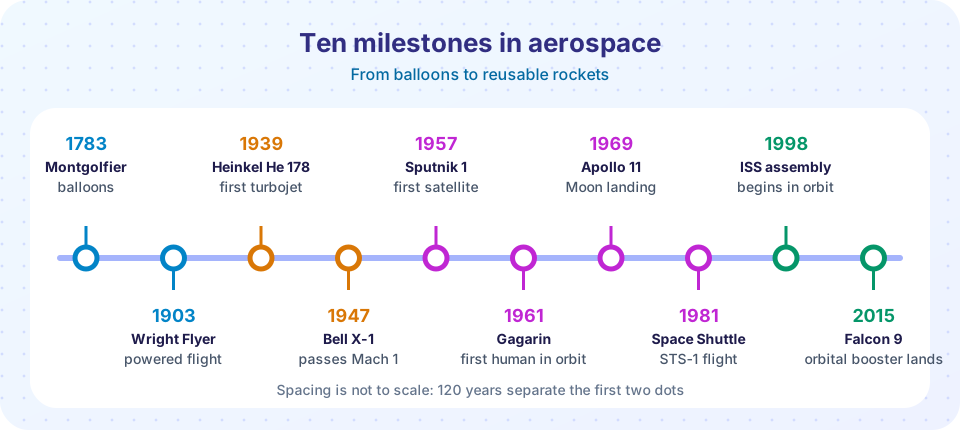
Read the timeline from left to right. Notice what the first dots have in common: each depended on a new technology that arrived just before it. Balloons needed cheap lightweight fabric and varnish. The Wright Flyer needed a light gasoline engine and a wind tunnel to test wing shapes. The first turbojet needed heat-resistant metals. Sputnik needed a long-range ballistic missile, the R-7 rocket. Reusable boosters needed computers fast enough to land a rocket on a pad.
Three eras of aerospace
1783 to 1969 and beyond
What drove progress?
Vehicle families
What is in this chapter
- Early aviation: balloons, gliders, the Wright brothers and the first airplanes
- The jet and space ages: turbojets, supersonic flight, Sputnik, Apollo, the Shuttle and the ISS
- A tour of aerospace vehicles: aircraft, launchers and spacecraft and the environment each is built for
- Chapter 2 review: a one-page recap and a 9-question quiz
Try it
Press Run (or Ctrl + Enter) to see the console output here.
No output.
Press Run (or Ctrl + Enter) to see the result here.
Program input · what you'd type while the program runs
Type the answers before you press Run, one per line. Each time the program reads a line (with input()), it gets the next line from this box.
Common misconceptions
"The Wrights simply built an engine with wings." They solved control first, with wing warping and a rudder, and built their own wind tunnel to test wing shapes before the first flight.
"The space age began with the Moon landing." It began on 4 October 1957 with Sputnik 1. Apollo 11 came twelve years later.
Check your understanding
Quick check · 4 questions
of 4 answered You scored / 4 · perfect!
-
1. Which milestone came first?
The Wright Flyer flew in 1903, before the others. -
2. What technology made Sputnik possible?
The Soviet R-7 missile could lift a satellite to orbit. -
3. How many years passed between the Wright Flyer and Apollo 11?
1969 minus 1903 is 66 years. -
4. Which of these is a reusable-launcher milestone?
In December 2015 a Falcon 9 first stage landed upright after an orbital launch.
Summary
- Aerospace history runs through balloons, powered flight, jets, rockets and reusable launchers.
- Each leap followed a technology: engines, materials, computers and funding.
- Vehicle families (aircraft, launchers, spacecraft) are set by the environment they work in.
- The next lessons tell the story in detail.
Next: Early aviation
Track your progress
Create a free account to tick off lessons and pick up where you left off on any device.
of Aerospace Engineering lessons completed