


















Lesson 11 of 45 · Aircraft Structures and Propulsion
Aircraft structures and propulsion: chapter overview
A map of chapter 3: how wings make lift and drag, how airframes carry loads and how aircraft engines make thrust, with a first look at the numbers.
An aircraft is a compromise between three demands: a wing that makes lift cheaply, a structure that carries the loads without being heavy and an engine that turns fuel into thrust efficiently. Change one and the other two feel it. A bigger wing is lighter per unit lift but heavier in structure. A stronger structure is safer but costs payload. This chapter introduces the three parts and shows how they trade against each other.
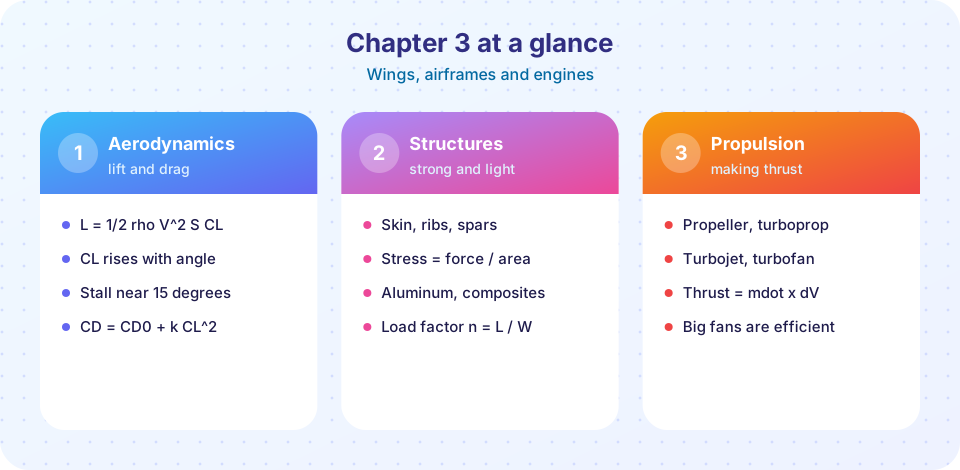
What you will learn
- How the chapter's five lessons connect
- The key equation of each topic: lift, stress and thrust
- How a small change in one part ripples through the others
Key terms
Airfoil is the cross-section shape of a wing.
Stress is force per unit area inside a material.
Thrust is the forward force from an engine.
Lift-to-drag ratio (L/D) is the aerodynamic efficiency of a whole aircraft.
The big picture
Three coupled parts
Change one, the others move
The key equations
A trade in action
What each lesson covers
- Lift and airfoils: pressure, circulation, angle of attack, stall and lift curves.
- Drag and the drag polar: parasite, induced and wave drag, and the parabolic polar
CD = CD0 + k CL². - Airframe structures and loads: skin, spars, ribs, stringers, stress, load factor, safety factors and fatigue.
- Aircraft propulsion: propellers, turbofans, turbojets, thrust and efficiency.
- Chapter 3 review: recap and a 10-question quiz.
A preview of the trade
Here is the long-wing trade you will study in detail. Induced drag falls as the wing gets longer and thinner, but wing weight rises because the wing root must carry a larger bending moment. The best design sits somewhere in between. The first TryIt below shows the shape of that trade with a deliberately simple model, labelled as such.
Try it
Press Run (or Ctrl + Enter) to see the result here.
Program input · what you'd type while the program runs
Type the answers before you press Run, one per line. Each time the program reads a line (with input()), it gets the next line from this box.
Press Run (or Ctrl + Enter) to see the console output here.
No output.
Common misconceptions
"Each part can be optimized on its own." The best wing for the aerodynamicist may be too heavy for the structures team. Real designs are found by trading all three together.
"Stronger is always better." Extra strength costs weight, and extra weight costs fuel and payload.
Check your understanding
Quick check · 4 questions
of 4 answered You scored / 4 · perfect!
-
1. What does a longer, thinner wing do to induced drag?
Induced drag falls as span increases, at the same lift. -
2. What is the downside of a longer wing?
The bending moment at the wing root grows with span. -
3. Which quantity measures an aircraft's overall aerodynamic efficiency?
L/D is lift divided by drag, high for efficient aircraft. -
4. As fuel burns, the lift needed in level flight
L = W and W decreases as fuel is burned.
Summary
- Wings, structure and engines are coupled, and design means trading between them.
- Key equations:
L = 1/2 rho V² S CL,sigma = F/A,T = mdot (Ve - V0). - Longer wings save drag but cost structural weight; the optimum lies between the extremes.
- The chapter proceeds from lift to drag to structures to engines.
Next: Lift and airfoils
Track your progress
Create a free account to tick off lessons and pick up where you left off on any device.
of Aerospace Engineering lessons completed