


















Lesson 35 of 45 · Spacecraft Systems
Spacecraft Communications and the Link Budget
Learn how spacecraft talk to Earth: antenna gain, free-space path loss, noise, the decibel link budget, Shannon capacity and light-time delay, with worked numbers.
A spacecraft is only useful if its data reaches the ground and commands reach it. Radio waves cover the distance, but they get weaker very quickly with distance: a transmitter a few tens of watts strong, viewed from tens of thousands or millions of kilometers away, arrives with a power so tiny that engineers measure it in decibels and count every fraction of a decibel. The accounting method that tracks gains and losses from the transmitter to the receiver is the link budget.
What you will learn
- Convert between watts and decibels (dBW) and add gains and losses in dB.
- Compute antenna gain and free-space path loss.
- Build a complete link budget and compare the received signal with the noise.
- Use the Shannon limit to bound the data rate.
- Explain light-time delay and Doppler shift.
Key terms
Decibel (dB): ten times the base-10 logarithm of a power ratio; dBW references 1 watt.
Antenna gain (G): how much more power an antenna sends (or receives) in its best direction than an ideal point source; written in dBi.
Free-space path loss (L): the spreading loss of a radio wave, (4πd/λ)².
Noise power: N = k T B with Boltzmann's constant k = 1.380649×10⁻²³ J/K, system temperature T and bandwidth B.
Signal-to-noise ratio (SNR): received signal power divided by noise power.
Why decibels?
Powers in a link span dozens of orders of magnitude. In decibels, multiplication becomes addition. 10 log₁₀(2) ≈ 3.0 dB, so a doubling is +3 dB and a halving is −3 dB; a factor of 10 is 10 dB; a factor of 1,000 is 30 dB. A 20-watt transmitter is 10 log₁₀(20) = 13.0 dBW.
The link equation
Power reaches the receiver as
Pr = Pt · Gt · Gr · (λ / 4πd)²      in decibels:   Pr = Pt + Gt + Gr − L
L = 20 · log₁₀(4π d / λ)
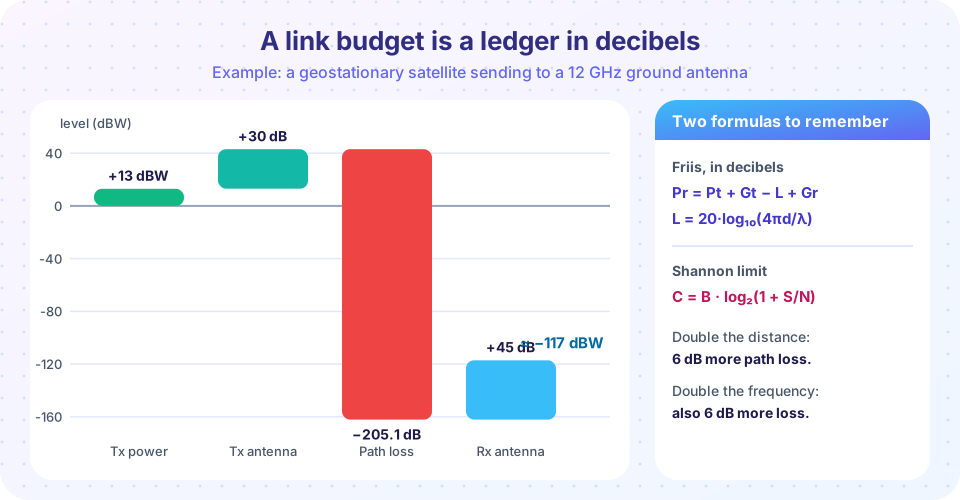
Let us follow one real-looking example: a satellite in geostationary orbit (d = 35,786 km, straight overhead) transmitting at 12 GHz (λ = 0.025 m).
- Transmitter: 20 W is +13.0 dBW.
- Transmit antenna: gain of a dish of diameter
DisG = η (π D / λ)². A 0.33 m dish with 60% efficiency givesG ≈ 1,000, which is +30 dBi. - Path loss:
L = 20 log₁₀(4π × 3.5786×10⁷ / 0.025) ≈ 205.1 dB. - Receive antenna: a 1.8 m ground dish at 12 GHz has
G ≈ 30,000, or +45 dBi. - Received power:
13.0 + 30 − 205.1 + 45 = −117.1 dBW, about 2×10⁻¹² W, a trillionth of a watt.
That sounds hopeless, but receivers are very sensitive. What matters is the signal compared with the noise.
Noise and capacity
Thermal noise power in a bandwidth B at system temperature T is N = k T B. For T = 150 K and B = 36 MHz: N ≈ 7.5×10⁻¹⁴ W = −131 dBW. The SNR is therefore about 14 dB, a ratio of about 26.
The theoretical limit on how fast you can send error-free data through a channel of this bandwidth and SNR is the Shannon capacity:
C = B · log₂(1 + SNR)
With B = 36 MHz and SNR ≈ 26 that is about 170 Mbit/s. Modern error-correcting codes (turbo, LDPC) come within a fraction of a decibel of that limit. When the signal is weak, the only options are to lower the data rate (a smaller bandwidth reduces noise too), use a bigger antenna, raise the power, or improve the receiver.
Choosing frequency and antennas
Antenna gain grows with the square of frequency for a fixed dish size: G ∝ (D/λ)². Path loss grows with the square of frequency too. With dishes at both ends fixed in size the two effects combine to Pr ∝ f²: higher frequency delivers more power, as long as pointing is accurate (a bigger gain means a narrower beam, about 70 λ / D degrees) and rain does not absorb the signal. That is why deep-space missions moved from S-band (about 2 GHz) to X-band (about 8 GHz) and now Ka-band (about 32 GHz). NASA's Deep Space Network, with 70 m dishes and a number of 34 m dishes at three sites around the world, receives signals from probes across the solar system.
Delay and Doppler
Radio travels at the speed of light, 299,792 km/s. One-way light time is about 0.12 s to a geostationary satellite, 1.3 s to the Moon, 3 to 22 minutes to Mars depending on the planets' positions, and more than 22 hours to Voyager 1. This means remote spacecraft cannot be joysticked: commands are sent in advance and the vehicle must act autonomously.
Motion causes a Doppler shift Δf = f · v_r / c. A low-orbit satellite moving at 7.7 km/s directly toward the station is shifted by about 56 kHz at 2.2 GHz. Ground receivers track and correct this shift.
Common misconceptions
"A more powerful transmitter is the best fix." Every +3 dB doubles the power. Doubling antenna diameter gives +6 dB at each end where it applies, often at a lower cost.
"Free-space loss absorbs the signal." It is just geometric spreading; the energy is not destroyed, it is spread over a sphere of growing area.
"Signals can be sent without noise." Noise is always present, and Shannon's formula shows how much data fits through it.
Try it
Press Run (or Ctrl + Enter) to see the result here.
Program input · what you'd type while the program runs
Type the answers before you press Run, one per line. Each time the program reads a line (with input()), it gets the next line from this box.
Press Run (or Ctrl + Enter) to see the result here.
Program input · what you'd type while the program runs
Type the answers before you press Run, one per line. Each time the program reads a line (with input()), it gets the next line from this box.
Check your understanding
Quick check · 5 questions
of 5 answered You scored / 5 · perfect!
-
1. A transmitter radiates 100 W. What is that in dBW?
10 × log₁₀(100) = 20 dBW. -
2. Doubling the distance to a spacecraft changes the free-space path loss by about
L = 20 log₁₀(4πd/λ), so doubling d adds 20 log₁₀ 2 ≈ 6 dB. -
3. What does the Shannon formula C = B log₂(1 + SNR) tell us?
It is the theoretical upper limit on error-free capacity. -
4. Why can't a rover on Mars be steered by joystick from Earth?
Light time of 3 to 22 minutes one way means commands must be planned in advance. -
5. A dish's gain is G = η (πD/λ)². If the dish diameter doubles, the gain changes by
Gain varies with D², so doubling the diameter gives 4 times the gain, or +6 dB.
Summary
- Add gains and subtract losses in decibels:
Pr = Pt + Gt − L + Gr, withL = 20 log₁₀(4πd/λ). - Dish gain scales with
(D/λ)²; path loss is 6 dB per doubling of distance. - Compare the received power with noise
k T B; Shannon'sC = B log₂(1 + SNR)bounds the data rate. - Light-time delay and Doppler shift shape how operations are planned.
Track your progress
Create a free account to tick off lessons and pick up where you left off on any device.
of Aerospace Engineering lessons completed