


















Lesson 18 of 45 · Flight Dynamics and Control
Stability basics
Learn static and dynamic stability, the center of gravity and neutral point, static margin, pitching moment curves, the short-period and phugoid modes.
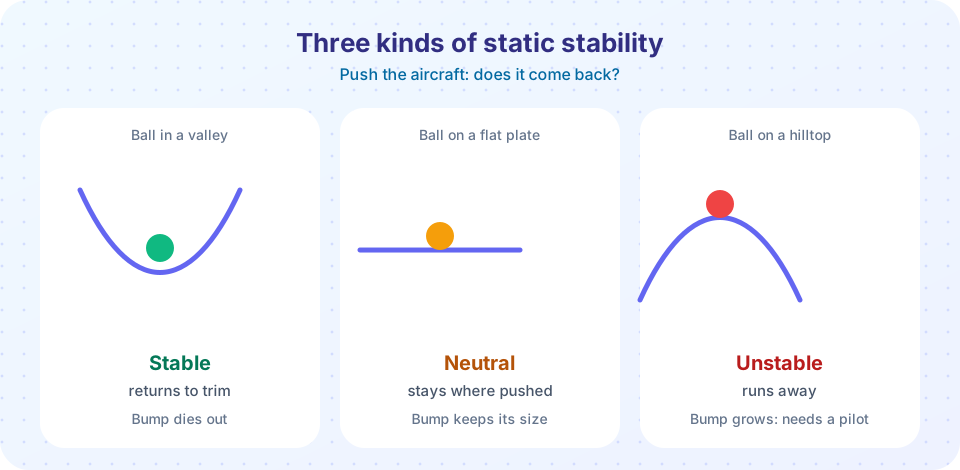
Let go of a pencil balanced on its tip and it falls over. Let go of a ball resting in a bowl and it rolls back. An aircraft must be like the ball in the bowl: if a gust upsets it, it should settle back by itself, so the pilot is not fighting the aircraft every second. In this lesson you learn how designers achieve that, using the position of the center of gravity, the size of the tail and a single number called the static margin.
What you will learn
- The difference between static and dynamic stability
- How the center of gravity and the neutral point set pitch stability
- How to read a pitching-moment curve and find the trim angle
- The short-period and phugoid motions, and a formula for the phugoid period
Key terms
Static stability is a tendency to return toward equilibrium when disturbed.
Neutral point is the CG position at which the aircraft would be neutrally stable in pitch.
Static margin is the distance from the CG to the neutral point, as a fraction of the mean chord.
Trim is a state of equilibrium in which the net moment is zero.
Phugoid is a slow oscillation in which the aircraft trades height for speed.
Static stability in pitch
Disturb the aircraft so that its angle of attack increases. If the resulting pitching moment pushes the nose back down, it is statically stable. In terms of the pitching-moment coefficient Cm (nose-up positive), stability needs a negative slope:
dCm/dalpha < 0
The tail does most of the work. When the angle of attack rises, the tail's lift changes by a small amount, and because the tail is far behind the CG, it gives a strong nose-down restoring moment.
The key design variable is the CG position. Every aircraft has a neutral point (also called the aerodynamic center of the whole aircraft). Measured as fractions of the mean aerodynamic chord c̄, from the leading edge, with CG at h and neutral point at h_n:
Cm_alpha = CL_alpha · (h - h_n)
The static margin is SM = h_n - h. Positive SM, with the CG ahead of the neutral point, gives Cm_alpha < 0: stable. If the CG moves back to the neutral point, the aircraft is neutral; behind it, unstable.
Worked example. An aircraft has CL_alpha = 5.0 per radian, h_n = 0.40 and h = 0.30. Then SM = 0.10 (10 percent of the chord) and Cm_alpha = 5.0 × (-0.10) = -0.50 per radian. Moving the CG aft to 0.38 cuts the margin to 2 percent and the slope to -0.10. The aircraft is nearly neutral, so it reacts sluggishly to the stabilizing moments and the pilot or the autopilot must work harder. Loading rules (weight and balance) exist to keep the CG inside a safe range.
Trim
The aircraft is in trim when the total pitching moment is zero: Cm = Cm0 + Cm_alpha alpha + Cm_elevator delta_e = 0, where delta_e is the elevator deflection. For a given elevator angle, the aircraft settles at the trim angle of attack that makes Cm = 0. Stability means that if you push away from that angle, the moment pushes you back.
Dynamic stability
Static stability says that the first reaction is in the right direction. Dynamic stability asks what happens next. Does the motion die away (stable), keep going (neutral) or grow (unstable)? Two classic longitudinal modes:
- Short-period mode. A fast, well-damped pitch oscillation lasting a few seconds, at an angle of attack roughly constant in speed. Its frequency is usually 2 to 4 rad/s on an airliner. The pilot barely notices it.
- Phugoid mode. A slow oscillation, with the aircraft trading height for speed: nose up, it slows and climbs, then dives and speeds up. The angle of attack stays almost constant. The period is long, 20 seconds to several minutes, and the damping is weak, but the motion is so slow that it is easy to control.
Lanchester's approximation of the phugoid period is
T ≈ π sqrt(2) V / g ≈ 0.453 V seconds (with V in m/s)
An airliner at 230 m/s has a period near 104 seconds, which is why you never see it from the cabin. The short period is the more important mode for handling.
Sideways, the lateral-directional modes include Dutch roll (a coupled yaw and roll wobble), spiral mode (a slowly growing bank angle) and roll subsidence (rolling is quickly damped). The fin gives directional stability like a weathercock, and wing dihedral (wings angled upward) or sweep gives roll stability.
Try it
Press Run (or Ctrl + Enter) to see the result here.
Program input · what you'd type while the program runs
Type the answers before you press Run, one per line. Each time the program reads a line (with input()), it gets the next line from this box.
Press Run (or Ctrl + Enter) to see the console output here.
No output.
Common misconceptions
"A stable aircraft cannot be turned." Stability only means it resists disturbances. The pilot overcomes it with the control surfaces, and a stable aircraft simply needs a steady, predictable input.
"The CG can be anywhere." Move it too far aft and the aircraft loses stability; too far forward and the elevator cannot raise the nose at landing. That is why every aircraft has a CG envelope.
"The phugoid is dangerous." It is slow and weakly damped, but pilots correct for it without noticing. It only matters for autopilot design.
Check your understanding
Quick check · 5 questions
of 5 answered You scored / 5 · perfect!
-
1. For static pitch stability, dCm/dalpha must be
A nose-up disturbance (higher alpha) must create a nose-down moment. -
2. With the CG ahead of the neutral point, the static margin is
SM = h_n - h, which is positive when the CG is ahead. -
3. CL_alpha = 5 per radian, SM = 0.08. What is Cm_alpha?
Cm_alpha = -CL_alpha x SM = -5 x 0.08 = -0.40 per radian. -
4. Which mode is slow and trades height for speed?
The phugoid has a period of tens of seconds to minutes. -
5. Lanchester's period for V = 100 m/s is about
T = pi sqrt(2) x 100 / 9.81 = 45 s.
Summary
- Pitch stability needs
dCm/dalpha < 0; the tail provides the restoring moment. Cm_alpha = CL_alpha (h - h_n); static marginSM = h_n - hmust be positive.- The short-period mode is fast and well damped; the phugoid is slow and weakly damped, with
T ≈ 0.453 V. - Lateral stability comes from the fin (directional) and dihedral or sweep (roll).
Next: Control surfaces
Track your progress
Create a free account to tick off lessons and pick up where you left off on any device.
of Aerospace Engineering lessons completed