


















Lesson 42 of 45 · Projects and Practice
Project: Sizing a Launch Vehicle
Size a two-stage launch vehicle step by step: split the delta-v, apply the rocket equation, find stage masses, tank volumes and thrust, and test how structure and Isp change the answer.
You have all the pieces: the rocket equation, structure fractions, staging. Now put them in order and design a rocket. The project asks a classic first-pass question: what size must a two-stage launcher be to put 1 tonne into low Earth orbit? The method is the one real teams use in the first week of a launcher study. It will not give a flyable design, but it will tell you whether the idea is sensible and how sensitive it is to your assumptions.
What you will learn
- Follow the standard stage-sizing recipe from payload upward.
- Optimize the split of Δv between stages.
- Convert propellant mass into tank volume and engine thrust.
- Run sensitivity tests on
Ispand structure fraction. - Interpret the results realistically.
Key terms
Sizing: estimating the masses and dimensions needed to meet a requirement. Structure fraction (ε): stage dry mass divided by stage dry-plus-propellant mass. Mixture ratio (O/F): oxidizer mass flow divided by fuel mass flow. Propellant density: mass per volume; it sets tank size (kerosene about 810 kg/m³, liquid oxygen about 1,141 kg/m³, liquid hydrogen about 71 kg/m³). Sensitivity analysis: changing an input to see how much the output moves.
The requirements
- Payload: 1,000 kg to low Earth orbit.
- Required Δv: 9.4 km/s total (orbital speed plus gravity, drag and steering losses).
- Stage 1:
Isp = 300 s(a mean over its flight),ε = 0.08. - Stage 2:
Isp = 350 s(vacuum engine),ε = 0.08. - Both stages use kerosene and liquid oxygen, with mixture ratio
O/F = 2.6. - Liftoff thrust-to-weight ratio 1.3.
These are plausible but not tuned to any real vehicle.
The recipe
- Split the Δv. Pick a share
ffor stage 1:Δv₁ = f · 9.4,Δv₂ = (1 − f) · 9.4. - Mass ratios. For each stage,
R = e^(Δv/(Isp·g₀)). - Work from the top down. For a stage with mass
m_abovesitting on top of it (payload plus all stages above), the rocket equation with structure fractionεgives the stage mass:m_stage = (R − 1) · m_above / (1 − R ε). IfR ε ≥ 1no stage can do that Δv at thatε: it is infeasible. The stage's dry mass isε m_stageand its propellant is(1 − ε) m_stage. - Add up. Liftoff mass = payload + stage 2 + stage 1.
- Optimize over
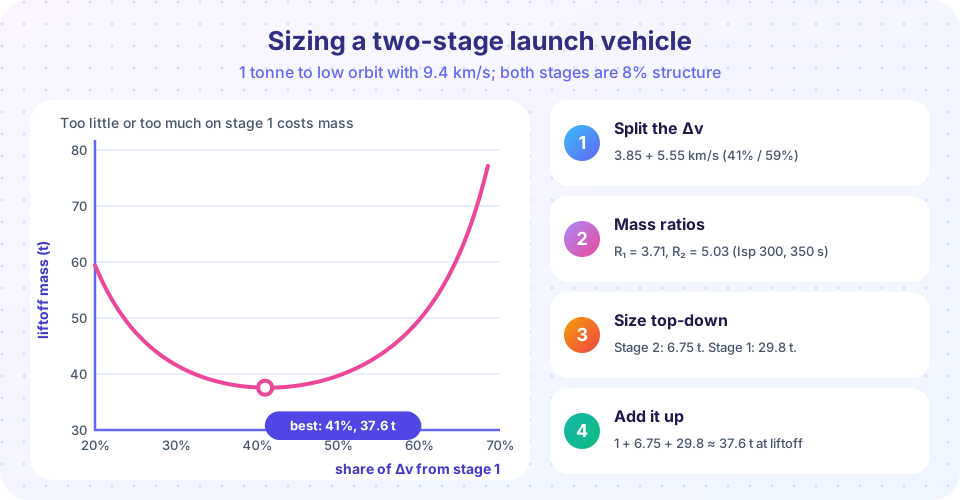
fby trying many values and keeping the smallest liftoff mass.
Derivation of step 3: the mass at start of the burn is m_above + m_stage. At burnout it is m_above + ε m_stage. Their ratio is R, so m_above + m_stage = R (m_above + ε m_stage), which rearranges to the formula.
The answer
For these inputs the minimum liftoff mass is about 37.6 tonnes at f ≈ 0.41 (the exact minimum of the code below is at 0.413, and the bottom of the curve is very flat; the rounded numbers here use 0.41), so stage 1 gives 3.85 km/s and stage 2 gives 5.55 km/s. The two stages have mass ratios 3.71 and 5.03. Stage 2 is about 6.75 t (0.54 t dry, 6.2 t propellant); stage 1 is about 29.8 t (2.4 t dry, 27.4 t propellant). The upper stage gets more Δv than the lower one because its engine is more efficient and it carries less mass.
Compare the single-stage alternative: with ε = 0.08 and Isp = 330 s, the mass ratio needed is 18.3, and R ε = 1.46, which is greater than 1, so a single stage of this quality can never reach orbit. Staging is not a luxury; it is the only way.
From masses to hardware
With O/F = 2.6, 27.4 t of stage-1 propellant is 19.8 t of liquid oxygen (about 17.4 m³) and 7.6 t of kerosene (about 9.4 m³). That is about 27 m³ in total; in a tank 2 m in diameter it would be around 9 m long (tank walls and domes add more). The liftoff weight is 37.6 t × 9.81 = 368 kN; with T/W = 1.3 the first-stage engines must produce about 480 kN at sea level in total.
Sensitivity: what breaks the design?
Small changes to ε have large effects, because the rocket equation is exponential. In the sensitivity run below, increasing ε from 0.08 to 0.10 raises the best liftoff mass from 37.6 t to about 48 t, and reducing both Isp values by 20 s raises it to about 51 t. That is why engineers fight for structural efficiency and engine performance: every gram of dry mass on the upper stage is a gram of payload lost, while the same gram on the first stage costs much less.
Common misconceptions
"Equal Δv per stage is optimal." That is true only when stages are identical. With different Isp and ε, the optimum shifts.
"A sizing result is a design." It is a starting point. Real vehicles add margins, aerodynamic loads, engine-out capability, fairing mass and many other details.
"If the numbers close, it will fly." They only show that the idea is not obviously impossible.
Try it
Press Run (or Ctrl + Enter) to see the result here.
Program input · what you'd type while the program runs
Type the answers before you press Run, one per line. Each time the program reads a line (with input()), it gets the next line from this box.
Press Run (or Ctrl + Enter) to see the result here.
Program input · what you'd type while the program runs
Type the answers before you press Run, one per line. Each time the program reads a line (with input()), it gets the next line from this box.
Your turn
- Add a third stage. How much lighter does the vehicle get for the same payload?
- Switch stage 2 to a hydrogen engine:
Isp = 450 s,ε = 0.12(hydrogen tanks are bulky). Does the best split move? Does the liftoff mass improve? - Find the payload that a 50-tonne liftoff mass can carry with the baseline design, by trying different payload values.
Check your understanding
Quick check · 5 questions
of 5 answered You scored / 5 · perfect!
-
1. In the sizing recipe, in which order do you compute the stage masses?
The mass above a stage is needed to size it, so you start with the payload, size stage 2, then stage 1. -
2. If R·ε ≥ 1 for a stage, then
The denominator 1 − R·ε becomes zero or negative: even a stage with zero payload could not reach that Δv. -
3. Why does the upper stage usually get more Δv than the lower one in the optimum split?
A more efficient engine and a smaller mass make each extra m/s of Δv cheaper on the upper stage. -
4. A stage carries 20 t of propellant with O/F = 2.5. How much oxidizer is that?
Oxidizer fraction = 2.5/3.5 = 0.714, so 20 t × 0.714 ≈ 14.3 t. -
5. A liftoff mass of 40 t with T/W = 1.3 needs first-stage thrust of about (g₀ = 9.81 m/s²)
T = 1.3 × 40,000 × 9.81 ≈ 510 kN.
Summary
- Sizing works from the payload downward:
m_stage = (R − 1) m_above / (1 − R ε). - The best Δv split balances the two stages; here about 41% on stage 1, and liftoff mass is about 37.6 t for 1 t of payload.
- Propellant mass gives tank volume (via densities and mixture ratio) and liftoff weight gives thrust.
- Structure fraction and
Ispdominate the answer; always run sensitivity checks.
Track your progress
Create a free account to tick off lessons and pick up where you left off on any device.
of Aerospace Engineering lessons completed