


















Lesson 21 of 45 · Flight Dynamics and Control
Chapter 4 review: flight dynamics and control
Review static margin, control surfaces, coordinated turns, glide, climb and Breguet range, with a recap table, a mission calculator and a 10-question quiz.
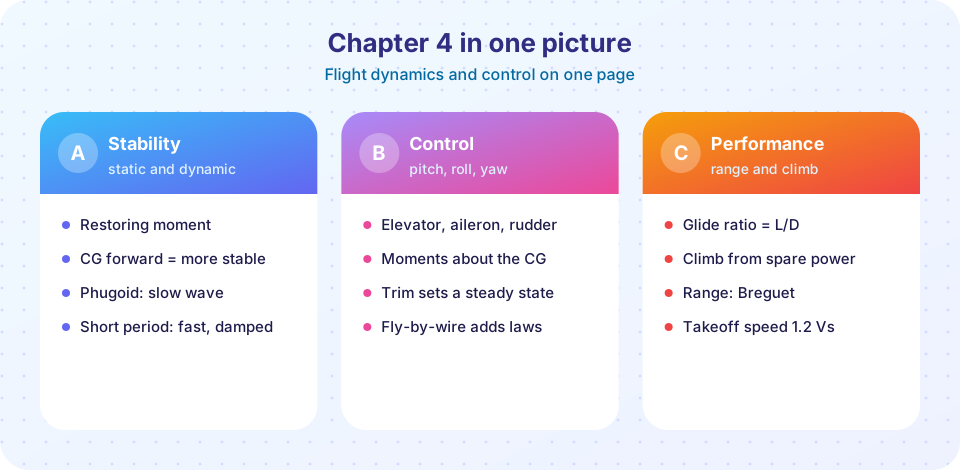
This chapter turned the aircraft from a point into a rigid body that can be stable, steered and flown on a mission. You met the static margin, the control surfaces, the coordinated turn and the performance equations. This review ties them into one picture and checks your recall, then puts a complete mission through a calculator.
What you will learn
- The key results of each lesson in the chapter
- How stability, control and performance limit one another
- A full short mission calculated from take-off to landing
Recap table
| Lesson | Key results |
|---|---|
| Overview | Six degrees of freedom; damped responses |
| Stability basics | Cm_alpha = CL_alpha (h - h_n), SM = h_n - h, phugoid T ≈ 0.453 V |
| Control surfaces | Elevator, aileron, rudder; tan(phi) = V²/(g R), n = 1/cos(phi) |
| Performance | Glide = L/D, RC = (T - D)V/W, Breguet range, takeoff roll ~ W² |
How the three fit together
The center of gravity ties stability and performance together: moving it back reduces the trim drag and so saves fuel, but cuts the static margin. Control power must be enough to trim and to maneuver across the CG range, and the manoeuvre limit is set by the structure (load factor) and the wing (stall). Every airliner is a compromise between these. Fighters shift the compromise toward agility, and fly-by-wire makes that possible.
A quick mental checklist before trusting any flight-dynamics result:
- Is the CG ahead of the neutral point?
- Does the load factor stay below the structural limit?
- Is the speed above the stall speed and below the limit speed?
- Is there enough thrust to climb with the weight on board?
Try it
Press Run (or Ctrl + Enter) to see the result here.
Program input · what you'd type while the program runs
Type the answers before you press Run, one per line. Each time the program reads a line (with input()), it gets the next line from this box.
Press Run (or Ctrl + Enter) to see the console output here.
No output.
Check your understanding
Quick check · 10 questions
of 10 answered You scored / 10 · perfect!
-
1. A positive static margin means the CG is
SM = h_n - h, positive when the CG is forward of the neutral point. -
2. The elevator mainly controls
It creates a pitching moment about the CG. -
3. Which mode has a period of tens of seconds to minutes?
The phugoid is a slow exchange of height and speed. -
4. In a 45-degree banked level turn the load factor is about
n = 1/cos(45 degrees) = 1.414. -
5. Glide distance from 3,000 m with L/D = 18 is
3,000 x 18 = 54,000 m. -
6. Rate of climb is proportional to
RC = (T - D) V / W. -
7. What does adverse yaw come from?
The down-going aileron makes more drag, yawing the nose away from the turn. -
8. Breguet range increases when
R = (V / (g TSFC)) (L/D) ln(W0/W1). -
9. Fly-by-wire envelope protection prevents
The computer limits commands to keep the aircraft within a safe envelope. -
10. Moving the CG aft of the neutral point makes the aircraft
With a negative static margin, Cm_alpha becomes positive.
Summary
- Stability needs the CG ahead of the neutral point; control surfaces create moments about the CG.
- A coordinated turn needs bank:
n = 1/cos(phi),R = V²/(g tan(phi)). - Glide, climb, range and takeoff all follow from
L/D, thrust, weight and TSFC. - Stability, control and performance limit one another, and every design is a compromise.
Track your progress
Create a free account to tick off lessons and pick up where you left off on any device.
of Aerospace Engineering lessons completed