


















Lesson 3 of 45 · Getting Started
The atmosphere and units
Learn the layers of the atmosphere, the International Standard Atmosphere equations, and the units, Mach number and conversions used in aerospace work.
Everything an aircraft does depends on the air around it. Lift, drag, engine thrust and even the speed of sound all change with altitude, temperature and pressure. Because the real atmosphere changes daily, engineers use an agreed reference model, the International Standard Atmosphere (ISA). If two teams in two countries both say "at 10,000 m in ISA conditions", they mean exactly the same air.
This lesson builds that model, step by step, and then sets out the units you will use for the rest of the course.
What you will learn
- The four lower atmospheric layers and why temperature changes between them
- The ISA sea-level values and how to compute temperature, pressure and density up to 20 km
- What Mach number is and how the speed of sound depends on temperature
- Which units aerospace uses, and how to convert knots, feet and flight levels
Key terms
ISA is the International Standard Atmosphere, a fixed reference model of temperature, pressure and density against altitude.
Lapse rate is the rate at which temperature changes with height. In the ISA troposphere it is 6.5 K per kilometer of fall.
Mach number is airspeed divided by the local speed of sound.
Density altitude is the altitude in the ISA that has the same air density as the current conditions.
Layers of the atmosphere
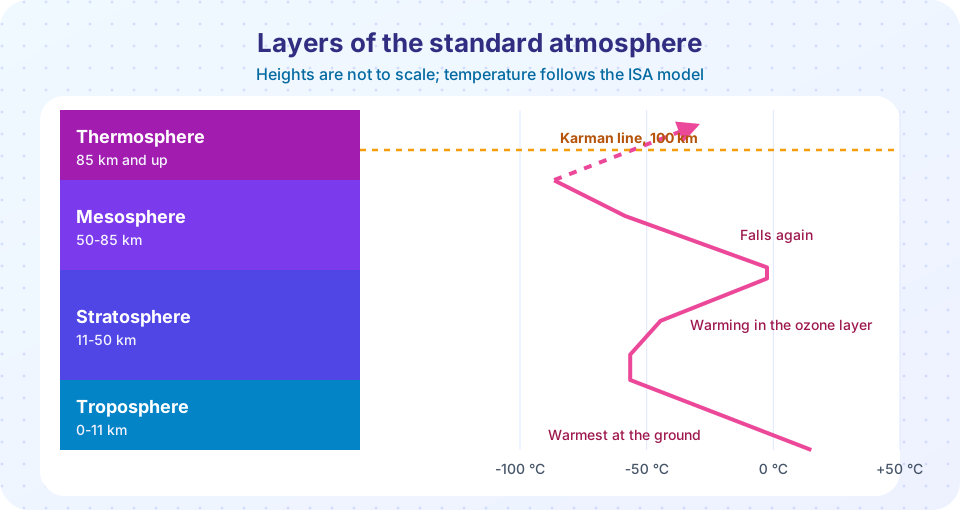
The atmosphere is divided by how temperature behaves.
- Troposphere (0 to 11 km). Where weather happens and airliners spend their climb. Temperature falls steadily with height because the air is warmed from the ground up.
- Stratosphere (11 to 50 km). Temperature is constant at first, then rises, because the ozone layer absorbs ultraviolet light. Airliners cruise in the lower stratosphere because the air is smooth and thin.
- Mesosphere (50 to 85 km). Temperature falls again. Meteors burn up here.
- Thermosphere (above about 85 km). Very thin air heated by solar radiation. The ISS orbits here, about 400 km up.
The Karman line, at 100 km, is the conventional boundary of space. It is a convention, not a physical wall: the air does not suddenly stop.
The ISA model
The ISA fixes these values at sea level:
| Quantity | Symbol | Value |
|---|---|---|
| Temperature | T0 |
288.15 K (15 °C) |
| Pressure | p0 |
101,325 Pa |
| Density | rho0 |
1.225 kg/m³ |
| Speed of sound | a0 |
340.29 m/s |
| Gravity | g0 |
9.80665 m/s² |
| Gas constant of air | R |
287.053 J/(kg·K) |
| Ratio of specific heats | gamma |
1.4 |
Air obeys the ideal gas law p = rho R T, so density follows from pressure and temperature.
Troposphere (0 to 11 km)
Temperature falls linearly: T = T0 - 0.0065 h, with h in meters. Hydrostatic balance (the pressure at a point supports the weight of the air above) combined with the gas law gives:
p = p0 · (T / T0)^5.2559
rho = p / (R T)
Worked example: 5,000 m. T = 288.15 - 32.5 = 255.65 K. The ratio is 255.65 / 288.15 = 0.8872, and 0.8872^5.2559 = 0.5331, so p ≈ 54,020 Pa. Then rho = 54,020 / (287.053 × 255.65) ≈ 0.736 kg/m³. At 5,000 m the air has about 60 percent of the sea-level density, which is why engines and wings produce less at altitude.
Lower stratosphere (11 to 20 km)
At 11 km the temperature is T = 216.65 K and stays constant to 20 km (the layer is isothermal). The pressure at 11 km is 22,632 Pa. Above it, pressure falls exponentially:
p = p11 · exp(-g0 (h - 11,000) / (R · 216.65))
The air in the stratosphere cools no more, but the pressure keeps dropping: one scale height (about 6.3 km at 216.65 K) lowers it by a factor of e.
Speed of sound and Mach number
Sound travels at a = sqrt(gamma R T). It depends only on temperature, not on pressure. At sea level, a = 340.3 m/s (1,225 km/h). At 11 km, a = 295.1 m/s, so the same airspeed represents a higher Mach number up there. Mach number is M = V / a. A cruising airliner at V = 250 m/s at 11 km flies at M ≈ 0.85. Aerodynamics changes character near M = 1, which is why Mach number, not speed alone, matters.
Units and conversions
Aerospace uses the SI system in engineering and calculation, but aviation operations still use older units. You must move between them.
| Quantity | SI | Common aviation unit | Conversion |
|---|---|---|---|
| Length | m | foot (ft) | 1 ft = 0.3048 m |
| Altitude | m | flight level (FL) | FL350 = 35,000 ft ≈ 10,668 m |
| Speed | m/s | knot (kt) | 1 kt = 0.51444 m/s = 1.852 km/h |
| Distance | m | nautical mile (nmi) | 1 nmi = 1,852 m |
| Pressure | Pa | hPa, inHg | 1 hPa = 100 Pa |
| Force | N | pound-force (lbf) | 1 lbf = 4.44822 N |
| Mass | kg | pound (lb) | 1 lb = 0.45359 kg |
Always keep the unit next to every number. A habit that has saved real missions.
Try it
Press Run (or Ctrl + Enter) to see the result here.
Program input · what you'd type while the program runs
Type the answers before you press Run, one per line. Each time the program reads a line (with input()), it gets the next line from this box.
Press Run (or Ctrl + Enter) to see the console output here.
No output.
Common misconceptions
"The atmosphere gets colder all the way up." It does not. It cools in the troposphere, warms in the stratosphere (ozone), cools again in the mesosphere and heats strongly in the thermosphere.
"The ISA is the weather." The ISA is a reference, not a forecast. Real days are warmer or colder; engineers describe that as "ISA plus 15 degrees", for example.
"Higher speed always means higher Mach number." Mach number depends on temperature too. The same speed in colder air is a higher Mach number.
Check your understanding
Quick check · 5 questions
of 5 answered You scored / 5 · perfect!
-
1. What is the ISA sea-level air density?
The ISA defines 1.225 kg/m3 at 15 degrees Celsius and 101,325 Pa. -
2. In the ISA troposphere, how fast does the temperature fall with height?
The lapse rate is 0.0065 K per meter, or 6.5 K per kilometer, up to 11 km. -
3. The speed of sound in air depends mainly on
a = sqrt(gamma R T), so temperature is the only variable. -
4. An airliner flies at 250 m/s where the speed of sound is 295 m/s. Its Mach number is about
M = 250 / 295 is about 0.85. -
5. FL350 means about
A flight level is the pressure altitude in hundreds of feet, so FL350 is 35,000 ft.
Summary
- The atmosphere has four lower layers defined by their temperature behavior; the Karman line at 100 km is the conventional edge of space.
- ISA sea level: 288.15 K, 101,325 Pa, 1.225 kg/m³. In the troposphere the temperature falls 6.5 K/km and
p = p0 (T/T0)^5.2559. - Speed of sound is
sqrt(gamma R T); Mach number isV / a. - Work in SI units and convert operational units (feet, knots, nautical miles) at the edges.
Track your progress
Create a free account to tick off lessons and pick up where you left off on any device.
of Aerospace Engineering lessons completed