


















Lesson 34 of 45 · Spacecraft Systems
Attitude Determination and Control
How spacecraft know and control their orientation: star trackers, gyros, reaction wheels, magnetorquers, slew calculations and a PD control simulation.
A telescope that points at the wrong star sees nothing. A communications satellite whose antenna points a little off Earth drops its link. A spacecraft whose solar arrays face away from the Sun runs out of power. Pointing matters, and in space it is surprisingly hard: there is no ground to push against, no air to push on, and the only tools are internal momentum and a few external effects. The field that handles this is called attitude determination and control (ADCS).
What you will learn
- Define attitude and describe the roll, pitch and yaw axes.
- Name the main sensors and actuators and what each does best.
- Compute the torque and wheel speed for a simple slew maneuver.
- Explain momentum saturation and how it is relieved.
- Simulate a PD attitude controller and see the effect of damping.
Key terms
Attitude: the orientation of a spacecraft's body axes relative to a reference frame. Slew: a deliberate rotation from one pointing direction to another. Reaction wheel: a spinning flywheel whose speed change produces a reaction torque on the body. Momentum saturation: a wheel reaching its maximum speed so it can no longer absorb torque. Damping ratio (ζ): a measure of how quickly oscillations die out in a control loop.
Knowing where you point
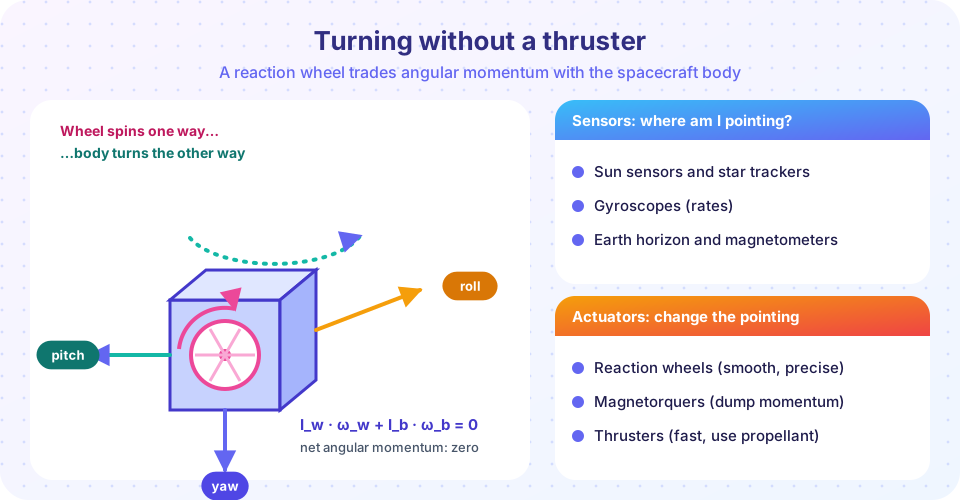
Determination comes first: you cannot control what you cannot measure. Typical sensors:
- Sun sensors give a direction to the Sun, simple and robust, essential for safe mode.
- Star trackers photograph the sky and match star patterns against a catalog. They are the most accurate attitude sensors, reaching arcsecond-class accuracy on good units, but cannot work while blinded by the Sun or Earth.
- Gyroscopes measure rotation rate. Integrated over time they give angle, but they drift.
- Magnetometers measure the local magnetic field; in low Earth orbit a field model turns that into direction information.
- Horizon (Earth) sensors find the Earth's edge in infrared, useful for Earth pointing.
A software filter (often a Kalman filter) blends the fast but drifting gyros with the slower but absolute star trackers. The result is an estimate of attitude and rate good enough for control.
Changing the attitude
An isolated spacecraft conserves angular momentum, so it can only rotate by trading momentum with something inside it, or by getting a torque from outside.
- Reaction wheels are motorized flywheels. Speeding one up gives the body an equal and opposite angular momentum, so it rotates the other way:
I_w ω_w + I_b ω_b = constant. Smooth, precise, no propellant, so most satellites use three or four wheels. - Control moment gyros (CMGs) are spinning wheels tilted by gimbals; the gyroscopic reaction torque is large. The ISS uses them.
- Magnetorquers are coils that push against Earth's magnetic field:
τ = m × B. They are cheap and need no propellant, but only work in low orbit and produce small torques. - Thrusters give fast, large torques but use propellant.
- Passive methods: spin stabilization (a spinning body resists changes in the direction of its axis), gravity-gradient booms, and aerodynamic fins.
External disturbance torques act continuously: the gravity gradient, solar radiation pressure (about 4.6 μPa at 1 AU on an absorbing surface), the magnetic field, and residual air drag in low orbit. Over time they push momentum into the wheels. When a wheel approaches its speed limit it is saturated and must be unloaded by magnetorquers or thrusters, which is called momentum dumping.
Worked example: a 90° slew
A spacecraft with moment of inertia I_b = 100 kg·m² must rotate 90° (π/2 rad) about one axis in 60 s, starting and ending at rest. Use constant acceleration for the first half and constant deceleration for the second:
θ = ½ α (t/2)² × 2   →   α = 4θ / t² = 4 × 1.571 / 3600 = 1.75×10⁻³ rad/s²
torque τ = I α = 0.175 N·m
peak rate ω = α · t/2 = 0.0524 rad/s  (3°/s)
wheel momentum h = I_b ω = 5.24 N·m·s
A wheel with I_w = 0.02 kg·m² would have to reach about 262 rad/s, roughly 2,500 rpm, to store that momentum. If the wheel's maximum is less, the maneuver must be slower. After the slew the wheel keeps spinning at the original speed, because the body's momentum returned to zero when it stopped; only the net change matters.
Closing the loop
A controller compares the measured attitude with the target and commands a torque. The simplest is PD control: torque proportional to the pointing error θ_e and to the rate ω:
τ = −K_p θ_e − K_d ω I θ'' = τ → θ'' + (K_d/I) θ' + (K_p/I) θ = 0
This is a damped oscillator with natural frequency ω_n = √(K_p/I) and damping ratio ζ = K_d / (2 √(K_p I)). With ζ near 0 the spacecraft overshoots and rings; with ζ = 0.7 it settles quickly with little overshoot; with ζ > 1 it is slow but never overshoots. Real controllers add sensor noise filters, wheel torque limits, flexible solar panels that jiggle and wheel friction, so the design task is much richer than this one-axis model.
Common misconceptions
"A spacecraft needs thrusters to turn." Wheels and magnetorquers can turn it without propellant. Thrusters are for large or fast maneuvers and for momentum dumping.
"Zero gravity means no torque." Even in free fall the gravity gradient exerts a torque on a body whose mass is not evenly distributed.
"Spinning wheels make the spacecraft spin." A wheel gaining speed turns the body in the opposite direction by only a small amount, since the body is much heavier; when the wheel stops, the body stops too.
Try it
Press Run (or Ctrl + Enter) to see the result here.
Program input · what you'd type while the program runs
Type the answers before you press Run, one per line. Each time the program reads a line (with input()), it gets the next line from this box.
Press Run (or Ctrl + Enter) to see the result here.
Program input · what you'd type while the program runs
Type the answers before you press Run, one per line. Each time the program reads a line (with input()), it gets the next line from this box.
Check your understanding
Quick check · 5 questions
of 5 answered You scored / 5 · perfect!
-
1. Why can a reaction wheel turn a spacecraft without propellant?
Total angular momentum is conserved, so speeding the wheel up in one direction rotates the body the other way. -
2. A gyroscope measures
Gyros measure rotation rate. Integrating it gives angle, but small errors accumulate as drift. -
3. Momentum saturation occurs when
A saturated wheel cannot absorb more torque. Magnetorquers or thrusters then dump the momentum. -
4. A spacecraft with I = 200 kg·m² must accelerate at 0.002 rad/s². What torque is needed?
τ = I α = 200 × 0.002 = 0.4 N·m. -
5. A PD controller is too lightly damped. What will the spacecraft do?
With a small damping ratio the response rings; ζ around 0.7 gives a quick settle with little overshoot.
Summary
- Attitude is measured by sun sensors, star trackers, gyros and magnetometers, blended by a filter.
- Wheels, CMGs, magnetorquers and thrusters change it; disturbances slowly build wheel momentum that must be dumped.
- A rest-to-rest slew needs torque
4Iθ/t²and peak momentumI·α·t/2. - PD control is a damped oscillator: choose
ω_nfor speed andζ ≈ 0.7for smooth settling.
Track your progress
Create a free account to tick off lessons and pick up where you left off on any device.
of Aerospace Engineering lessons completed