


















Lesson 19 of 45 · Flight Dynamics and Control
Control surfaces
Learn how elevators, ailerons, rudders, flaps, spoilers and trim control an aircraft, how a coordinated turn works, and the basics of fly-by-wire.
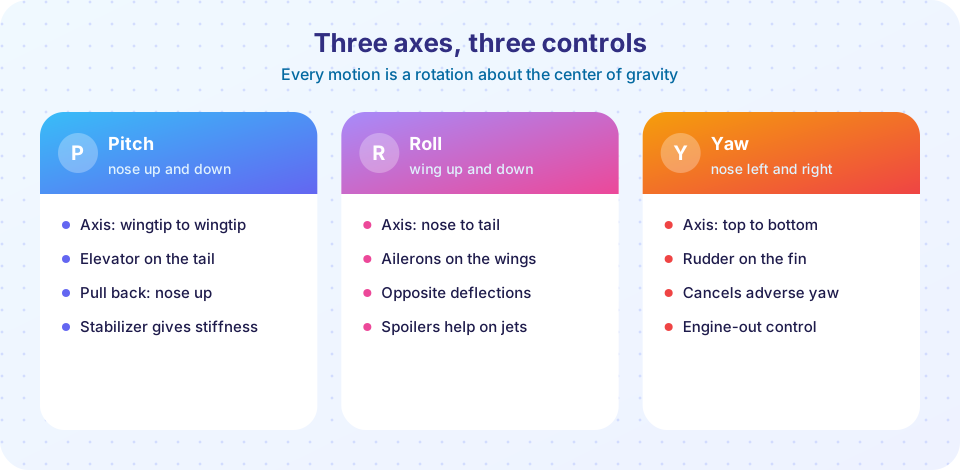
A stable aircraft resists change. To fly, you must overcome that resistance on purpose, in a controlled way. That is the job of the control surfaces: movable parts of the wings and tail that change the aerodynamic forces at the pilot's command. Each one is small, but because it sits far from the CG it creates a large moment, and each rotates the aircraft about one axis.
What you will learn
- What the elevator, ailerons, rudder, flaps, spoilers and trim tabs do
- Why a control surface works by changing local camber and lift
- How a coordinated turn works, with the formulas for radius and turn rate
- What fly-by-wire changes about the pilot's role
Key terms
Elevator is the movable surface on the horizontal tail that controls pitch.
Aileron is the movable surface on each wing's outer trailing edge that controls roll.
Rudder is the movable surface on the vertical tail that controls yaw.
Adverse yaw is the tendency for the nose to yaw opposite the direction of roll when ailerons are used.
Coordinated turn is a turn with no sideslip: the aircraft's nose points along its path.
The primary controls
Elevator (pitch). Pulling the control column back raises the elevator trailing edge, which pushes the tail down and the nose up. Some aircraft use a one-piece stabilator (the whole tailplane moves), and some put a small wing, a canard, in front.
Ailerons (roll). They move in opposite directions: the aileron on one wing goes down (more lift on that side) and the other goes up (less lift). The difference rolls the aircraft. Spoilers, panels that rise on top of the wing, help roll on large jets by dumping lift on one side.
Rudder (yaw). Pushing the left pedal deflects the rudder to the left and swings the nose to the left. It is also used to cancel adverse yaw, for crosswind landings and to keep the aircraft straight when an engine fails.
Each works by changing the camber of an airfoil section, and with it the lift. A deflected control surface does not need to be large to be effective: a tail 20 meters behind the CG turns a few kilonewtons into tens of kilonewton-meters.
Secondary controls
- Flaps are trailing-edge surfaces that increase camber and area, raising
CL_maxfor low-speed flight. Slats do the same at the leading edge. - Spoilers reduce lift and increase drag. In flight they work as speed brakes; on landing they dump lift so that the wheels brake effectively.
- Trim tabs are small tabs on the control surfaces, or a movable stabilizer, that hold a steady setting without the pilot having to keep pushing.
- Thrust vectoring nozzles on some fighters move the engine exhaust to provide pitch and yaw control even at very low speed.
Coordinated turns
To turn, the aircraft must be pushed toward the inside of the turn. The only force available is a horizontal component of lift, so you roll (bank) and let the lift vector tilt. In a coordinated level turn at bank angle phi:
- Vertical:
L cos(phi) = W, so the load factor isn = 1/cos(phi) - Horizontal:
L sin(phi) = W V² / (g R), which givestan(phi) = V² / (g R)
So the turn radius and turn rate are
R = V² / (g tan(phi)) and omega = g tan(phi) / V
Worked example. An airliner at V = 230 m/s banks 25 degrees. tan 25° = 0.4663, so R = 230² / (9.80665 × 0.4663) = 11,570 m and omega = 9.80665 × 0.4663 / 230 = 0.0199 rad/s = 1.14 degrees per second. A full circle takes more than five minutes. In contrast, a light aircraft at 50 m/s with a 45-degree bank: R = 2,500 / 9.80665 = 255 m.
A standard-rate turn is 3 degrees per second, a full circle in 2 minutes, and a common instrument-flying reference. At 100 m/s it needs tan(phi) = 0.05236 × 100 / 9.80665 = 0.534, a bank of 28 degrees. Notice the speed dependence: the faster you go, the steeper the bank you need for the same turn rate.
Adverse yaw
The aileron that goes down makes more lift and also more drag. The wing rising gets more drag, and so the nose yaws away from the turn. The cures include rudder input, differential ailerons (the up-going one moves further) and Frise ailerons with a protruding leading edge that adds drag on the other side.
Fly-by-wire
On older aircraft, cables and hydraulics connect the pilot's controls to the surfaces. In fly-by-wire systems, the pilot's inputs go to a computer, which commands electric or hydraulic actuators. The Airbus A320 (service from 1988) was the first airliner with digital fly-by-wire. The computers add three things:
- Stability augmentation. They damp oscillations, so even a lightly damped airframe feels well behaved.
- Envelope protection. They limit angle of attack, load factor and bank so that the pilot cannot overstress the aircraft.
- Relaxed stability. Fighters can be built unstable for agility, because the computer corrects at a rate faster than a human can.
Fly-by-wire also saves weight, because cables, pulleys and heavy hydraulic linkages disappear. In return the software must be developed with extreme care, with multiple redundant computers.
Try it
Press Run (or Ctrl + Enter) to see the result here.
Program input · what you'd type while the program runs
Type the answers before you press Run, one per line. Each time the program reads a line (with input()), it gets the next line from this box.
Press Run (or Ctrl + Enter) to see the console output here.
No output.
Common misconceptions
"The rudder turns the aircraft." In a normal turn the aircraft banks with the ailerons and lift does the turning. The rudder keeps the nose aligned, preventing sideslip.
"Pulling back on the stick always climbs." In a steep turn pulling back tightens the turn instead. Climbing needs more thrust or a lower bank angle.
"Fly-by-wire flies itself." It limits and smooths the pilot's commands but the pilot still decides what to do.
Check your understanding
Quick check · 5 questions
of 5 answered You scored / 5 · perfect!
-
1. Which control surface mainly changes pitch?
The elevator on the horizontal tail creates a pitching moment about the CG. -
2. In a coordinated level turn the load factor is
L cos(phi) = W, so n = L/W = 1/cos(phi). -
3. An aircraft at 100 m/s banks 30 degrees. Its turn radius is about
R = V^2 / (g tan phi) = 10,000 / (9.81 x 0.577) = 1,766 m. -
4. What is adverse yaw?
The down-going aileron adds drag on the rising wing, yawing the nose away from the turn. -
5. Which is a function of envelope protection in fly-by-wire?
Computers prevent commands that would exceed structural or aerodynamic limits.
Summary
- The elevator controls pitch, the ailerons roll and the rudder yaw; flaps, slats, spoilers and trim tabs are secondary controls.
- A coordinated turn needs bank:
tan(phi) = V²/(g R),n = 1/cos(phi),omega = g tan(phi)/V. - Adverse yaw is countered by rudder, differential or Frise ailerons.
- Fly-by-wire adds stability augmentation, envelope protection and allows relaxed-stability designs.
Next: Aircraft performance
Track your progress
Create a free account to tick off lessons and pick up where you left off on any device.
of Aerospace Engineering lessons completed