


















Lesson 36 of 45 · Spacecraft Systems
Chapter 7 Review: Spacecraft Systems on One Page
One-page recap of spacecraft subsystems: power and eclipse sizing, thermal balance, attitude control and the link budget, with a design check calculator and a quiz.
A spacecraft works only if all its subsystems work together. The four you studied in depth each ask a different question: where does the electricity come from (power), where does the heat go (thermal), which way are we pointing (attitude), and can we be heard (communications). The numbers are connected: pointing sets how much sunlight the arrays collect and whether the antenna sees Earth; power runs the radio; the radio's waste heat loads the thermal system. This review puts the formulas side by side and lets you check a complete small design.
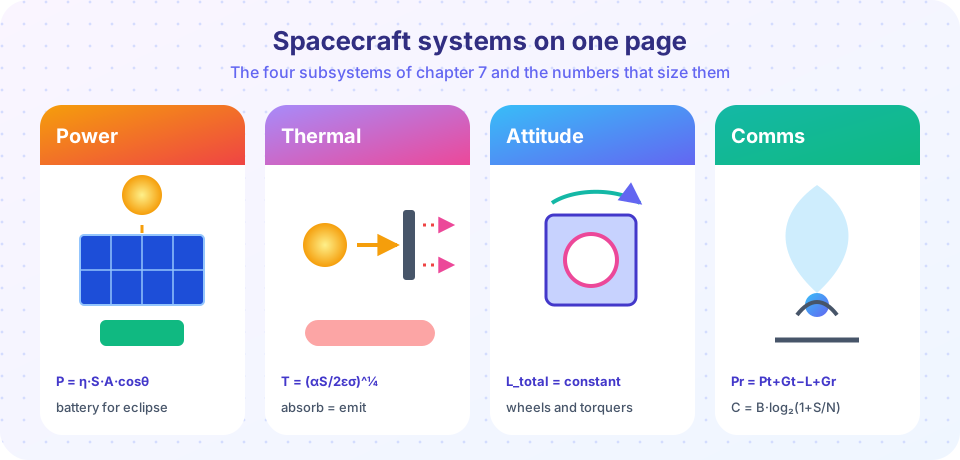
The chapter in a table
| Subsystem | Key relation | Example number |
|---|---|---|
| Power | P = η S A cos θ; battery = eclipse energy / (η · DoD) |
500 W load, 35 min eclipse: about 1,080 Wh at 30% DoD |
| Thermal | α S A_sun + Q = ε σ A_rad T⁴ |
plate facing the Sun, α = ε: about 331 K |
| Attitude | I_w ω_w + I_b ω_b = const; τ = I α |
90° in 60 s, I = 100 kg·m²: 0.175 N·m |
| Control loop | ω_n = √(K_p/I), ζ = K_d / (2√(K_p I)) |
aim for ζ about 0.7 |
| Link | Pr = Pt + Gt − L + Gr |
GEO, 12 GHz: path loss 205.1 dB, received −117 dBW |
| Capacity | C = B log₂(1 + SNR) |
36 MHz at 14 dB SNR: about 170 Mbit/s upper bound |
How the subsystems interact
- Pointing and power. An array only produces
cos θof its full power. Poor pointing wastes array area (and mass). - Power and heat. Every watt consumed becomes heat. A radio transmitting 20 W with 50% efficiency dissipates about 20 W of heat; the thermal design must account for it.
- Heat and batteries. Batteries charge and last best near room temperature, so heaters draw power in eclipse, which enlarges the battery.
- Comms and pointing. A narrow-beam, high-gain antenna needs very accurate pointing. A fixed low-gain antenna is forgiving but slow.
- Everything and mass. Every kilogram added to any subsystem costs launch mass, which was the whole point of the last chapter.
Common misconceptions
"Subsystems can be designed one by one." They are coupled; a change in one moves the budgets of the others.
"A bigger battery always helps." It adds mass and, if kept at the wrong temperature, can shorten its own life.
"A link that closes on paper will work in practice." Always carry margin (often several dB) for pointing loss, rain, equipment aging and calculation uncertainty.
Try it
Press Run (or Ctrl + Enter) to see the result here.
Program input · what you'd type while the program runs
Type the answers before you press Run, one per line. Each time the program reads a line (with input()), it gets the next line from this box.
Press Run (or Ctrl + Enter) to see the result here.
Program input · what you'd type while the program runs
Type the answers before you press Run, one per line. Each time the program reads a line (with input()), it gets the next line from this box.
Check your understanding
Quick check · 10 questions
of 10 answered You scored / 10 · perfect!
-
1. A satellite needs 400 W continuously with 30 min eclipse in a 90 min orbit. Roughly how much energy must the battery supply each eclipse?
400 W × 0.5 h = 200 Wh (before dividing by efficiency and depth of discharge). -
2. A shallow depth of discharge for a battery mainly improves
Using only part of the capacity each cycle lets the battery survive many more cycles. -
3. A spacecraft surface with low α and high ε in sunlight will be
It absorbs less sunlight yet radiates well, so its equilibrium temperature is lower. -
4. Why do star trackers and gyroscopes complement each other?
A filter combines fast but drifting rates with slower but absolute star-based attitude. -
5. Which damping ratio usually gives a quick settle with little overshoot?
ζ ≈ 0.7 is the classic compromise between speed and overshoot. -
6. The free-space path loss increases by about how much when the frequency doubles (same distance)?
L = 20 log₁₀(4πd f / c); doubling f adds 20 log₁₀ 2 ≈ 6 dB. -
7. A signal travels 384,400 km to the Moon. The one-way light time is about
384,400 km / 299,792 km/s ≈ 1.28 s. -
8. What does a reaction wheel NOT need?
Wheels use only electricity; they trade momentum with the body instead of expelling mass. -
9. A link budget has Pr = −120 dBW and noise = −135 dBW. The SNR is
SNR (dB) = signal − noise = −120 − (−135) = 15 dB. -
10. Why does thermal design matter for the radio transmitter?
Waste heat from amplifiers and electronics must be conducted to a radiator and radiated away.
Summary
- Power, thermal, attitude and communications are linked by budgets in mass, power, heat and decibels.
- Size arrays for end-of-life, batteries for shallow discharge, radiators for equilibrium, wheels for momentum, and links with margin.
- Spacecraft cannot be repaired, so redundancy, margins and fault protection replace maintenance.
Track your progress
Create a free account to tick off lessons and pick up where you left off on any device.
of Aerospace Engineering lessons completed