


















Lesson 43 of 45 · Projects and Practice
Glossary of Orbits, Rockets and Spacecraft
A plain-language glossary of about 50 key terms from orbital mechanics, rocket propulsion, spacecraft systems and mission design, with formulas, units and links to the lessons.
Every field has its own words, and aerospace has many. This glossary collects the terms from chapters 5 to 8 in one place, grouped by topic, with the formula or unit where one exists. Use it for revision, and try the flashcards at the end to test yourself.
What you will learn
- Recall the precise meaning of the main terms of the course.
- Link each term to the formula or lesson that uses it.
- Distinguish look-alike terms such as thrust and impulse, or apoapsis and aphelion.
- Test yourself with flashcards.
Key terms
Glossary: an alphabetical or thematic list of terms with definitions.
Symbol: the letter used for a quantity in equations, such as μ or Isp.
Unit: the measure attached to a number, such as m/s or seconds.
Analogy: a comparison that helps you remember a term; use them, but check the definition.
Orbits
| Term | Meaning |
|---|---|
| Altitude | Height above the surface; orbital radius = body radius + altitude. |
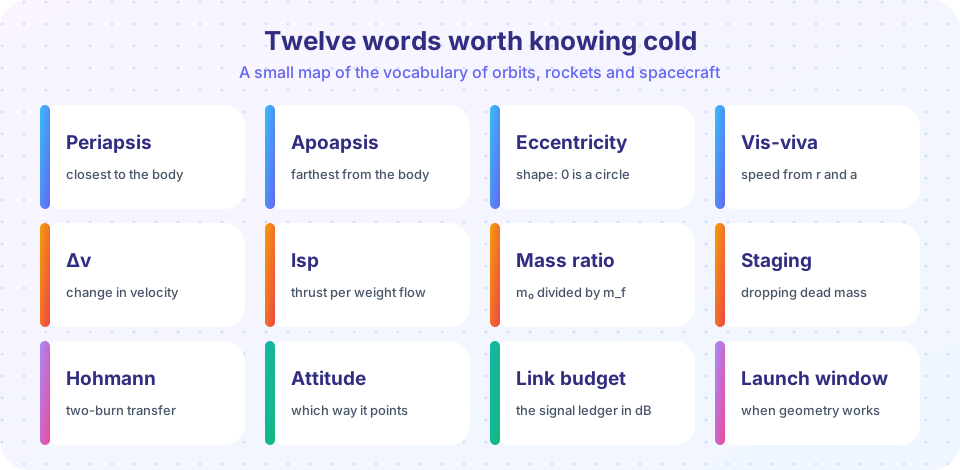
| Apoapsis | The farthest point of an orbit from the central body (apogee for Earth, aphelion for the Sun). |
| Periapsis | The closest point of an orbit (perigee for Earth, perihelion for the Sun). |
Semi-major axis (a) |
Half the long diameter of an ellipse; sets the period and the energy. |
Eccentricity (e) |
Shape number: 0 is a circle, between 0 and 1 an ellipse, 1 a parabola, above 1 a hyperbola. |
Inclination (i) |
Tilt of the orbit plane relative to the equator. |
Period (T) |
Time for one revolution: T = 2π√(a³/μ). |
Gravitational parameter (μ) |
G·M of the central body; for Earth 3.986×10¹⁴ m³/s². |
Specific orbital energy (ε) |
Energy per unit mass, v²/2 − μ/r = −μ/(2a). |
| Vis-viva equation | v² = μ(2/r − 1/a): orbital speed from position and orbit size. |
| Circular speed | √(μ/r), the speed of a circular orbit of radius r. |
| Escape speed | √(2μ/r), the least speed needed to leave a body's gravity. |
Hyperbolic excess speed (v∞) |
The speed an escaping body still has far from the planet. |
| Hohmann transfer | A two-burn transfer along an ellipse that touches two circular orbits. |
| Bi-elliptic transfer | A three-burn transfer through a distant apoapsis; cheaper for very large radius ratios. |
| Phasing | Adjusting position along an orbit so you arrive at the same place as a target. |
| Sidereal day | One rotation of Earth relative to the stars: 23 h 56 min 4 s. |
| Geostationary orbit (GEO) | Equatorial circular orbit with a one-sidereal-day period, at 35,786 km altitude. |
| Sun-synchronous orbit | A near-polar orbit whose plane turns once per year, keeping the local solar time constant. |
| Perturbation | A small force (non-spherical gravity, drag, third bodies, sunlight) that makes a real orbit differ from a two-body one. |
Rockets
| Term | Meaning |
|---|---|
Thrust (F) |
The force from the engine: ṁ vₑ + (pₑ − pₐ) Aₑ; unit newton. |
| Propellant | The fuel and oxidizer (or single material) that a rocket expels. |
Exhaust velocity (vₑ) |
Speed of the exhaust relative to the rocket. |
Specific impulse (Isp) |
Thrust per unit weight flow, F/(ṁ g₀), in seconds; the efficiency of an engine. |
Delta-v (Δv) |
The total change in velocity a vehicle can produce. |
| Rocket equation | Δv = vₑ ln(m₀/m_f) (Tsiolkovsky). |
| Mass ratio | m₀/m_f, initial mass over burnout mass. |
Structure fraction (ε) |
Stage dry mass divided by dry mass plus propellant. |
| Payload fraction | Payload mass divided by liftoff mass. |
| Stage | A self-contained part of a rocket with its own tanks and engines. |
| Staging | Dropping empty stages so later burns accelerate less mass. |
| Thrust-to-weight ratio | Thrust divided by weight; must exceed 1 at liftoff. |
| Gravity loss | Speed lost because the engine must work against gravity during the climb. |
| De Laval nozzle | A converging-diverging nozzle that accelerates the flow to supersonic speed. |
| Throat | The narrowest section of a nozzle, where the flow is Mach 1. |
| Expansion ratio | Exit area divided by throat area, Aₑ/A_t. |
| Chamber pressure | Pressure inside the combustion chamber. |
| Mixture ratio (O/F) | Oxidizer mass flow divided by fuel mass flow. |
| Oberth effect | A burn adds more energy when the vehicle is moving fast, such as at periapsis. |
Spacecraft
| Term | Meaning |
|---|---|
| Payload | The instruments or equipment that perform the mission. |
| Bus | Everything that supports the payload: power, thermal, attitude, communications, computing, structure. |
Solar constant (S) |
Sunlight power per square meter at Earth's distance: 1361 W/m². |
| Depth of discharge (DoD) | The fraction of a battery's capacity used each cycle. |
| RTG | Radioisotope thermoelectric generator: electricity from the heat of a decaying isotope. |
Absorptivity (α) and emissivity (ε) |
How much sunlight a surface absorbs, and how well it radiates infrared. |
| Equilibrium temperature | The temperature at which absorbed power equals radiated power. |
| Attitude | The orientation of the spacecraft in space. |
| Reaction wheel | A flywheel whose speed change turns the spacecraft the other way. |
| Momentum saturation | A wheel reaching its maximum speed, so it can absorb no more torque. |
| Slew | A planned change of pointing direction. |
| Link budget | Accounting of gains and losses, in decibels, from transmitter to receiver. |
| Free-space path loss | Spreading loss of a radio wave, 20 log₁₀(4πd/λ) in dB. |
| Antenna gain | Ratio of power sent in the best direction to that of an ideal point source, in dBi. |
| Shannon capacity | B log₂(1 + SNR), the maximum error-free data rate. |
| Doppler shift | Change in received frequency caused by relative motion, Δf = f v_r/c. |
| Safe mode | A minimal survival state entered automatically after a fault. |
Mission design
| Term | Meaning |
|---|---|
| Requirement | A verifiable statement of what the system must do. |
| Trade study | A weighted comparison of options. |
| PDR and CDR | Preliminary and critical design reviews, at the ends of phases B and C. |
| Delta-v budget | The list of all maneuvers in a mission, with margin. |
| Margin | Reserve held in a budget against surprises. |
| Synodic period | Time for two planets to return to the same relative position, 1/S = abs(1/T₁ − 1/T₂). |
| Phase angle | Angle at the Sun between the departure and target planets at launch. |
| Launch window | The period of dates on which a launch can reach its target. |
| Gravity assist | A planetary flyby that changes the heliocentric velocity without propellant. |
| Patched conics | A method that joins two-body orbits at the boundaries of planets' gravity spheres. |
| Aerobraking | Using the thin upper atmosphere over many passes to lower an orbit without propellant. |
Look-alike terms
Thrust vs. impulse: thrust is a force (newtons); total impulse is thrust integrated over time (newton-seconds). Specific impulse is thrust per unit weight flow (seconds).
Speed vs. delta-v: speed is how fast you are going; delta-v is the change you can still make, the "fuel gauge".
Apoapsis vs. aphelion: general term vs. the Sun-specific word. Each central body has its own pair (apogee/perigee for Earth).
Orbital period vs. rotation period: the first is the time to circle the central body; the second is how long the body takes to spin once.
Try it
Press Run (or Ctrl + Enter) to see the result here.
Program input · what you'd type while the program runs
Type the answers before you press Run, one per line. Each time the program reads a line (with input()), it gets the next line from this box.
Check your understanding
Quick check · 5 questions
of 5 answered You scored / 5 · perfect!
-
1. Which pair of terms describes the closest and farthest points of an orbit around Earth?
Perigee and apogee are the Earth-specific words; perihelion and aphelion refer to the Sun. -
2. What does specific impulse measure?
Isp = F/(ṁ g₀). It is an efficiency measure, not a duration. -
3. A margin in a budget is
Margins protect a design from underestimates and surprises. -
4. What does the throat of a nozzle do?
The narrowest section chokes the flow at the speed of sound. -
5. Which term means the orientation of a spacecraft in space?
Attitude is orientation; inclination is the tilt of an orbit plane.
Summary
- The glossary groups terms by orbits, rockets, spacecraft and mission design.
- Many terms have a formula or unit attached; learn them as a pair.
- Look-alike terms (thrust and impulse, apoapsis and aphelion) differ in meaning or scope.
Track your progress
Create a free account to tick off lessons and pick up where you left off on any device.
of Aerospace Engineering lessons completed