


















Lesson 44 of 45 · Projects and Practice
Cheat Sheet: The One-Page Formula Sheet
A one-page cheat sheet of the key equations from orbital mechanics, rocket propulsion and spacecraft design, with constants, units, worked numbers and a calculator.
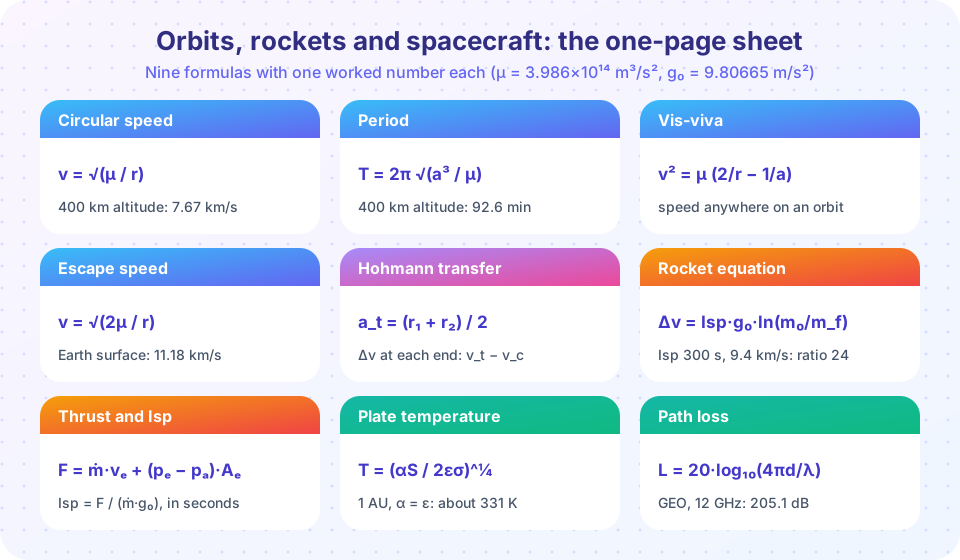
This page is the quick reference for chapters 5 to 8. It has the nine formulas you will use most, the constants and unit conversions, a short guide for picking the right formula, and a calculator that applies them. Keep it open when you work through problems; the goal is that you understand where each formula comes from, so the sheet only reminds you.
What you will learn
- Find the right equation for an orbit, rocket or spacecraft question quickly.
- Use consistent units and the correct constants.
- Check answers with known benchmark numbers.
- Apply the formulas in a calculator.
Key terms
Benchmark number: a well-known result you can use to check a calculation, such as 7.67 km/s at 400 km.
SI units: meters, kilograms, seconds; always convert km to m before using μ in m³/s².
Order of magnitude: a rough size check, such as expecting a LEO period near 90 minutes.
Dimensional analysis: checking that both sides of an equation have the same units.
Constants and conversions
| Quantity | Value |
|---|---|
Earth μ |
3.986004418×10¹⁴ m³/s² |
| Earth equatorial radius | 6,378.137 km |
Standard gravity g₀ |
9.80665 m/s² |
Sun μ |
1.32712440018×10²⁰ m³/s² |
| Astronomical unit | 1.495978707×10¹¹ m |
| Solar constant at 1 AU | 1361 W/m² |
Stefan-Boltzmann σ |
5.670374×10⁻⁸ W/(m²·K⁴) |
Boltzmann k |
1.380649×10⁻²³ J/K |
Speed of light c |
299,792,458 m/s |
| Sidereal day | 86,164.09 s |
| GEO radius | 42,164 km (altitude 35,786 km) |
Which formula do I need?
- "How fast is it going?" Circular orbit:
√(μ/r). Any point of any orbit: vis-vivav² = μ(2/r − 1/a). - "How long is one orbit?"
T = 2π√(a³/μ); for a circle,a = r. - "Can it escape?" Compare speed with
√(2μ/r), or check whetherε = v²/2 − μ/ris positive. - "What does it cost to change orbit?" Hohmann: compute both transfer speeds with vis-viva and subtract the circular speeds; plane change
2v sin(Δi/2). - "How much propellant?"
Δv = Isp g₀ ln(m₀/m_f); invert for the mass ratio. For several stages, add the stage Δv values. - "How big a nozzle or engine?" Thrust
F = ṁ vₑ + (pₑ − pₐ) Aₑ;Isp = F/(ṁ g₀). - "How hot will it get?" Balance
α S A_sun + Q = ε σ A_rad T⁴. - "Does the radio link close?"
Pr = Pt + Gt − L + Gr(dB); compare with noisek T B; limitC = B log₂(1 + SNR). - "When do we go?" Synodic period
1/S = abs(1/T₁ − 1/T₂); phase angle180° − n₂ t_transfer.
Benchmark numbers
| Situation | Value |
|---|---|
| Circular speed at 400 km altitude | 7.67 km/s, period 92.6 min |
| Escape speed at Earth's surface | 11.18 km/s |
| GPS orbit (26,560 km radius) | 11.97 h period |
| LEO to GEO by Hohmann | 3.89 km/s, 5.28 h |
| Mass ratio for 9.4 km/s at Isp 300 s | 24.4 (96% propellant) |
| Earth to Mars Hohmann | 259 days, v∞ = 2.94 km/s, 3.61 km/s from LEO |
| Free-space loss to GEO at 12 GHz | 205.1 dB |
| Equilibrium of a flat plate at 1 AU | about 331 K |
Common misconceptions
"Units will sort themselves out." Use meters in μ formulas; a stray kilometer gives an answer off by a factor of a thousand or its square root.
"One formula fits all orbits." Circular speed formulas are only for circles; use vis-viva whenever the orbit is not circular.
"Round numbers are exact." 9.4 km/s to orbit and 3.9 km/s to GEO are typical values with real-mission variations.
Try it
Press Run (or Ctrl + Enter) to see the result here.
Program input · what you'd type while the program runs
Type the answers before you press Run, one per line. Each time the program reads a line (with input()), it gets the next line from this box.
Check your understanding
Quick check · 5 questions
of 5 answered You scored / 5 · perfect!
-
1. Which formula gives the speed at any point of an elliptical orbit?
Vis-viva works for every conic. √(μ/r) is only for circular orbits and √(2μ/r) only for the parabolic escape case. -
2. You are given a distance in kilometers and want to use μ = 3.986×10¹⁴ m³/s². What must you do?
μ is in m³/s², so radii must be in meters. -
3. How many sidereal seconds are in one sidereal day?
A sidereal day is 23 h 56 min 4 s, about 86,164 seconds. -
4. A mass ratio of 24.4 at Isp 300 s corresponds to a Δv of about
Δv = 300 × 9.80665 × ln 24.4 ≈ 9.4 km/s. -
5. Which benchmark is correct for the circular speed at 400 km altitude?
7.67 km/s with a period near 92.6 minutes.
Summary
- Nine formulas cover most of chapters 5 to 8: circular speed, period, vis-viva, escape, Hohmann, rocket equation, thrust and Isp, plate temperature and path loss.
- Always use SI base units with the constants, then convert for display.
- Check your answers against benchmark numbers before you trust them.
Track your progress
Create a free account to tick off lessons and pick up where you left off on any device.
of Aerospace Engineering lessons completed