


















Lesson 12 of 45 · Aircraft Structures and Propulsion
Lift and airfoils
Learn airfoil geometry, NACA 4-digit codes, how pressure and downwash create lift, the lift curve, thin-airfoil theory, finite-wing corrections, stall and flaps.
A wing is a surprisingly subtle machine. Cut it open and you see only a smooth, curved shape. Yet from that shape comes a force large enough to hold a 70-tonne airliner in the air. In this lesson you learn the vocabulary of airfoils, the physical reasons wings lift, the lift curve and the limit of stall, and then you build and test an airfoil in code.
What you will learn
- The names of the parts of an airfoil and what a NACA 4-digit code means
- Why a wing produces lift, from pressure, downwash and circulation viewpoints
- The lift curve: slope, zero-lift angle and stall
- How finite span, flaps and slats modify the picture
Key terms
Chord is the straight line from the leading edge to the trailing edge, of length c.
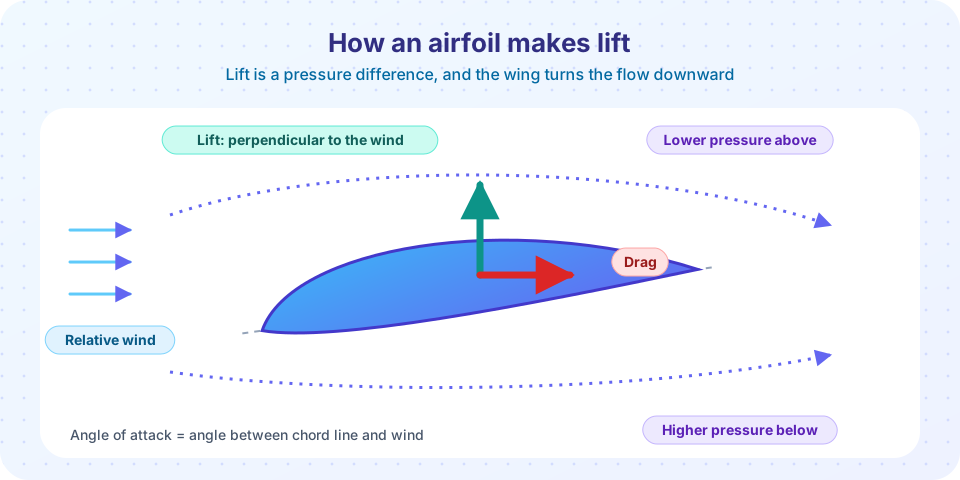
Angle of attack (alpha) is the angle between the chord line and the oncoming air.
Camber is the curvature of the mean line midway between the upper and lower surfaces.
Aspect ratio (AR) is the wingspan squared divided by the wing area, b² / S.
Stall is the loss of lift when airflow separates from the upper surface.
Airfoil anatomy
Take a slice of a wing along the flight direction and you get an airfoil. Its parts:
- Leading edge: the rounded front.
- Trailing edge: the sharp rear.
- Chord line: straight line from front to back.
- Mean camber line: the line halfway between the upper and lower surfaces.
- Thickness: distance between the surfaces, usually quoted as a percentage of chord.
The NACA (the predecessor of NASA) published families of shapes with simple codes. In a 4-digit series, NACA 2412 means: maximum camber 2 percent of chord, located at 40 percent of the chord from the leading edge, and maximum thickness 12 percent of chord. NACA 0012 is symmetric (no camber) and 12 percent thick. Many light aircraft, such as the Cessna 172, use airfoils from this family.
Why does a wing lift?
There are three correct ways to describe the same force, and they agree.
- Pressure. The airflow over the upper surface speeds up and its pressure falls; below, the pressure is higher. Integrated over the area, the pressure difference is the lift. Bernoulli's equation relates the speed and pressure changes, but it does not by itself tell you why the air speeds up.
- Momentum. The wing turns a stream of air downward. By Newton's second law the wing gives the air downward momentum; by the third law the air pushes the wing up. The lift equals the rate at which downward momentum is given to the air.
- Circulation. Mathematically the flow around a wing equals a uniform stream plus a circulating flow, with circulation
Γ. The Kutta-Joukowski theorem says lift per unit span isrho V Γ. The sharp trailing edge fixes the circulation so the flow leaves smoothly (the Kutta condition).
The popular "equal transit time" explanation, that air must meet again at the trailing edge, is false. Air over the top actually arrives early.
The lift curve
For small angles, the lift coefficient grows linearly with angle of attack:
CL = a0 (alpha - alpha0)
a0is the lift-curve slope. Thin-airfoil theory givesa0 = 2πper radian, which is about 0.110 per degree.alpha0is the zero-lift angle, the angle at whichCL = 0. A symmetric airfoil hasalpha0 = 0. A cambered airfoil has a negative value: NACA 2412 has about -2 degrees, so it still makes lift when its chord is parallel to the wind.
At some angle, typically 12 to 16 degrees for a clean wing, the flow can no longer follow the upper surface. It separates, the lift drops and drag rises: the stall. The peak value is CL_max; for NACA 2412 at typical test conditions it is about 1.6.
Finite wings
A real wing has a finite span, and air spills from the high-pressure underside around the tips. This weakens the lift slope. For an elliptical wing,
a = a0 / (1 + a0 / (π AR))
(with angles in radians). For AR = 8 this reduces the slope from 6.28 to about 5.03 per radian. A larger aspect ratio keeps more of the 2D performance, which is why gliders have long, narrow wings.
High-lift devices
At takeoff and landing the aircraft needs a large CL_max to keep the speed low. Flaps at the trailing edge increase camber; slats at the leading edge let the wing reach higher angles of attack before stalling. Together they can raise CL_max from about 1.4 to above 2.5, or even 3 on large airliners, at the cost of more drag.
Try it
Press Run (or Ctrl + Enter) to see the result here.
Program input · what you'd type while the program runs
Type the answers before you press Run, one per line. Each time the program reads a line (with input()), it gets the next line from this box.
Press Run (or Ctrl + Enter) to see the console output here.
No output.
Common misconceptions
"Wings lift only because of Bernoulli." Bernoulli's equation relates pressure and speed, but the lift is also, equally, a momentum change of the air. Using only one view hides part of the story.
"A stall means the engine stopped." An aerodynamic stall is about the wing's angle of attack, not about speed or engine power. A wing can stall at any speed if the angle is too high.
"Symmetric wings cannot lift." They produce lift at any positive angle of attack; they just make none at zero angle.
Check your understanding
Quick check · 5 questions
of 5 answered You scored / 5 · perfect!
-
1. NACA 2412 has a maximum thickness of
The last two digits give thickness as a percentage of the chord. -
2. Thin-airfoil theory predicts a lift-curve slope of about
2 pi per radian is about 0.11 per degree. -
3. Why does a longer, thinner wing keep more of the ideal lift slope?
High aspect ratio reduces the tip effect, so the finite wing approaches the 2D value. -
4. What does a flap do?
Flaps add camber, raising lift at a given angle and the maximum lift coefficient. -
5. Stall occurs when
Separated flow cannot sustain the low pressure over the top.
Summary
- An airfoil is described by chord, camber and thickness; NACA 2412 means 2% camber at 40% chord and 12% thickness.
- Lift can be explained by pressure, by downward momentum of the air or by circulation; all agree.
- Below stall,
CL = a0 (alpha - alpha0)witha0 = 2πper radian; finite span lowers the slope. - Flaps and slats raise
CL_maxfor takeoff and landing.
Next: Drag and the drag polar
Track your progress
Create a free account to tick off lessons and pick up where you left off on any device.
of Aerospace Engineering lessons completed