


















Lesson 39 of 45 · Mission Design
Gravity Assists: Borrowing Speed from Planets
Understand how a gravity assist changes a spacecraft's speed without fuel: hyperbolic flybys, vector addition, deflection angle and worked Earth and Jupiter examples.
To reach Saturn directly with a rocket you would need a launcher far larger than anything built for the job. Yet Cassini reached Saturn in 2004 on a Titan-class launcher. The secret was not a bigger rocket but a path that swung past Venus twice, then Earth, then Jupiter. Each passage gave the spacecraft a free change in speed, taken from the planet's motion around the Sun. This is the gravity assist (or slingshot): the most valuable trick in the mission designer's toolbox.
What you will learn
- Explain why a flyby changes speed in the Sun's frame but not the planet's frame.
- Compute the deflection angle from the periapsis radius and
v∞. - Use vector addition to find the speed after a flyby.
- Describe how flybys can speed up, slow down or bend a trajectory.
- Recognize famous missions that depended on gravity assists.
Key terms
Flyby: a close pass of a planet or moon that bends the trajectory. v∞ (v-infinity): the spacecraft's speed relative to the planet far from it. Deflection angle (δ): the angle by which the relative velocity vector is turned. Heliocentric: measured relative to the Sun. Periapsis radius (r_p): the closest approach distance, measured from the planet's center.
Two frames, one flyby
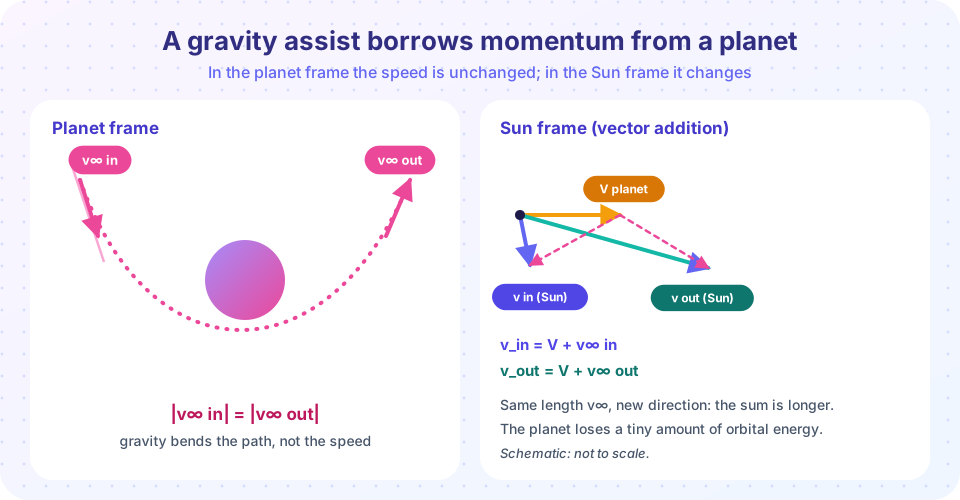
Stand on the planet. A spacecraft comes in from far away with relative speed v∞, curves around the planet on a hyperbola, and leaves with the same speed v∞ (energy is conserved in that frame) but in a different direction. The bend is the deflection angle δ. Gravity cannot add speed relative to the planet.
Now step back to a frame fixed on the Sun. The planet is moving with velocity V (about 29.8 km/s for Earth, 13.1 km/s for Jupiter). The spacecraft's heliocentric velocity is the vector sum of the planet's velocity and its velocity relative to the planet:
v_in  = V + v∞,in         v_out = V + v∞,out
|v∞,in| = |v∞,out|        (but the directions differ by δ)
Because v∞,out is a rotated copy of v∞,in, the sum V + v∞,out can be longer or shorter than V + v∞,in. If the rotation turns the relative velocity toward the planet's direction of motion the spacecraft speeds up; if it turns it away, the spacecraft slows down. Passing behind the planet (on its trailing side) speeds you up; passing ahead of it slows you down. The extra energy comes from the planet, which slows by an immeasurably small amount because it is so massive.
How much bending?
For a two-body hyperbola the eccentricity depends on the closest approach and the incoming speed:
e = 1 + r_p · v∞² / μ_planet sin(δ/2) = 1 / e
A closer pass (smaller r_p) or a slower approach (smaller v∞) makes e smaller, so 1/e is larger and the bending is greater. A large μ does the same at a given distance.
Example 1: an Earth flyby
v∞ = 5 km/s at an altitude of 300 km (r_p = 6,678 km), μ_Earth = 3.986×10¹⁴ m³/s²:
e = 1 + 6.678×10⁶ × 25×10⁶ / 3.986×10¹⁴ ≈ 1.419 δ = 2 arcsin(1/1.419) ≈ 89.6°
Earth turns the relative velocity by almost a right angle. The Sun-frame speed change is Δv = 2 v∞ sin(δ/2) ≈ 7.1 km/s at most, in the direction that depends on the geometry. That is a Δv gift larger than the whole cost of a Mars departure, achieved with no propellant.
Example 2: a Jupiter flyby
Jupiter's μ = 1.267×10¹⁷ m³/s² is about 300 times that of Earth, and it moves at 13 km/s. A probe on a Hohmann trajectory from Earth arrives at Jupiter's orbit moving at only about 7.4 km/s, trailing the planet; the relative speed v∞ is about 5.6 km/s. Passing at two Jupiter radii, the deflection is about 150°, and the spacecraft leaves with a heliocentric speed close to the solar escape speed at that distance (about 18.5 km/s). Voyager 2's 1979 Jupiter flyby made possible the later passes of Saturn, Uranus and Neptune on a single mission in the 1980s.
What can a gravity assist do?
- Speed up (outer planets, and escaping the solar system).
- Slow down (reaching Mercury or the Sun: Parker Solar Probe uses repeated Venus flybys to lower its closest approach to the Sun; MESSENGER used one Earth, two Venus and three Mercury flybys before it could be captured).
- Change the orbital plane (turn a trajectory out of the ecliptic).
- Chain: Cassini used Venus (1998, 1999), Earth (1999) and Jupiter (2000) flybys. Galileo used a similar Venus-Earth-Earth sequence.
Flybys have constraints: they need planets in the right place, so they reshape the launch window; they add flight time; they need accurate navigation, since the exit direction is very sensitive to the approach; and some flybys pass through radiation belts or close to the atmosphere. The trade is a smaller launch vehicle and less propellant against a longer, more intricate mission.
Common misconceptions
"Gravity pulls the spacecraft forward as it approaches and speeds it up." In the planet frame, speed on the way in equals speed on the way out. The gain happens only in the Sun's frame, because the planet is moving.
"It breaks conservation of energy." The planet loses exactly the energy the spacecraft gains. The planet's change is far too small to measure.
"You must pass very close to the planet." Closer gives more bending, but there is a limit: you must stay outside the atmosphere and any hazards, and the benefit is largest for the heaviest planets.
Try it
Press Run (or Ctrl + Enter) to see the result here.
Program input · what you'd type while the program runs
Type the answers before you press Run, one per line. Each time the program reads a line (with input()), it gets the next line from this box.
Press Run (or Ctrl + Enter) to see the result here.
Program input · what you'd type while the program runs
Type the answers before you press Run, one per line. Each time the program reads a line (with input()), it gets the next line from this box.
Check your understanding
Quick check · 5 questions
of 5 answered You scored / 5 · perfect!
-
1. In the planet's frame, what happens to the spacecraft's speed in a gravity assist?
The flyby is a hyperbolic orbit. Speed far away on the way out equals speed far away on the way in. -
2. Where does the spacecraft's extra energy come from?
The planet loses a minuscule amount of orbital energy, equal to what the spacecraft gains. -
3. A flyby with e = 2 deflects the relative velocity by
sin(δ/2) = 1/e = 0.5, so δ/2 = 30° and δ = 60°. -
4. Which pass speeds a spacecraft up in the Sun's frame?
Turning the relative velocity toward the planet's direction of motion adds to the heliocentric speed; passing behind the planet does that. -
5. Why did Parker Solar Probe use Venus flybys?
Flybys can slow a spacecraft in the Sun's frame. Reducing its energy lets it fall closer to the Sun.
Summary
- A flyby preserves
v∞but rotates its direction byδ, wheresin(δ/2) = 1/eande = 1 + r_p v∞²/μ. - In the Sun's frame
v_out = V + v∞,out: rotating toward the planet's motion gains speed, away loses speed. - The energy comes from the planet, which is so massive that it does not change measurably.
- Gravity assists enable missions to Saturn, Mercury and the Sun with small launchers, at the price of fixed windows and longer flights.
Track your progress
Create a free account to tick off lessons and pick up where you left off on any device.
of Aerospace Engineering lessons completed