


















Lesson 10 of 45 · History and Vehicle Types
Chapter 2 review: history and vehicle types
Review the history of flight from balloons to reusable rockets and the families of aerospace vehicles with a recap table, orbital speed calculator and quiz.
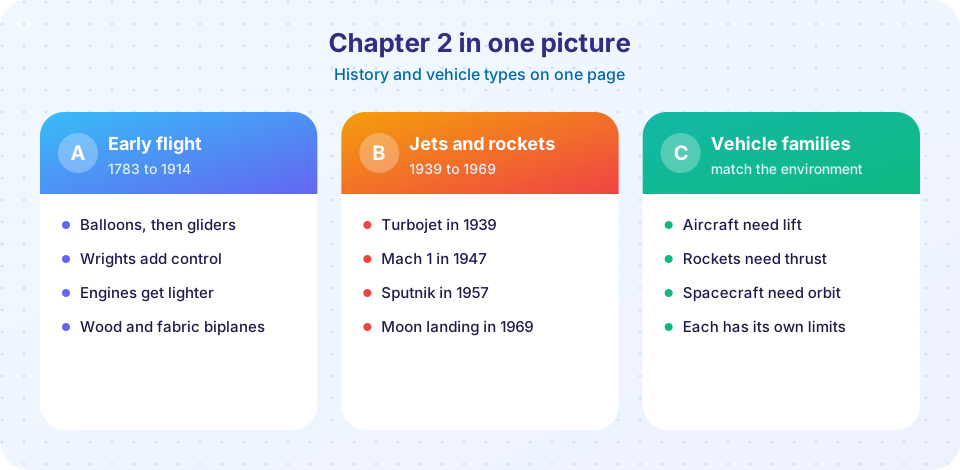
Chapter 2 gave you two things: a timeline that shows how fast aerospace changed, and a taxonomy of vehicles that shows what each is built for. This review puts them side by side and tests whether you can recall the key facts and use one new equation, the circular orbital speed.
What you will learn
- The main dates and the technology that enabled each
- The families of vehicles and the environment that shapes each
- How circular orbital speed depends on altitude
Recap table
| Lesson | Big idea | Remember |
|---|---|---|
| Overview | Progress came in bursts | Technology first, then the milestone |
| Early aviation | Control, wing data and light engines | 1783 balloons; 17 Dec 1903 Wright Flyer |
| Jet and space ages | Turbojets, rockets, reuse | 1939 He 178; 1947 Mach 1; 1957 Sputnik; 1969 Apollo 11; 2015 landing |
| Vehicle types | Environment sets the design | Air, gravity, vacuum; LEO, MEO, GEO |
The one new equation: circular orbital speed
A satellite in a circular orbit moves at
v = sqrt(mu / r)
with mu = 3.986004 × 10¹⁴ m³/s² and r the distance from the Earth's center. At 400 km altitude (r = 6,778 km) this gives about 7.67 km/s. Higher orbits are slower, because gravity is weaker. You will derive this in chapter 5. Here, just remember the trend: the higher the orbit, the slower the satellite and the longer the period.
Try it
Press Run (or Ctrl + Enter) to see the console output here.
No output.
Press Run (or Ctrl + Enter) to see the result here.
Program input · what you'd type while the program runs
Type the answers before you press Run, one per line. Each time the program reads a line (with input()), it gets the next line from this box.
Check your understanding
Quick check · 9 questions
of 9 answered You scored / 9 · perfect!
-
1. Which pair is in the correct order of first flight?
1903 comes before 1957. -
2. Why did Cayley matter?
His 1799 layout became the template for the airplane. -
3. What did the Wrights' wind tunnel give them?
They measured lift and drag on many wing shapes. -
4. Who was the first human in space?
Gagarin orbited Earth on 12 April 1961. -
5. A drone with no pilot aboard belongs to which group?
UAS stands for uncrewed aircraft systems. -
6. Hypersonic means a Mach number above about
Hypersonic flow begins near Mach 5. -
7. A geostationary satellite's period is
It matches the Earth's rotation. -
8. A higher circular orbit means
v = sqrt(mu/r) falls and T = 2 pi sqrt(r^3/mu) rises with r. -
9. The Comet jet airliner crashes of 1954 were traced to
Pressurization cycles fatigued the corners of square windows.
Summary
- Aerospace progress followed technology: light engines, turbojets, long-range rockets and computers.
- Vehicle families follow environment: air, gravity and vacuum.
- Circular orbital speed
sqrt(mu/r)falls with altitude while the period rises.
Track your progress
Create a free account to tick off lessons and pick up where you left off on any device.
of Aerospace Engineering lessons completed