


















Lesson 23 of 45 · Orbital Mechanics
Kepler's Laws of Planetary Motion
Learn Kepler's three laws of orbital motion with worked numbers for GPS, the Moon and Halley's comet, plus simulations of equal areas and the period law.
Between 1609 and 1619 Johannes Kepler turned the best naked-eye measurements ever made into three simple rules. The data came from Tycho Brahe, who had spent decades recording the position of Mars. Kepler's rules do not explain why planets move as they do; Newton did that in 1687 by showing that an inverse-square gravitational force produces exactly these laws. For an aerospace engineer the laws are still the quickest way to reason about any orbit, around the Sun or around Earth.
What you will learn
- State all three of Kepler's laws and what each one means physically.
- Use
a,b,e, periapsis and apoapsis distances of an ellipse. - Explain why a body moves fastest at periapsis, using angular momentum.
- Compute an orbital period from the semi-major axis.
- Check the laws numerically with a simulation.
Key terms
Ellipse: a closed curve in which the sum of the distances to two fixed points (the foci) is constant.
Semi-major axis (a): half the longest diameter of the ellipse.
Eccentricity (e): how stretched the ellipse is, e = c / a where c is the distance from the center to a focus.
Periapsis and apoapsis: the closest and farthest points, at distances a(1 − e) and a(1 + e).
Specific angular momentum (h): h = r × v, angular momentum per unit mass; it is constant on an orbit.
The first law: orbits are ellipses
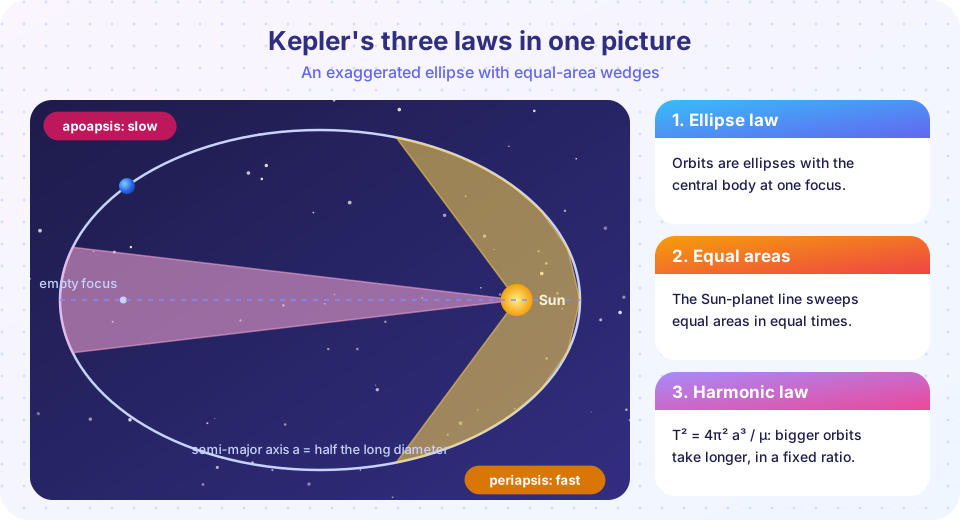
The body being orbited sits at one focus of the ellipse, not at its center. The other focus is empty. A circle is the special case where both foci coincide and e = 0.
An ellipse has a handful of relations worth memorizing:
b = a √(1 − e²)         (semi-minor axis)
r_p = a (1 − e)          (periapsis distance)
r_a = a (1 + e)          (apoapsis distance)
r(ν) = a(1 − e²) / (1 + e cos ν)   (distance at true anomaly ν)
Earth's orbit has e ≈ 0.0167, so it is almost a circle: the Sun-Earth distance only varies by about 3%. Earth is closest to the Sun in early January, which shows that the seasons are caused by axial tilt, not by distance. Halley's comet, with e ≈ 0.967, swings between about 0.59 AU and 35 AU.
The second law: equal areas in equal times
A line from the central body to the orbiting body sweeps out equal areas in equal times. Look at the two shaded wedges in the picture: the one near periapsis is short and wide, the one near apoapsis is long and thin, but they have the same area and take the same time.
This is the law of conservation of angular momentum in disguise. The central force of gravity points along the line between the bodies, so it cannot twist the orbit, and h = r v_⊥ stays constant. Near periapsis r is small, so the speed must be large; near apoapsis r is large, so the speed is small. Comparing the two apsides:
r_p · v_p = r_a · v_a so v_p / v_a = r_a / r_p = (1 + e) / (1 − e)
For e = 0.5 the satellite is three times faster at periapsis than at apoapsis. For Halley's comet the ratio is about 60.
The rate at which area is swept is dA/dt = h/2, and since h = √(μ a (1 − e²)), the whole ellipse is covered in the time
T = (π a b) / (h / 2) = 2π √(a³ / μ)
which is exactly the third law.
The third law: the period depends on the size
The square of the period is proportional to the cube of the semi-major axis:
T² = (4π² / μ) · a³
Only a appears, not e: an eccentric orbit and a circular orbit with the same semi-major axis have the same period. For bodies circling the Sun, measure T in years and a in astronomical units and the constant becomes 1, so T² = a³. Mars has a = 1.524 AU, so T = 1.524^1.5 ≈ 1.88 years.
Worked example, a GPS satellite: a = 26,560 km = 2.656×10⁷ m.
T = 2π √((2.656×10⁷)³ / 3.986×10¹⁴) ≈ 4.31×10⁴ s ≈ 11.97 hours
That is half a sidereal day, so the satellite repeats the same ground track twice per Earth rotation. The Moon, at a = 384,400 km, gives T ≈ 27.4 days with Earth's μ alone; the real sidereal month is 27.3 days because the Moon's own mass adds to μ and the Sun perturbs the orbit.
Where Kepler's laws stop
Kepler's laws assume exactly two bodies and a perfectly spherical central mass. Real orbits suffer perturbations: Earth's equatorial bulge (the J2 term) makes the orbit plane precess, the Moon and Sun pull on high satellites, sunlight pushes lightly on large panels, and thin air drags LEO satellites down. Mission designers start with Kepler and then add these effects as small corrections. That is why the two-body model is the right starting point.
Common misconceptions
"The Sun is at the center of the ellipse." It is at a focus. At periapsis the planet is much closer to the Sun than at apoapsis.
"A planet slows down as it approaches the Sun." The opposite: it speeds up, trading potential energy for kinetic energy while angular momentum stays constant.
"A longer, thinner orbit takes longer." Only the semi-major axis sets the period. A skinny ellipse and a circle with the same a have the same period.
Try it
The first TryIt checks the equal-area law numerically by solving Kepler's equation M = E − e sin E and measuring two wedges. The second checks the period law against real planets. The third is a live animation where you change the eccentricity.
Press Run (or Ctrl + Enter) to see the result here.
Program input · what you'd type while the program runs
Type the answers before you press Run, one per line. Each time the program reads a line (with input()), it gets the next line from this box.
Press Run (or Ctrl + Enter) to see the result here.
Program input · what you'd type while the program runs
Type the answers before you press Run, one per line. Each time the program reads a line (with input()), it gets the next line from this box.
Check your understanding
Quick check · 5 questions
of 5 answered You scored / 5 · perfect!
-
1. Where is the Sun located in a planet's elliptical orbit?
Kepler's first law puts the central body at one of the two foci. At the center, distances to periapsis and apoapsis would be equal. -
2. A satellite has e = 0.5. How does its speed at periapsis compare with its speed at apoapsis?
v_p / v_a = (1 + e) / (1 − e) = 1.5 / 0.5 = 3. -
3. Two satellites have the same semi-major axis, one on a circle and one on a long ellipse. Their periods are
T = 2π√(a³/μ) contains only the semi-major axis. -
4. Kepler's second law is a consequence of the conservation of
Gravity is a central force, so it exerts no torque about the central body and the specific angular momentum r × v stays constant. -
5. For a body orbiting the Sun with a = 4 AU, what is the period in years?
T² = a³ = 64, so T = 8 years.
Summary
- Orbits are ellipses with the central body at a focus;
emeasures the stretch. - The line to the central body sweeps equal areas in equal times, so speed is highest at periapsis (
v_p/v_a = (1+e)/(1−e)). T = 2π√(a³/μ): the period depends only on the semi-major axis.- Real orbits add perturbations (
J2, drag, third bodies) on top of this two-body picture.
Track your progress
Create a free account to tick off lessons and pick up where you left off on any device.
of Aerospace Engineering lessons completed