


















Lesson 22 of 45 · Orbital Mechanics
Orbital Mechanics: The Big Picture
Chapter 5 overview: why satellites fall around Earth, the main orbit families (LEO, MEO, GEO), and a map of Kepler, vis-viva and Hohmann transfers.
A satellite does not stay up because gravity is "turned off" up there. At the height of the International Space Station (about 400 km) gravity is still roughly 89% as strong as on the ground. The station stays up because it is falling, and it is moving sideways so fast that the ground curves away beneath it as quickly as it falls. That single idea, falling around a planet, is orbital mechanics.
This chapter gives you the tools that mission designers use every day: Kepler's laws, the energy equation that links speed and position, and the burns that move a spacecraft between orbits. We stay in two dimensions and use one central body at a time. That "two-body" model is simple, and it is accurate enough to plan most of a mission.
Orbits in four steps
Why it matters
Orbits are the language of mission design.
What you will learn
- Explain an orbit as continuous free fall with enough sideways speed.
- Name the main Earth orbit families and why each exists.
- Read the six numbers that describe an orbit.
- Compute circular orbit speed and period from altitude.
- See how the five lessons of this chapter fit together.
Key terms
Orbit: the path of one body around another under gravity. Altitude: height above the surface; the orbit radius is Earth's radius plus altitude. Period: the time for one complete revolution. Apsis: the closest (periapsis) or farthest (apoapsis) point of an orbit. Inclination: the tilt of the orbit plane relative to the equator. μ (mu): the gravitational parameter G·M; for Earth, 3.986×10¹⁴ m³/s².
Newton's cannonball
In 1687 Isaac Newton asked you to imagine a cannon on a very tall mountain. Fire a ball gently and it lands nearby. Fire it faster and it lands farther away. At around 7.9 km/s (near the surface, ignoring air) the Earth's surface curves away as fast as the ball drops, and the ball never lands. It is in orbit.
An astronaut inside the ISS floats for the same reason a passenger in a falling elevator would: everything inside is in free fall together. The correct term is microgravity, not "zero gravity". Gravity is still pulling on every part of the station with about 89% of its ground-level strength.
For a circular orbit of radius r the required speed follows from setting gravity equal to the centripetal need:
v = √(μ / r) T = 2π r / v = 2π √(r³ / μ)
Notice what is missing: the mass of the satellite. A grain of sand and a space station at the same altitude share the same orbit. Notice also the trend: larger r means smaller v but a longer period. Higher orbits are slower.
The orbit families
Where you put a satellite depends on what it must do.
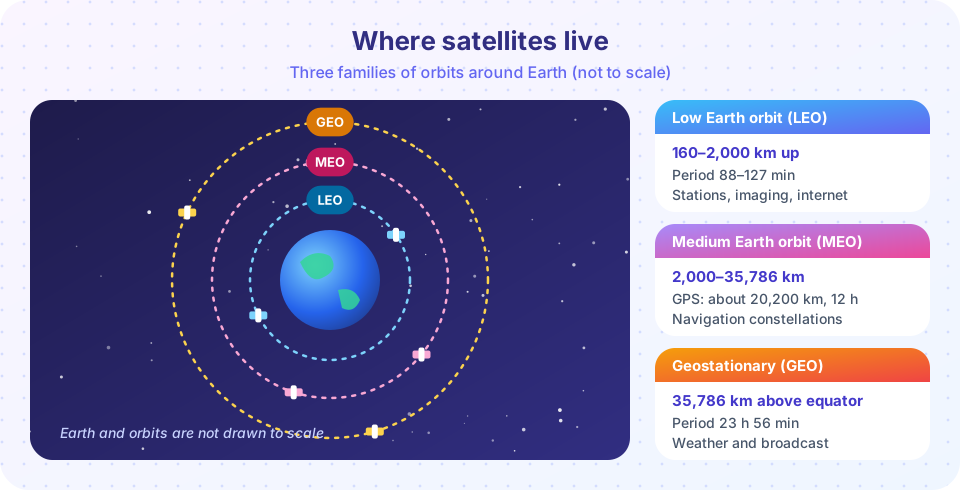
- Low Earth orbit (LEO), roughly 160 to 2,000 km. Close to the ground, so images are sharp and radio delay is tiny. The ISS flies near 400 km with a period of about 92.5 minutes, and a satellite must move fast (about 7.7 km/s) so it sweeps across the sky in minutes. Very low LEO still has a trace of atmosphere, so satellites there slowly lose altitude.
- Medium Earth orbit (MEO), from 2,000 km up to just below geostationary height. Navigation constellations live here. GPS satellites orbit at about 20,200 km with a period of roughly 12 hours.
- Geostationary orbit (GEO), 35,786 km above the equator. The period equals one rotation of the Earth (23 h 56 min, a sidereal day), so the satellite hovers over one spot. Weather and broadcast satellites love it. The arrangement was proposed by Arthur C. Clarke in a 1945 article.
- Highly elliptical orbits (HEO) such as the Russian Molniya type, with a period of about 12 hours. The satellite lingers for hours near its far point above high latitudes.
- Sun-synchronous orbits (SSO), typically near 98° inclination at 600 to 800 km. Earth's slight bulge turns the orbit plane about one degree per day, so the satellite passes over each place at the same local solar time. Imaging satellites use it for consistent lighting.
Six numbers describe an orbit
An orbit in space is fixed by six orbital elements:
| Symbol | Name | What it sets |
|---|---|---|
| a | semi-major axis | size (and so the period) |
| e | eccentricity | shape: 0 is a circle, near 1 is a long thin ellipse |
| i | inclination | tilt of the plane to the equator |
| Ω | right ascension of the ascending node | where the plane crosses the equator, going north |
| ω | argument of periapsis | where the ellipse points within its plane |
| ν | true anomaly | where the satellite is along the orbit right now |
The first two describe the shape in the plane; the next three orient it in space; the last gives the position at a moment in time. In this chapter we mostly use a and e, because they decide speeds, energies and transfer costs.
Common misconceptions
"There is no gravity in space." At 400 km altitude gravity is still about 89% of its surface value. Astronauts float because they are in free fall.
"Heavier satellites orbit faster." Circular orbit speed depends only on the central body and the radius, not on the satellite mass.
"To speed up and catch the satellite ahead, fire the engine forward." Speeding up raises your orbit, which slows your progress around Earth. Orbital intuition is covered in the Hohmann lesson.
Try it
A table of orbit speeds first, then an interactive satellite where you move the altitude slider.
Press Run (or Ctrl + Enter) to see the result here.
Program input · what you'd type while the program runs
Type the answers before you press Run, one per line. Each time the program reads a line (with input()), it gets the next line from this box.
What each lesson covers
- Kepler's laws: ellipses, equal areas, the period law.
- Vis-viva and orbital energy: speed at any point and the shapes of all orbits.
- Hohmann transfers: moving between circular orbits cheaply.
- Chapter review: a one-page recap and a long quiz.
Check your understanding
Quick check · 5 questions
of 5 answered You scored / 5 · perfect!
-
1. Why does an astronaut on the ISS float?
Gravity at 400 km is still about 89% of its surface value. Everything in the station falls together, so nothing presses on anything else. -
2. What happens to circular orbital speed as altitude increases?
v = √(μ/r), so a larger radius gives a smaller speed. Higher orbits are slower and have longer periods. -
3. Which orbit has a period equal to one sidereal day and stays above the equator?
At 35,786 km above the equator the period is 23 h 56 min, the same as Earth's rotation, so the satellite appears fixed in the sky. -
4. Which orbital element mainly sets the shape of the orbit?
Eccentricity is 0 for a circle and approaches 1 for a long, thin ellipse. Inclination only tilts the plane. -
5. A 10-tonne satellite and a 100 kg satellite are in the same circular orbit. Compare their speeds.
Circular orbit speed v = √(μ/r) does not depend on the satellite's mass.
Summary
- An orbit is free fall with enough sideways speed to keep missing the ground.
- Circular orbit speed is
√(μ/r)and period is2π√(r³/μ); higher means slower and longer. - LEO, MEO, GEO, HEO and sun-synchronous orbits each solve a different coverage problem.
- Six orbital elements fix an orbit;
aandedecide size and shape. - Chapter 5 builds Kepler, vis-viva and the Hohmann transfer on this base.
Track your progress
Create a free account to tick off lessons and pick up where you left off on any device.
of Aerospace Engineering lessons completed