


















Lesson 16 of 45 · Aircraft Structures and Propulsion
Chapter 3 review: structures and propulsion
Review lift, drag, airframe loads and aircraft engines with a recap table, a chain calculation from lift-to-drag to fuel flow and a 10-question quiz.
This chapter followed one thread: what an aircraft needs to stay up and move forward. Wings make lift at the price of drag, the structure carries the loads with as little weight as possible and the engine turns fuel into the thrust that balances the drag. The review connects them into a single chain of calculations, the way an engineer would, and ends with a ten-question quiz.
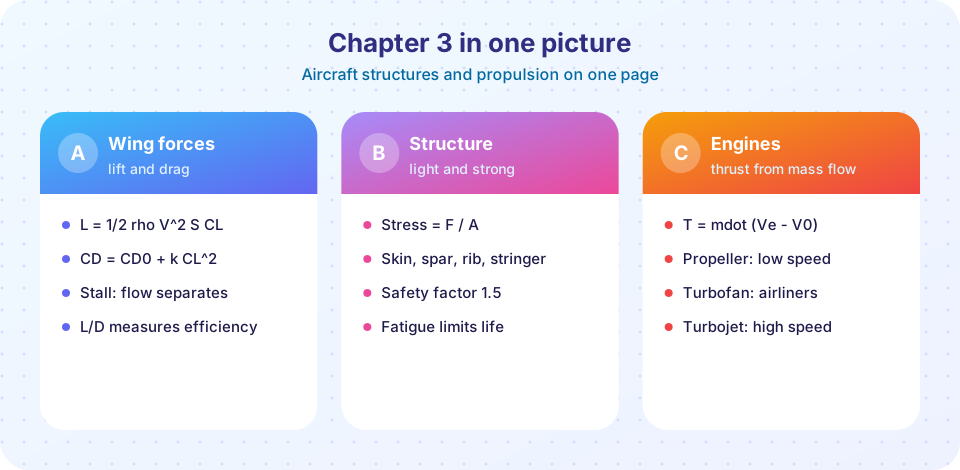
What you will learn
- How the equations of the chapter chain from weight to fuel flow
- Which formulas to remember
- Where you stand, with a quiz that mixes all five lessons
Recap table
| Lesson | Key results |
|---|---|
| Overview | Wings, structure and engines are coupled; the long-wing trade |
| Lift and airfoils | CL = a0 (alpha - alpha0), a0 = 2π per radian, stall near 12 to 16 degrees, flaps raise CL_max |
| Drag and the polar | CD = CD0 + k CL², k = 1/(π e AR), (L/D)max = 1/(2 sqrt(CD0 k)) |
| Airframe and loads | sigma = F/A, limit +2.5 g, ultimate ×1.5, sigma = p r / t, fatigue |
| Propulsion | T = mdot (Ve - V0), eta_p = 2/(1 + Ve/V0), TSFC = V0/(eta_o Hf) |
The chain from weight to fuel
Follow one airliner through the chain:
- Weight:
W = 686,466 N(70 t). - Aerodynamics: polar with
CD0 = 0.022,k = 0.0419gives(L/D)max = 16.47. - Drag equals thrust:
T = W / (L/D) = 41.7 kN. - Engine: with
V0 = 250 m/sand overall efficiency 0.40,TSFC = 1.45 × 10⁻⁵ kg/(N·s). - Fuel flow:
mdot_fuel = TSFC × T = 0.605 kg/s, which is about 2,180 kg per hour.
Each step uses one idea from this chapter. If you want to save fuel, the chain tells you where to push: lower the weight, raise L/D (smaller CD0, larger AR) or raise overall efficiency (a higher bypass ratio and a hotter, higher-pressure core). Each of these also affects the structure: longer wings add bending load; higher pressures and temperatures need better materials.
Try it
Press Run (or Ctrl + Enter) to see the result here.
Program input · what you'd type while the program runs
Type the answers before you press Run, one per line. Each time the program reads a line (with input()), it gets the next line from this box.
Press Run (or Ctrl + Enter) to see the console output here.
No output.
Check your understanding
Quick check · 10 questions
of 10 answered You scored / 10 · perfect!
-
1. The lift-curve slope of a thin airfoil is about
Thin-airfoil theory gives 2 pi per radian, about 0.11 per degree. -
2. At maximum L/D, parasite and induced drag are
The sum CD0 + k CL^2 over CL is smallest where CD0 = k CL^2. -
3. An aircraft with (L/D)max = 16 and weight 600 kN needs thrust (at best L/D) of about
T = W / (L/D) = 600 / 16 = 37.5 kN. -
4. Which part of a wing carries most of the bending moment?
Spar caps act as the flanges of a beam. -
5. The ultimate load factor is
The ultimate safety factor is 1.5 for aircraft. -
6. A 4 mm thick fuselage skin carries the same pressure as a 2 mm skin. Hoop stress is
sigma = p r / t, so doubling t halves the stress. -
7. High-bypass turbofans save fuel because
Propulsive efficiency 2/(1 + Ve/V0) rises as Ve approaches V0. -
8. In a 60-degree banked level turn the wing must carry
n = 1/cos(60 degrees) = 2. -
9. Stall happens because
Separated flow cannot hold low pressure on the upper surface. -
10. TSFC of 1.45e-5 kg/(N s) at 40 kN thrust gives fuel flow of about
1.45e-5 x 40,000 = 0.58 kg/s, about 2,090 kg per hour.
Summary
- The chain weight, L/D, thrust, TSFC, fuel flow links every lesson of the chapter.
- Reducing weight, drag or engine losses all save fuel, and each has structural and cost consequences.
- Know the key equations: lift, drag polar, stress, load factor, thrust and efficiency.
Track your progress
Create a free account to tick off lessons and pick up where you left off on any device.
of Aerospace Engineering lessons completed