


















Lesson 27 of 45 · Rocket Propulsion
Rocket Propulsion: The Big Picture
Chapter 6 overview: how a rocket pushes itself forward, the main engine types from solid to ion, why most of a rocket is propellant, and a map of the chapter.
A jet engine breathes air. A rocket carries everything it needs, including the oxygen, so it works in the vacuum of space where there is nothing to breathe and nothing to push against. How can anything accelerate in a vacuum? The answer is as old as Newton: throw something backward and you move forward. A rocket engine is a machine for throwing mass backward as fast as possible, and the rest of the rocket is a very large, very light container that holds the mass to be thrown.
This chapter explains how much speed a given amount of propellant buys (the rocket equation), how engines turn heat into exhaust speed (nozzles and specific impulse), and why rockets are built in stages.
How a rocket moves
Engine families
The big surprise
The payload is a small fraction.
What you will learn
- Explain thrust using conservation of momentum.
- Name the main rocket engine types and what each is good at.
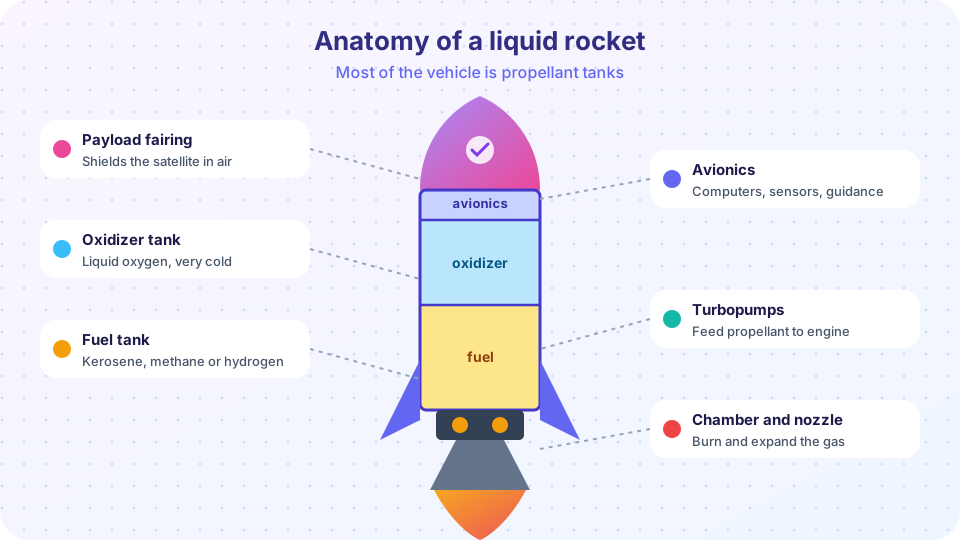
- Describe the major parts of a liquid rocket.
- Understand why launchers are mostly propellant.
- See how the next four lessons fit together.
Key terms
Thrust: the force a rocket engine exerts on the vehicle, in newtons. Propellant: the fuel plus the oxidizer (or the single material) that is expelled. Exhaust velocity (vₑ): the speed of the exhaust relative to the rocket. Specific impulse (Isp): thrust per unit weight flow of propellant, in seconds; a measure of engine efficiency. Thrust-to-weight ratio: thrust divided by weight; it must exceed 1 for liftoff.
Momentum, not "pushing on the air"
In 1903 Konstantin Tsiolkovsky, a schoolteacher in Russia, worked out the mathematics of rocket flight. Robert Goddard launched the first liquid-fueled rocket on 16 March 1926. Hermann Oberth, in Germany, published the theory in 1923. The ideas are straightforward. If a rocket of mass M expels a small mass dm backward at speed vₑ relative to itself, the total momentum is unchanged, so the rocket gains speed dv = vₑ · dm / (M − dm). Repeat this thousands of times and the rocket's speed grows by a large amount, even though each step is tiny.
The force that results is the thrust: F = ṁ · vₑ (mass flow rate times exhaust speed), plus a correction for pressure at the nozzle exit that the nozzle lesson will cover. Two ways to get more thrust: burn more propellant per second, or expel it faster. Thrust and efficiency are different things, and that difference drives the whole design of rocket engines.
A rocket does not push against the air. In fact it works better in a vacuum, because the outside pressure does not push back on the nozzle exit. A common mistake in old newspaper reports was to claim rockets could not work in space for lack of something to push on.
The engine families
| Type | How it works | Typical Isp | Typical use |
|---|---|---|---|
| Cold gas | Release compressed gas through a nozzle | tens of seconds | tiny attitude jets |
| Solid | Propellant is cast into the motor and burns from the inside | about 250 to 290 s | boosters, military rockets |
| Liquid | Fuel and oxidizer in tanks, pumped into a chamber | about 300 to 350 s (kerosene or methane), up to about 450 s (hydrogen), in vacuum | launch vehicles, upper stages |
| Hybrid | Solid fuel with a liquid or gas oxidizer | in the solid-to-liquid range | niche vehicles |
| Electric (ion, Hall) | Electric fields accelerate ions | about 1,500 to several thousand s | satellites, deep space |
Solids are simple, store well and give huge thrust, but they cannot be shut down or throttled at will. Liquids need pumps, valves and plumbing, but can throttle, restart and reach higher efficiency. Electric thrusters are extremely efficient but produce a force of millinewtons to a newton, so they can only accelerate a spacecraft that is already in orbit, slowly, over weeks or months. A launcher needs thrust greater than its own weight, which only chemical engines can supply.
Why a rocket is mostly propellant
Look at the anatomy picture: the tanks fill most of the vehicle. A typical launcher at liftoff is roughly 90% propellant by mass or more. The structure is thin-walled and as light as possible, and the payload is a few percent. The next lesson shows that this is not poor engineering but a direct consequence of the rocket equation: to reach orbital speed you must throw away most of your mass.
Common misconceptions
"Rockets push against the air." They push against their own exhaust. Vacuum operation is better, not worse.
"More thrust means more efficient." Efficiency is measured by specific impulse (thrust per unit propellant flow). Ion engines have tiny thrust and enormous efficiency.
"A rocket accelerates at a constant rate." As propellant burns the rocket gets lighter, so the same thrust gives larger acceleration. Launch accelerations rise through the burn.
Try it
Press Run (or Ctrl + Enter) to see the result here.
Program input · what you'd type while the program runs
Type the answers before you press Run, one per line. Each time the program reads a line (with input()), it gets the next line from this box.
What each lesson covers
- The rocket equation: how much speed a given mass ratio buys.
- Thrust, specific impulse and nozzles: turning heat into exhaust speed.
- Staging: throwing away empty tanks.
- Chapter review.
Check your understanding
Quick check · 5 questions
of 5 answered You scored / 5 · perfect!
-
1. What produces thrust in a rocket in vacuum?
Thrust is the reaction to accelerating propellant out of the nozzle. No outside medium is needed. -
2. Which engine type has the highest specific impulse?
Ion engines reach thousands of seconds, but with very small thrust. -
3. Roughly how much of a typical launch vehicle's liftoff mass is propellant?
The rocket equation forces a high propellant fraction to reach orbital speed. -
4. Why can a solid rocket motor not easily be shut down and restarted?
Once ignited, the grain burns on its exposed surface; liquids can be stopped by closing valves. -
5. A rocket ejects more mass each second at the same exhaust speed. Its thrust
F = ṁ · vₑ: thrust is proportional to the mass flow rate at fixed exhaust speed.
Summary
- A rocket accelerates by ejecting mass backward; thrust is about
ṁ · vₑ. - Rockets work best in vacuum and carry their own oxidizer.
- Solid, liquid, hybrid and electric engines trade thrust against efficiency.
- A launcher is mostly propellant by mass; the rocket equation explains why.
Next: The Rocket Equation
Track your progress
Create a free account to tick off lessons and pick up where you left off on any device.
of Aerospace Engineering lessons completed