


















Lesson 31 of 45 · Rocket Propulsion
Chapter 6 Review: Rockets on One Page
One-page recap of rocket propulsion: thrust, specific impulse, the rocket equation, nozzles and staging, with a sizing calculator and a ten-question quiz.
Rocket propulsion boils down to a short chain of ideas. Engines turn propellant into fast exhaust (Isp, nozzles), exhaust speed and mass ratio set the speed gained (Δv), and staging lets a vehicle drop dead mass so the mass ratio can be large enough to reach orbit. This review lines the ideas up, lets you try a quick sizing calculator, and checks your understanding with a longer quiz.
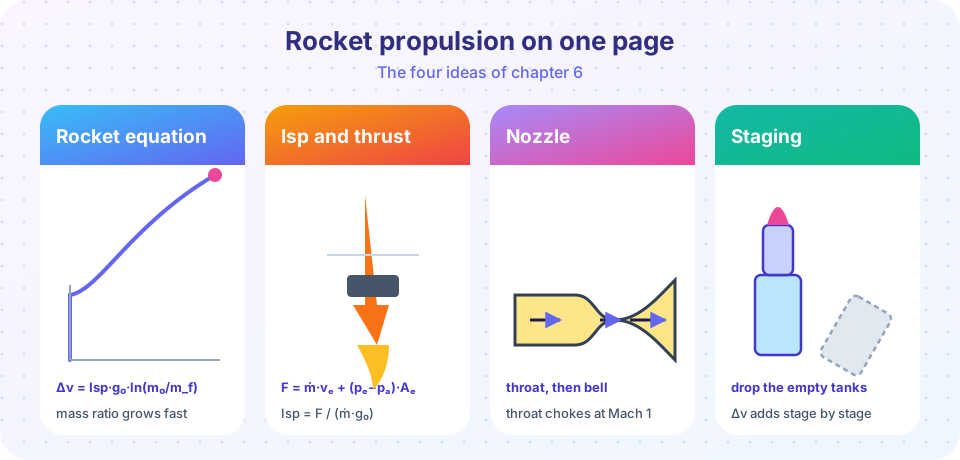
The chapter in a table
| Idea | Formula | Rule of thumb |
|---|---|---|
| Thrust | F = ṁ vₑ + (pₑ − pₐ) Aₑ |
more flow or faster exhaust |
| Specific impulse | Isp = F / (ṁ g₀) = c / g₀ |
seconds; vacuum is higher than sea level |
| Rocket equation | Δv = Isp g₀ ln(m₀/m_f) |
each extra exhaust velocity multiplies the ratio by e |
| Mass ratio | m₀/m_f = e^(Δv/vₑ) |
9.4 km/s at 300 s: ratio 24, 96% propellant |
| Structure fraction | ε = m_s/(m_s + m_p) |
0.05 to 0.12 for liquid stages |
| Gravity loss | about g · t_burn in a vertical climb |
high T/W wastes less |
| Throat | Mach 1, choked, flow set by p_c A_t |
the bell speeds the flow up further |
| Staging | Δv = Σ Isp_i g₀ ln(m₀,i/m_f,i) |
two or three stages is the sweet spot |
Connecting the pieces
- Pick the requirement: the mission needs a Δv (about 9.4 km/s to LEO).
- Pick the engine: its
Ispgivesvₑ = Isp g₀. Hydrogen engines in vacuum: about 450 s. Kerosene and methane engines: about 300 to 350 s. - Check the rocket equation: the exponent
Δv/vₑgives the mass ratio. If it is larger than1/ε, a single stage cannot work. - Split into stages: add stage burns until the sum reaches the Δv, then size the stage masses top-down.
- Check thrust-to-weight: the first stage must exceed 1 at liftoff (typically 1.2 to 1.6) so gravity loss stays modest.
Common misconceptions
"Thrust and Isp mean the same thing." Thrust is force; Isp is efficiency. Ion engines have large Isp and tiny thrust.
"A single-stage rocket would work if it were just lighter." It would need a structure fraction below about 5% with high Isp, which is at the edge of what is possible. That is why single-stage-to-orbit remains very hard.
"Rockets work by pushing against the launch pad." They work the same in a vacuum chamber.
Try it
Press Run (or Ctrl + Enter) to see the result here.
Program input · what you'd type while the program runs
Type the answers before you press Run, one per line. Each time the program reads a line (with input()), it gets the next line from this box.
Press Run (or Ctrl + Enter) to see the result here.
Program input · what you'd type while the program runs
Type the answers before you press Run, one per line. Each time the program reads a line (with input()), it gets the next line from this box.
Check your understanding
Quick check · 10 questions
of 10 answered You scored / 10 · perfect!
-
1. A stage has Isp = 450 s. What is its effective exhaust velocity? (g₀ = 9.80665 m/s²)
vₑ = Isp × g₀ = 450 × 9.80665 ≈ 4,413 m/s. -
2. Doubling a rocket's specific impulse, for the same Δv, changes the mass ratio to
The ratio is exp(Δv/vₑ). Doubling vₑ halves the exponent, which takes the square root of the ratio. -
3. A rocket has m₀ = 100 t and m_f = 20 t with Isp 300 s. Its Δv is about
Δv = 300 × 9.80665 × ln 5 = 2,942 × 1.609 ≈ 4.7 km/s. -
4. What does a high thrust-to-weight ratio at liftoff reduce?
A faster climb spends less time fighting gravity, so less of the Δv is wasted. -
5. In a de Laval nozzle the flow becomes supersonic
The throat is Mach 1; in the widening section the supersonic flow keeps accelerating. -
6. Why does a hydrogen-oxygen engine have a higher Isp than a kerosene-oxygen engine?
Ideal exhaust speed grows with R·T_c, and a light exhaust has a large R. -
7. Which of these does staging change?
Staging removes empty structure; engine efficiency is unchanged. -
8. With Isp 350 s and ε = 0.08, why can a single stage not reach 9.4 km/s with a payload?
e^(−Δv/vₑ) = 0.065 is smaller than ε = 0.08, so even with zero payload the structure alone is too heavy. -
9. Two stages have Δv 3.4 km/s and 6.4 km/s. The vehicle's total Δv is
Stage Δv values add: 3.4 + 6.4 = 9.8 km/s. -
10. An engine delivers 1,200 kN of thrust with a propellant flow of 400 kg/s. Its Isp is about
Isp = F/(ṁ g₀) = 1,200,000 / (400 × 9.80665) ≈ 306 s.
Summary
vₑ = Isp g₀; thrust isṁ vₑ + (pₑ − pₐ)Aₑ.Δv = vₑ ln(m₀/m_f); mass ratio grows exponentially with Δv.- The nozzle makes exhaust speed; its throat is Mach 1, and the bell is matched to ambient pressure.
- Staging drops dead mass; two or three stages are typical; check T/W at liftoff.
Track your progress
Create a free account to tick off lessons and pick up where you left off on any device.
of Aerospace Engineering lessons completed