


















Lesson 1 of 45 · Getting Started
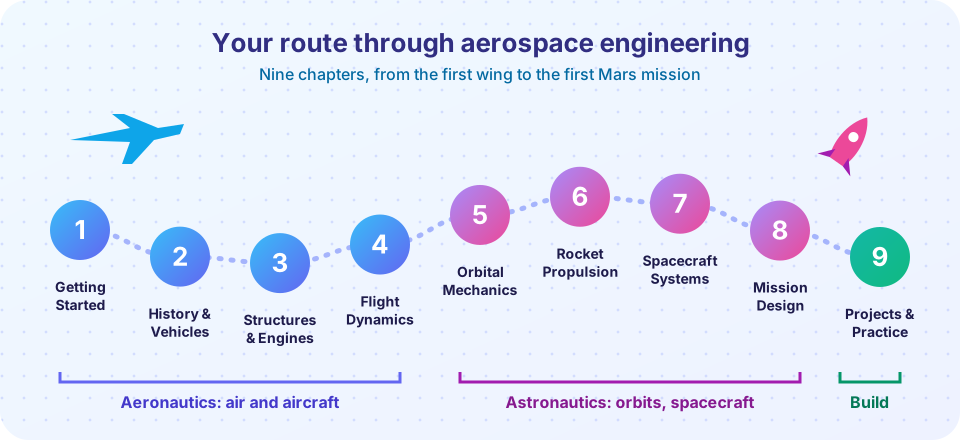
Course map: your route through aerospace engineering
Who this aerospace engineering course is for, what you need first, how the nine chapters fit together and how to study them with simulations.
Aerospace engineering is the craft of designing things that fly: aircraft that stay in the air, rockets that climb out of it and spacecraft that live beyond it. It sits on top of physics and mathematics, but it is also a very practical subject. Engineers trade mass against strength, thrust against fuel and cost against risk, and they do it with numbers.
This course takes you from "why does a wing lift?" to "how do we plan a trip to Mars?" in nine chapters. Every lesson has diagrams, worked examples and small programs you can run and change in the page. No simulator download, no setup.
This course is educational. It teaches the physics and the engineering methods behind real vehicles, but it is not a design certification guide. Real aircraft and spacecraft are built under strict regulations and many layers of review.
What you will learn
- What aerospace engineers do and how the field divides into aeronautics and astronautics
- How the chapters build on each other, from the atmosphere to orbital missions
- Which math and physics you need, and how to refresh them as you go
- How to use the runnable examples to build intuition
Key terms
Aeronautics is the science and engineering of flight inside the atmosphere.
Astronautics is the science and engineering of flight above it.
Trade study is a structured comparison of design options against requirements.
Requirement is a measurable statement of what a vehicle must do.
Who this course is for
You may be a student of about 15 or older who loves planes and rockets, a first-year university student, or an adult changing career. The course follows the common core of international introductory aerospace syllabi: standard atmosphere, aerodynamics, structures, propulsion, flight dynamics, orbital mechanics, rocket propulsion, spacecraft subsystems and mission design.
You need:
- Algebra and basic trigonometry. You will rearrange equations and use sine and cosine.
- Introductory physics. Force, mass, acceleration, energy and momentum. If these are rusty, the lessons restate them where they appear.
- Curiosity about numbers. Almost every idea is tested with a small calculation.
Calculus helps but is not required. Where a derivative or an integral appears, the idea is explained in words and shown numerically first.
The nine chapters
The route ahead
Chapters 1 to 4: aeronautics
Into space
Chapters 5 to 8: astronautics
Make it real
Apply everything
How the ideas connect
Notice how the same few physical ideas return in different clothes. Newton's second law explains why a wing lifts, why a rocket accelerates and why a satellite stays in orbit. Conservation of energy explains glide range, orbital speed and re-entry heating. The atmosphere, which you meet in lesson 3, sets the speed limits of aircraft, the drag on rockets and the lifetime of low satellites.
Engineers also share a way of thinking. Start with requirements ("carry 150 passengers 5,000 km"), pick a concept, estimate with simple equations, build a better model and compare. You will practice that loop again and again. Early estimates are rough on purpose. A back-of-the-envelope calculation that is right within 20 percent is far more useful on day one than an exact answer on day one hundred.
How to study
- Run every example. Change a number, predict the result and then run it. The gap between your prediction and the output is where learning happens.
- Keep units on everything. Many famous failures were unit mistakes. In 1999 the Mars Climate Orbiter was lost partly because one team's software produced impulse in pound-force seconds while the other expected newton seconds.
- Estimate before you calculate. Is a jet at 250 m/s faster or slower than 1,000 km/h? (It is 900 km/h, so slightly slower.)
- Use the quizzes as checkpoints, not exams.
Try it
A quick feel for scale first. The chart below places typical vehicles on a logarithmic altitude axis, because altitudes span almost five orders of magnitude.
Press Run (or Ctrl + Enter) to see the result here.
Program input · what you'd type while the program runs
Type the answers before you press Run, one per line. Each time the program reads a line (with input()), it gets the next line from this box.
Press Run (or Ctrl + Enter) to see the console output here.
No output.
Common misconceptions
"You need to be a genius at math." You need to be careful and persistent. Most aerospace calculations use algebra, a calculator and good units.
"Space is just very high up." Reaching 100 km altitude is not the hard part of spaceflight. Staying there requires going sideways at about 7.8 km/s, which is the subject of chapter 5.
Check your understanding
Quick check · 4 questions
of 4 answered You scored / 4 · perfect!
-
1. Which pair correctly names the two halves of aerospace engineering?
Aeronautics deals with flight in the air, astronautics with flight beyond the atmosphere. -
2. Why does the course ask you to estimate before calculating?
An estimate gives you a sanity check, so an answer that is off by a factor of 1,000 is noticed at once. -
3. Which idea appears in several chapters, explaining wings, rockets and orbits alike?
Force equals the rate of change of momentum, and it underlies lift, thrust and gravity-driven motion. -
4. A requirement is best described as
Requirements are measurable, such as carrying 150 passengers 5,000 km, so designs can be checked against them.
Summary
- Aerospace engineering splits into aeronautics (air) and astronautics (space), tied together by systems engineering.
- The nine chapters run from the atmosphere to missions, and the same physical laws return throughout.
- You need algebra, trigonometry and basic physics; calculus is explained as it comes up.
- Run, change and break the examples, keep units on every number and estimate first.
Track your progress
Create a free account to tick off lessons and pick up where you left off on any device.
of Aerospace Engineering lessons completed