


















Lesson 37 of 45 · Mission Design
Mission Design: The Big Picture
Chapter 8 overview: how a space mission goes from idea to operations, the lifecycle phases and design reviews, trade studies, and lessons from two famous failures.
Everything so far in this course has been a part: an orbit, an engine, a power system. A mission is how the parts fit together to do something useful, such as photographing farmland every day, relaying television to a continent, or landing a rover on Mars. Mission design asks the whole-system questions. What orbit meets the need? Which rocket? How much Δv does it take, and when can we go? What happens at the end?
Behind these questions sits a discipline called systems engineering: breaking a big problem into parts, writing down what each part must do, and checking that the parts, once joined, meet the original goal. This chapter covers the mission lifecycle, how to budget the Δv for a trajectory, and how gravity assists make impossible missions possible.
From idea to orbit
Mission design tools
Why reviews matter
Cost of change rises each phase.
What you will learn
- Describe the phases of a space mission lifecycle and what each produces.
- Explain requirements, trade studies and design reviews.
- Understand why decisions made early are the hardest to reverse.
- Learn from two famous failures how small errors become mission losses.
- See how the next lessons build the Δv budget and use planets as slingshots.
Key terms
Requirement: a statement of what the system must do or be, written so that it can be verified. Concept of operations (ConOps): a description of how the system will be used, from launch to end of life. Trade study: a structured comparison of options against weighted criteria. Design review (PDR, CDR): a formal checkpoint where outside experts examine the design before work continues. Verification and validation: checking that you built it right and that it is the right thing.
The lifecycle
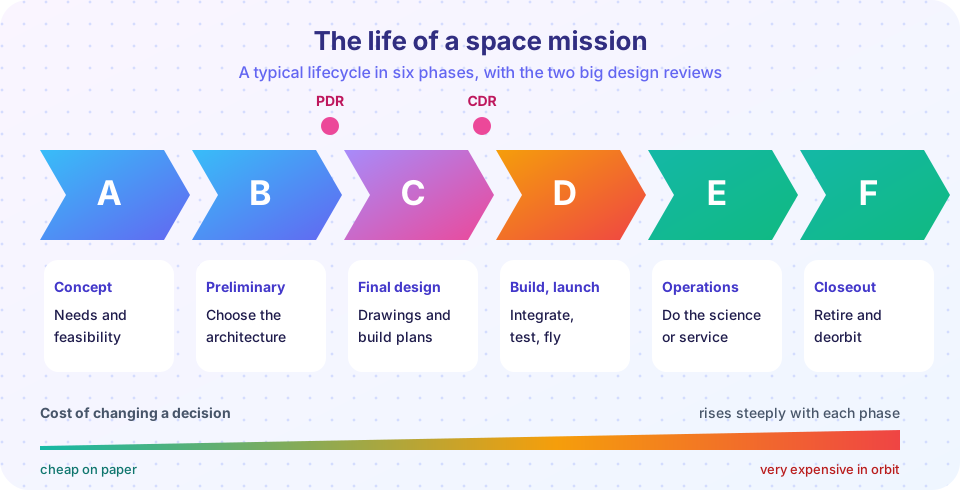
Space agencies and companies use similar sequences. NASA's version has six phases:
- Phase A, concept and technology development. Define the need, study alternatives, find out whether the idea is feasible.
- Phase B, preliminary design. Pick the architecture (orbit, launcher, number of spacecraft, major subsystems). It ends with a preliminary design review (PDR).
- Phase C, final design and fabrication. Complete drawings and software plans. A critical design review (CDR) approves the design for building.
- Phase D, assembly, integration, test and launch. Build the spacecraft, shake it, bake it in vacuum, and fly it.
- Phase E, operations and sustainment. Do the science or provide the service.
- Phase F, closeout. Retire the spacecraft, de-orbit or park it safely, archive the data.
Other organizations use different names and extra reviews, but the shape is the same: the cost of changing a design rises with every phase. A change that takes an afternoon in Phase A can take a year and millions of dollars in Phase D. This is why mission designers do so much analysis early.
Requirements and trade studies
A mission starts with a need: "monitor crop health every five days at 10 m resolution". From the need come requirements, such as swath width, orbit altitude, revisit time and data volume. Each requirement must be testable. Then comes the heart of design: trade studies. Many choices compete: a single big satellite or a constellation of small ones, a higher orbit (wider view, weaker signal) or a lower orbit (sharper images but more drag), chemical or electric propulsion. A weighted decision matrix is a simple tool: score each option against each criterion, multiply by weights, and total.
Mission design also handles non-technical requirements: launch schedule, budget, licensing of frequencies, safety, and end-of-life disposal. Regulators now expect LEO satellites to leave orbit soon after their mission ends, with a trend toward about five years, rather than the older guideline of 25 years, to limit orbital debris.
Two failures that taught the field
- Mars Climate Orbiter (1999). The spacecraft was lost when it reached Mars. Ground software produced thruster-impulse data in pound-force seconds, while the navigation software expected newton seconds. The small, repeated error shifted the trajectory so that the probe passed far too low in the atmosphere. Cause: a units mismatch at a software interface.
- Ariane 5 flight 501 (1996). About 37 seconds after launch, the rocket veered and was destroyed. Its inertial reference software, reused from Ariane 4, tried to convert a large 64-bit floating-point value into a 16-bit integer. Ariane 5 flew a different trajectory with larger values, the conversion overflowed, and both redundant units failed the same way. Cause: reuse without re-checking the assumptions, plus redundancy that was identical, not independent.
Neither failure was a physics problem. Both came from system-level assumptions that were not checked. This is why reviews, interface control documents and end-to-end testing matter.
Common misconceptions
"Mission design is just orbit math." Orbit math is one part. Requirements, risk, schedule, budget, regulation and operations shape the design just as much.
"Reviews are paperwork." They are where independent experts find the mistakes the design team has become blind to.
"We can fix it after launch." Software can often be patched, hardware cannot. Verification must happen before launch.
Try it
Press Run (or Ctrl + Enter) to see the result here.
Program input · what you'd type while the program runs
Type the answers before you press Run, one per line. Each time the program reads a line (with input()), it gets the next line from this box.
What each lesson covers
- Delta-v budgets and launch windows: adding up the burns, and when to go.
- Gravity assists: borrowing momentum from a planet.
- Chapter review.
Check your understanding
Quick check · 5 questions
of 5 answered You scored / 5 · perfect!
-
1. Which phase ends with the critical design review (CDR)?
Phase C (final design and fabrication) ends with the CDR; the preliminary design review closes Phase B. -
2. Why are early design decisions the most expensive to change later?
Hardware, software, schedules and contracts are built on the early choices, so reversing them ripples through the whole project. -
3. What was the primary cause of the Mars Climate Orbiter loss?
One system produced impulse data in pound-force seconds and another expected newton seconds. -
4. A trade study is
Trade studies help justify choices among competing options. -
5. Which is a requirement?
A good requirement is specific and verifiable by test or analysis.
Summary
- Missions run through lifecycle phases A to F; cost of change rises sharply as work proceeds.
- Requirements, trade studies and reviews protect against late surprises.
- Famous failures (Mars Climate Orbiter, Ariane 501) came from interface and reuse assumptions, not physics.
- The rest of the chapter adds Δv budgets, launch windows and gravity assists to your toolbox.
Track your progress
Create a free account to tick off lessons and pick up where you left off on any device.
of Aerospace Engineering lessons completed