


















Lesson 20 of 45 · Flight Dynamics and Control
Aircraft performance: glide, climb, range and takeoff
Calculate glide distance, rate of climb, jet range with the Breguet equation, endurance and takeoff ground roll from lift, drag, thrust and fuel data.
Performance is the part of aerospace engineering that turns into numbers a passenger or an airline cares about: how far, how fast, how high and from what runway. It builds on everything you have learned: lift and drag from the polar, thrust from the engine, weight from the structure. This lesson takes the chain from the previous chapters and extracts the five classic results: glide, climb, range, endurance and takeoff.
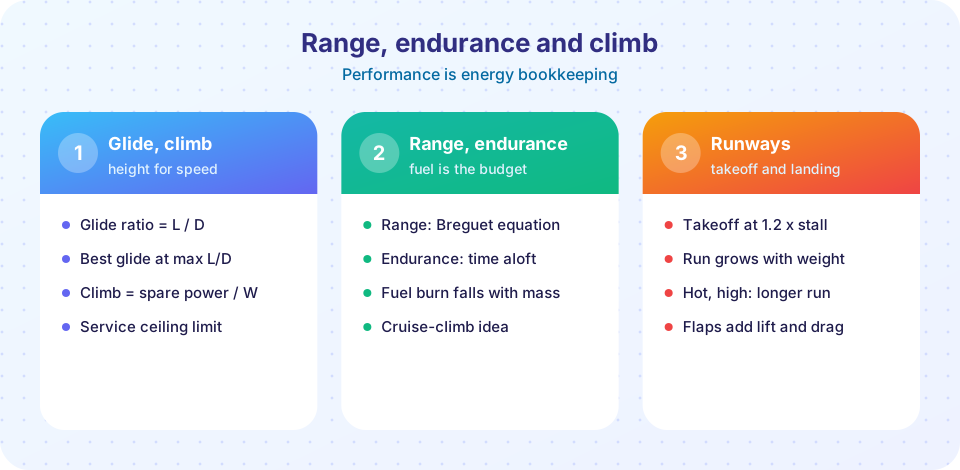
What you will learn
- The glide ratio and why it equals L/D
- Rate of climb from excess thrust, and the best climb speed
- The Breguet range and endurance equations for a jet
- A simple model of takeoff ground roll and how it scales with weight
Key terms
Glide ratio is the horizontal distance traveled per unit of height lost.
Rate of climb (RC) is the vertical speed, in m/s.
Range is the distance flown on a given amount of fuel.
Endurance is the time an aircraft can stay airborne on its fuel.
Service ceiling is the altitude at which the maximum rate of climb falls to a small specified value (typically 0.5 m/s).
Glide
With the engines at idle, thrust is zero, and weight pulls the aircraft along the path. On a steady descent at angle gamma below horizontal, L = W cos(gamma) and D = W sin(gamma). Dividing, tan(gamma) = D / L = 1 / (L/D). So the glide ratio equals L/D:
distance = height × (L/D)
An airliner with L/D = 16 loses 1,000 m for 16 km of distance. A sailplane with L/D = 40 flies 40 km from 1,000 m. The sink rate is V sin(gamma) ≈ V / (L/D). The best glide speed is the minimum-drag speed from lesson 13, where L/D peaks.
Climb
Along the flight path in a steady climb, T = D + W sin(gamma). The vertical speed is RC = V sin(gamma), so
RC = (T - D) V / W
Here T V is the power available and D V the power required; the difference, the excess power, divided by the weight is the rate of climb. A jet makes roughly constant thrust, so it climbs fastest at a speed above the minimum-drag speed. A propeller aircraft makes roughly constant power and climbs fastest closer to the minimum-power speed.
Worked example. At some altitude, T = 100 kN and D = 41.8 kN at V = 150 m/s, with W = 686 kN. Then RC = (100 - 41.8) × 150 / 686 ≈ 12.7 m/s, about 2,500 feet per minute. As the aircraft climbs, thrust falls with air density and RC falls to zero at the absolute ceiling.
Range and endurance
Burning fuel reduces weight, so the lift and drag change during the flight. The Breguet range equation for a jet in steady level flight is
R = (V / (g TSFC)) · (L/D) · ln(W0 / W1)
with W0 and W1 the weights at the start and the end of cruise, and TSFC in kg/(N·s). Three ingredients: engine efficiency (1/TSFC), aerodynamic efficiency (L/D) and the fuel fraction (the logarithm of the weight ratio). The speed V multiplies it, so flying fast at a high L/D is best.
Worked example. V = 230 m/s, TSFC = 1.45×10⁻⁵ kg/(N·s), L/D = 16, a start weight of 70 t and 12 t of fuel burned:
R = 230 / (9.80665 × 1.45×10⁻⁵) × 16 × ln(70/58) ≈ 4,870 km
The endurance equation, dropping V, is E = (1/(g TSFC)) (L/D) ln(W0/W1): it is largest when L/D is largest, so the aircraft should fly at the minimum-drag speed to stay aloft the longest.
For jets, the best range is not at maximum L/D, because the speed also matters: the quantity V · L/D peaks where CL = sqrt(CD0 / (3k)). At that point L/D is 87 percent of the maximum, but the speed is 3^(1/4) = 1.316 times higher than the minimum-drag speed, so range is better by about 14 percent. (For a propeller aircraft the best range is at maximum L/D.)
Takeoff
Takeoff has two parts: the ground roll to the liftoff speed V_LOF (about 1.1 to 1.2 times the stall speed), then the climb over an obstacle. For a simple estimate of the ground roll, use the acceleration at 70 percent of the liftoff speed as the average:
a = g [ T/W - mu - (1/2 rho (0.7 V_LOF)² S / W) (CD_g - mu CL_g) ], s = V_LOF² / (2 a)
with mu the rolling friction coefficient (around 0.02 on a dry runway) and CD_g, CL_g the drag and lift coefficients with the flaps set and the wheels on the ground. Because V_LOF² scales with W and a falls as W rises, ground roll grows faster than linearly with weight: roughly with W² for a given thrust. Hot days and high airports lower the density: the aircraft needs a higher true speed and the engines produce less thrust, so the runway has to be longer. That is why runways at high-altitude airports are so long.
Certified takeoff distances are longer than this simple estimate, because they include margins for an engine failure at the worst moment, the rotation time and the climb to 35 ft.
Try it
Press Run (or Ctrl + Enter) to see the result here.
Program input · what you'd type while the program runs
Type the answers before you press Run, one per line. Each time the program reads a line (with input()), it gets the next line from this box.
Press Run (or Ctrl + Enter) to see the console output here.
No output.
Common misconceptions
"Maximum range happens at maximum L/D." That is true for propeller aircraft, but for jets the best speed is higher, at about 87 percent of maximum L/D.
"A gliding airplane falls like a rock." With zero thrust it still glides; an airliner with both engines out can cover about 100 km from 6,000 m, as several real events have shown.
"Heavier aircraft climb at the same rate." Higher weight cuts the excess power divided by weight and lowers the rate of climb.
Check your understanding
Quick check · 5 questions
of 5 answered You scored / 5 · perfect!
-
1. A glider with L/D = 30 starts a glide at 2,000 m in still air. How far can it travel?
Distance = height x L/D = 2,000 x 30 = 60,000 m. -
2. Rate of climb equals
Excess power divided by weight gives the vertical speed. -
3. In the Breguet range equation, range increases with
R = (V / (g TSFC)) (L/D) ln(W0/W1), so higher L/D and lower TSFC help. -
4. Which speed gives maximum endurance for a jet?
Endurance is largest at the highest L/D, which is the minimum-drag speed. -
5. Takeoff ground roll increases rapidly with weight because
s = V^2 / (2a): V_LOF grows with the square root of W, and a falls as W grows.
Summary
- Glide ratio equals
L/D; glide distance is height timesL/D. RC = (T - D) V / Wis excess power over weight; it falls with altitude to the ceiling.- Jet range is
R = (V/(g TSFC)) (L/D) ln(W0/W1); best endurance is at maxL/D, best jet range slightly faster. - Takeoff roll scales roughly with
W², and grows on hot, high or heavy days.
Next: Chapter 4 review
Track your progress
Create a free account to tick off lessons and pick up where you left off on any device.
of Aerospace Engineering lessons completed