


















Lesson 7 of 45 · History and Vehicle Types
Early aviation: balloons, gliders and the Wright Flyer
Follow early aviation from the 1783 balloons through Cayley and Lilienthal to the Wright brothers and their 1903 flights, with the physics of the first airplane.
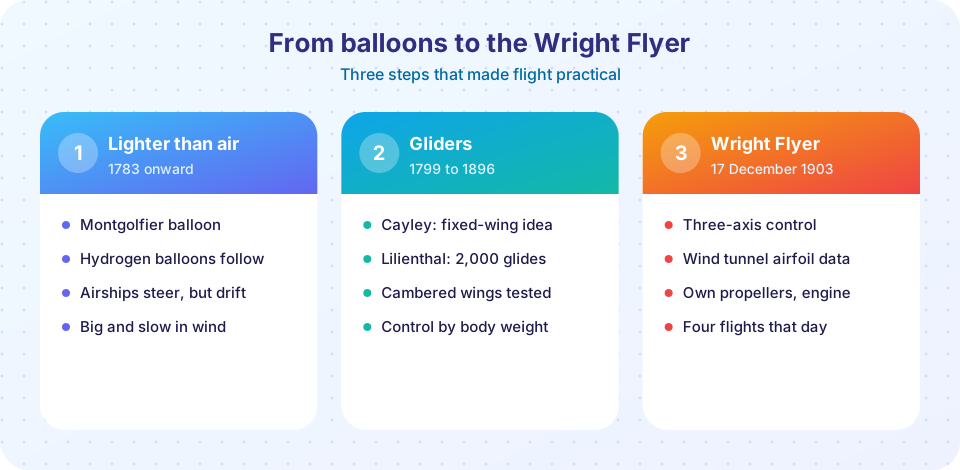
For most of history, people watched birds and failed to copy them. Flapping wings do not scale up to human size, and engines were far too heavy. Flight arrived through three separate routes: lighter-than-air balloons, unpowered gliders that taught the science of wings, and finally the powered, controllable airplane. This lesson follows each route and ends with the physics of the 1903 Wright Flyer.
What you will learn
- How balloons and airships worked and why they could not become general transport
- What Cayley and Lilienthal contributed to wing science
- How the Wright brothers solved control, propulsion and wing design
- How much wing area and power the first Flyer needed compared with today
Key terms
Buoyancy is the upward force on a body in a fluid, equal to the weight of the fluid displaced.
Camber is the curvature of a wing section.
Wing warping is twisting the wing tips to control roll, the Wrights' method.
Wing loading is aircraft weight divided by wing area (N/m²).
Lighter than air: balloons and airships
In June 1783 the brothers Joseph-Michel and Jacques-Étienne Montgolfier showed a large hot-air balloon in France. On 21 November 1783 two men, Pilâtre de Rozier and the Marquis d'Arlandes, made the first free flight by humans, lasting about 25 minutes across Paris. A few days later the physicist Jacques Charles flew a hydrogen balloon.
A balloon works by buoyancy, Archimedes' principle: the lifting force is the weight of the air displaced minus the weight of the gas inside. Hot air is lighter than cold air, hydrogen and helium are lighter still. No wing, no engine, no speed needed.
The weakness is steering. A balloon drifts with the wind. Airships add engines and propellers, and the first successful rigid airship, the Zeppelin LZ 1, flew in 1900. They carried passengers across oceans in the 1920s and 1930s, but their huge volume made them slow and vulnerable to weather, and the 1937 Hindenburg fire ended their era as airliners.
Gliders and the science of wings
Sir George Cayley (1773 to 1857) was the first to separate the three jobs of an aircraft: lift from a fixed wing, thrust from a separate propulsion system and control from a tail. In 1799 he engraved that layout on a silver disk, and in the 1800s he built gliders, including one reported to carry a person in 1853.
Otto Lilienthal of Germany made more than 2,000 glider flights between 1891 and 1896. He published tables of lift measured on cambered wing shapes, showing that a curved wing makes much more lift than a flat plate. He controlled his gliders by shifting his body weight. In 1896 he died after a stall and crash. His data and his example inspired the Wright brothers.
The Wright brothers
Wilbur and Orville Wright ran a bicycle shop in Dayton, Ohio. They approached flight as an engineering problem and tackled it in order of risk:
- Control. Gliders had to be steered in three axes: pitch with a front elevator, roll by twisting the wingtips ("wing warping") and yaw with a rudder. The Wrights made the pilot a controller, not a passenger.
- Wing data. Lilienthal's tables did not match their glider tests, so in autumn 1901 they built a small wind tunnel and tested more than 200 wing shapes. Their 1902 glider flew well.
- Propulsion. No engine on the market was light enough, so they built one, together with their mechanic Charlie Taylor: about 12 horsepower (9 kW). They also designed the propellers, treating them as rotating wings.
On 17 December 1903, at Kitty Hawk, North Carolina, the Flyer made four flights. The first, by Orville, lasted 12 seconds and covered about 37 m. The fourth, by Wilbur, lasted 59 seconds and covered about 260 m. The aircraft had a wingspan of about 12.3 m, a wing area of about 47 m² and weighed roughly 340 kg with its pilot.
How big was the Flyer's lift coefficient?
Use the lift equation from the four forces. With W ≈ 3,350 N (about 340 kg), S ≈ 47.4 m² and rho ≈ 1.2 kg/m³, a flight through the air at 12 m/s needs:
CL = W / (1/2 rho V² S) = 3,350 / (0.5 × 1.2 × 144 × 47.4) ≈ 0.82
That is a plausible figure for a cambered wing, near the top of its range for a thin wing, which explains why the Flyer flew slowly and close to the ground. Its wing loading, W/S ≈ 71 N/m², is tiny: a modern airliner carries about 5,600 N/m².
After 1903 progress was fast. By 1909 Louis Blériot crossed the English Channel (25 July). Between 1914 and 1918 the air war pushed engines from tens of horsepower to hundreds and made aircraft stronger, faster and more reliable.
Try it
Press Run (or Ctrl + Enter) to see the result here.
Program input · what you'd type while the program runs
Type the answers before you press Run, one per line. Each time the program reads a line (with input()), it gets the next line from this box.
Press Run (or Ctrl + Enter) to see the console output here.
No output.
Common misconceptions
"The Wrights had no competition." Others, such as Samuel Langley, had well-funded programs. The Wrights succeeded because they tested control and wing shapes systematically.
"Balloons were useless for flight science." They gave the first data on the upper atmosphere, and they proved that people could survive in the air.
"The first flight was a hop." It was short, but it was sustained, controlled and powered, which is exactly what distinguishes a flight from a jump.
Check your understanding
Quick check · 5 questions
of 5 answered You scored / 5 · perfect!
-
1. A balloon rises because of
The displaced air weighs more than the balloon plus its hot gas, so the net force is up. -
2. Which person first described the layout of fixed wings, a separate engine and a tail?
Cayley separated lift, thrust and control in 1799. -
3. What did the Wrights build in 1901 that Lilienthal's followers did not have?
Their tunnel tests produced reliable lift data for their 1902 glider and 1903 Flyer. -
4. How did the Wright Flyer control roll?
The pilot twisted the wingtips with a hip cradle; hinged ailerons came later. -
5. The Flyer's wing loading was about
3,350 N divided by 47.4 m2 is about 71 N/m2.
Summary
- Balloons flew in 1783 by buoyancy but could not be steered; airships added engines but stayed large and slow.
- Cayley defined the airplane layout, Lilienthal measured cambered wings in 2,000 glides.
- The Wrights succeeded by solving control, collecting wing data and building their own engine and propellers.
- The 1903 Flyer flew at very low wing loading and speed; wartime pressure then drove rapid progress.
Next: The jet and space ages
Track your progress
Create a free account to tick off lessons and pick up where you left off on any device.
of Aerospace Engineering lessons completed