


















Lesson 38 of 45 · Mission Design
Delta-v Budgets and Launch Windows
Learn to add up the delta-v for a mission, work backward through the rocket equation to propellant mass, and find launch windows from synodic periods and phase angles.
Every maneuver costs Δv, and every kilogram of propellant to supply it has to be carried by the earlier burns. A delta-v budget lists all maneuvers in a mission and their sizes, with a margin on top. It is the single most useful planning tool in mission design: from it you can tell at a glance whether a mission is easy (a few hundred m/s), demanding, or impossible with today's rockets. And because planets keep moving, even a perfect budget must be matched with the right date: the launch window.
What you will learn
- Read and build a delta-v budget, including margin.
- Work backward from the end of a mission to the starting mass.
- Estimate the cost of common maneuvers and station-keeping.
- Compute synodic periods and the phase angle for a Hohmann transfer.
- Explain why interplanetary launch windows come in periodic bursts.
Key terms
Delta-v budget: the list of all velocity changes a mission needs, usually with a margin.
Synodic period: the time for two orbiting bodies to return to the same relative position, 1/S = |1/T₁ − 1/T₂|.
Phase angle: the angle at the central body between the departure and target planets at launch.
Launch window: the span of dates on which a launch can reach the target with the available Δv.
Station-keeping: small burns that hold a satellite on its assigned orbit against perturbations.
Reading the map
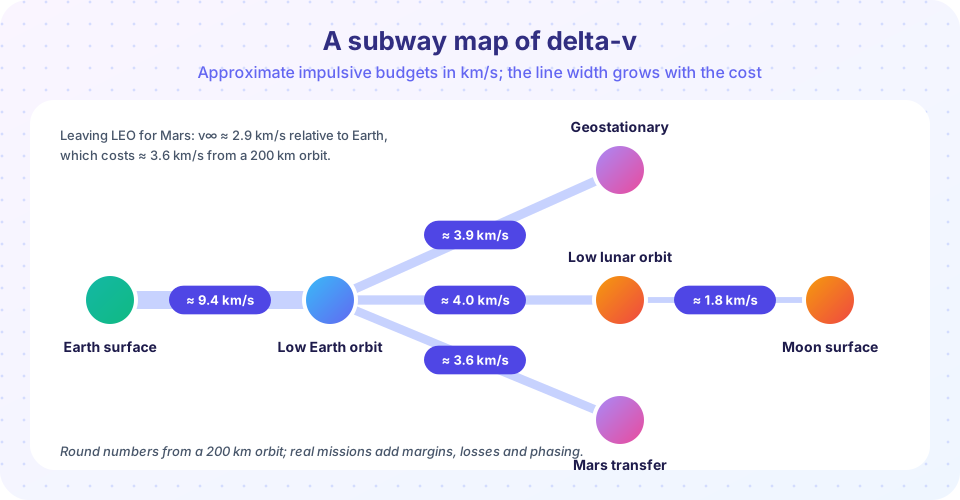
The picture lists rounded, impulsive values from a 200 km parking orbit:
| Maneuver | Approximate Δv |
|---|---|
| Earth surface to low Earth orbit | 9.3 to 9.5 km/s (including gravity and drag losses) |
| LEO to geostationary orbit (via a transfer orbit) | about 3.9 km/s |
| LEO to low lunar orbit (trans-lunar injection plus lunar orbit insertion) | about 4.0 km/s (roughly 3.1 + 0.9) |
| Low lunar orbit to the surface (powered descent) | about 1.7 to 2 km/s |
LEO to Mars transfer (leaving with v∞ = 2.94 km/s) |
about 3.6 km/s |
| GEO north-south station-keeping | about 50 m/s per year |
| De-orbit a low satellite | tens to a few hundred m/s |
Values depend on the exact orbit, the date and how losses are counted. In practice every budget gets a margin, commonly a few percent to ten percent or more early in a project, shrinking as the design matures.
Working backward with the rocket equation
Budgets multiply. Say a lunar lander has a dry mass of 2,000 kg and must descend from lunar orbit (1.8 km/s) with an engine of Isp = 320 s (vₑ = 3,138 m/s). The propellant it needs is
m_prop = m_dry · (e^(Δv/vₑ) − 1) = 2000 × (e^(1800/3138) − 1) ≈ 1,550 kg
So the lander at the start of descent has a mass of 3,550 kg. Whatever carried it to the Moon must now push 3,550 kg through lunar orbit insertion and trans-lunar injection. Each earlier burn faces a heavier spacecraft, so the mass grows geometrically as you work backward. This is the rocket equation applied stage after stage, and it is why Moon and Mars missions need rockets of enormous size, or refueling in orbit.
The right procedure is therefore to start at the end of the mission with the final mass (the payload plus dry hardware), step backward through each burn, and read off the starting mass.
Launch windows
Orbits are periodic, so the geometry repeats. For two planets with orbital periods T₁ and T₂, the synodic period is
S = 1 / | 1/T₁ − 1/T₂ |
Earth (365.256 d) and Mars (686.98 d) give S ≈ 780 days, about 26 months; Earth and Venus give about 584 days; Earth and Jupiter about 399 days. A Hohmann transfer to Mars takes 259 days, during which Mars moves forward by about 136° along its orbit. To arrive at the right spot, Mars must lead Earth by 180° − 136° ≈ 44° at departure. That phase angle happens once per synodic period, so Mars launch opportunities come in clusters about every 26 months, each lasting a few weeks. NASA's Perseverance rover, for example, launched on 30 July 2020 within one such window.
Missing a window is costly: the next one is more than two years away. Real windows have width because a spacecraft can accept more Δv, a longer flight or a different trajectory shape in exchange for flexibility. Earth orbit missions have daily windows set by the Earth's rotation, because the launch site must pass through the orbital plane. A sun-synchronous satellite launches at a specific local time of day.
Beyond the impulsive model
Electric propulsion changes the budget: it needs more time but much less propellant for the same Δv, thanks to a very high Isp. A spacecraft that spirals out over months uses a different Δv accounting, since long burns do not follow the impulsive formulas exactly. Also, finite-burn losses, gravity losses during landing and the cost of safely correcting trajectory errors all need to be added to the textbook numbers.
Common misconceptions
"The Δv map is a distance table." Δv is not additive over distance; it depends on speed changes. A trip to the Moon's surface and back is the sum of four large burns, not a measure of kilometers.
"We can launch to Mars any day." Without a window, the Δv rises steeply or the flight takes much longer.
"Margin is waste." A 5% error in a large budget is hundreds of m/s, enough to end a mission.
Try it
Press Run (or Ctrl + Enter) to see the result here.
Program input · what you'd type while the program runs
Type the answers before you press Run, one per line. Each time the program reads a line (with input()), it gets the next line from this box.
Press Run (or Ctrl + Enter) to see the result here.
Program input · what you'd type while the program runs
Type the answers before you press Run, one per line. Each time the program reads a line (with input()), it gets the next line from this box.
Check your understanding
Quick check · 5 questions
of 5 answered You scored / 5 · perfect!
-
1. Approximately how long is the Earth-Mars synodic period?
1/S = 1/365.26 − 1/686.98 gives S ≈ 780 days, about 26 months. -
2. Why does working backward through the burns increase the mass at each step?
Propellant for later maneuvers is part of the mass that earlier burns accelerate, so the starting mass grows geometrically. -
3. A lander with dry mass 1,000 kg must produce Δv = 1.5 km/s with Isp = 300 s. How much propellant does it need? (vₑ = 2,942 m/s)
m_prop = 1000 × (e^(1500/2942) − 1) = 1000 × (1.665 − 1) ≈ 665 kg. -
4. What does the phase angle for a Mars Hohmann transfer describe?
Mars must lead Earth by about 44° so that it arrives at the transfer orbit's aphelion at the same time as the spacecraft. -
5. Which is the largest single Δv in a typical Earth-to-Moon mission?
About 9.4 km/s to reach LEO beats every later maneuver.
Summary
- A Δv budget sums every maneuver plus margin; work backward from the end to find starting mass.
- Reaching orbit is the biggest single cost (about 9.4 km/s); LEO to Mars is about 3.6 km/s, Moon orbit about 4 km/s.
- Launch windows repeat every synodic period (Earth-Mars about 780 days) because planetary geometry repeats.
- Margins, finite-burn losses and station-keeping must be added to textbook values.
Track your progress
Create a free account to tick off lessons and pick up where you left off on any device.
of Aerospace Engineering lessons completed