


















Lesson 28 of 45 · Rocket Propulsion
The Rocket Equation
Derive and use the Tsiolkovsky rocket equation, from mass ratio and propellant fraction to gravity losses, with worked numbers and plots for real launchers.
How fast can a rocket go? The answer is one of the most important equations in all of engineering, and it is surprisingly short. It says that the speed a rocket can gain depends on only two things: how fast it throws its exhaust, and the ratio of its starting mass to its final mass. It does not depend on how fast the rocket burns its fuel, nor on the shape of the vehicle. But because the relation is a logarithm, adding speed gets harder and harder, and that fact shapes every rocket ever built.
What you will learn
- Derive the rocket equation from conservation of momentum.
- Compute delta-v from specific impulse and mass ratio, and the reverse.
- Explain why the relationship is exponential and what that does to payload.
- Use structural fraction to find the payload a single stage could carry.
- Account for gravity and drag losses on the way to orbit.
Key terms
Delta-v (Δv): the total change in velocity a vehicle can produce; the "fuel gauge" of space flight.
Mass ratio: m₀ / m_f, initial mass divided by final (burnout) mass.
Structural coefficient (ε): stage structure mass divided by structure plus propellant mass, ε = m_s / (m_s + m_p).
Gravity loss: speed lost because the engine must fight gravity while still climbing.
g₀: the standard gravity 9.80665 m/s², used as a unit-conversion constant in Isp.
Deriving the equation
Let the rocket have mass m and speed v. A tiny mass dm of propellant leaves backward at relative speed vₑ. Conservation of momentum gives m dv = −vₑ dm (the rocket loses mass, so dm is negative). Rearranging, dv = −vₑ dm / m. Integrate from the initial mass m₀ to the final mass m_f, with vₑ constant:
Δv = vₑ ln(m₀ / m_f) with vₑ = Isp · g₀
This is the Tsiolkovsky rocket equation. Invert it to find the mass ratio for a mission:
m₀ / m_f = e^(Δv / (Isp · g₀)) propellant fraction = 1 − m_f/m₀
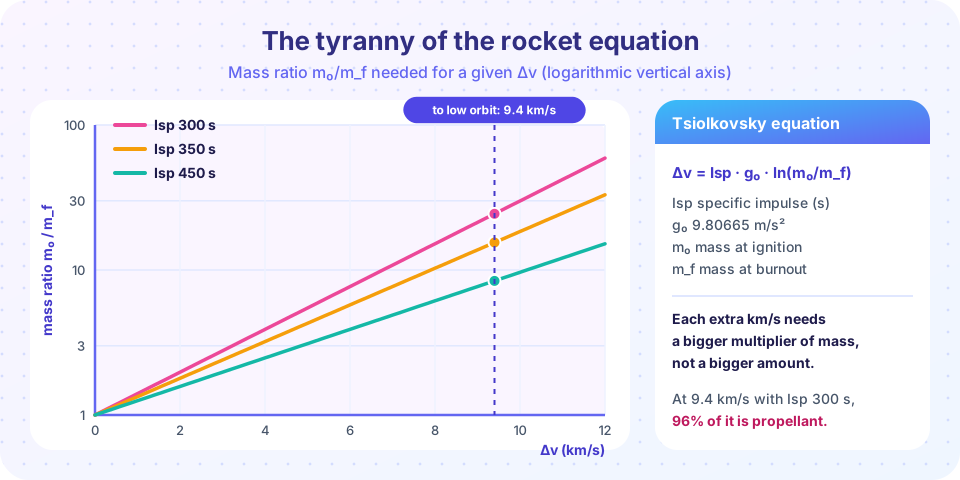
Worked example: to produce 9.4 km/s with Isp = 300 s (so vₑ = 2,942 m/s):
mass ratio = e^(9400 / 2942) = e^3.195 ≈ 24.4 propellant = 1 − 1/24.4 ≈ 96%
A rocket that is 96% propellant has only 4% left for engines, tanks, wiring and payload. With Isp = 450 s (hydrogen-oxygen), the ratio falls to about 8.4 and the propellant to 88%. Better efficiency pays off exponentially.
The tyranny of the logarithm
The exponent is Δv / vₑ. Each extra vₑ of Δv multiplies the required mass ratio by e ≈ 2.72. For a mass ratio of 2.72 you gain exactly one exhaust velocity. Gain two, you need 7.4. Three, 20. This is why:
- Small increases in Δv are expensive. Going from 9.4 to 10.4 km/s with
Isp = 300 smultiplies the mass ratio bye^(1000/2942) ≈ 1.40, so a 40% bigger ratio for a 10% bigger Δv. - Efficiency matters enormously. Doubling
Ispsquares-root the ratio (the exponent halves). - Payload is what is left over. Every kilogram of structure added to a stage reduces the payload by about a kilogram.
Structure and payload
A real stage needs tanks, engines and structure. Define ε = m_s / (m_s + m_p), a number around 0.05 to 0.12 for modern liquid stages (smaller is better). If the payload is a fraction λ = m_pl / m₀ of the liftoff mass, then
m_f / m₀ = ε + (1 − ε) λ so λ = ( e^(−Δv/(Isp·g₀)) − ε ) / (1 − ε)
For Δv = 9.4 km/s, Isp = 350 s, e^(−Δv/vₑ) = 0.065. If ε = 0.08 the numerator is negative: a single stage cannot reach orbit with that structure. Even a very light stage (ε = 0.05) would deliver only about 1.5% payload. This is the "single-stage-to-orbit" problem, and the reason almost every launcher uses several stages (next lessons).
Gravity and drag: why 9.4, not 7.8?
Circular orbit speed at LEO is about 7.8 km/s, but launch vehicles are sized for about 9.3 to 9.5 km/s of Δv. The difference is losses:
- Gravity loss, about 1.0 to 1.5 km/s: while the rocket climbs, gravity subtracts
g·tfrom the speed. A short, powerful burn (high thrust-to-weight) loses less. A rocket that hovers losesgevery second. - Drag loss, about 0.1 to 0.2 km/s: air resistance in the lowest 20 km.
- Steering loss: thrust not perfectly aligned with motion.
- Earth's rotation helps: up to about 0.46 km/s at the equator for an eastward launch.
In a vertical climb without drag the speed at burnout is Δv_ideal − g·t_burn. The plot below compares different thrust-to-weight ratios.
Common misconceptions
"Double the propellant, double the Δv." Δv grows with the logarithm of the mass ratio. Doubling the propellant of a rocket that is already 90% fuel adds only a modest amount.
"A more powerful engine gives more Δv." Thrust sets how quickly Δv is gained and therefore the gravity loss. Δv itself depends on Isp and mass ratio.
"g₀ in Isp is the gravity where you are." It is a fixed constant, 9.80665 m/s², used to express Isp in seconds. The same engine has the same Isp on the Moon.
Try it
Press Run (or Ctrl + Enter) to see the result here.
Program input · what you'd type while the program runs
Type the answers before you press Run, one per line. Each time the program reads a line (with input()), it gets the next line from this box.
Press Run (or Ctrl + Enter) to see the result here.
Program input · what you'd type while the program runs
Type the answers before you press Run, one per line. Each time the program reads a line (with input()), it gets the next line from this box.
Press Run (or Ctrl + Enter) to see the result here.
Program input · what you'd type while the program runs
Type the answers before you press Run, one per line. Each time the program reads a line (with input()), it gets the next line from this box.
Check your understanding
Quick check · 5 questions
of 5 answered You scored / 5 · perfect!
-
1. A rocket has Isp = 400 s and a mass ratio of 10. What Δv can it produce? (g₀ = 9.80665 m/s²)
Δv = 400 × 9.80665 × ln 10 = 3,922 × 2.303 ≈ 9,030 m/s. -
2. If the Δv requirement increases by one exhaust velocity, the mass ratio is multiplied by
m₀/m_f = exp(Δv/vₑ), so adding vₑ to Δv multiplies the ratio by e. -
3. Which change most reduces the propellant needed for a fixed Δv?
Higher Isp raises vₑ, which lowers the exponent Δv/vₑ. -
4. Why is a launcher sized for about 9.4 km/s even though orbital speed is about 7.8 km/s?
Gravity loss (about 1 to 1.5 km/s), drag, and steering losses add to the ideal 7.8 km/s, partly offset by Earth's rotation. -
5. With Isp 350 s and structure fraction 0.08, a single stage designed for 9.4 km/s
e^(−9400/3432) = 0.065, which is smaller than ε = 0.08, so the formula gives a negative payload fraction.
Summary
Δv = vₑ ln(m₀/m_f)withvₑ = Isp · g₀; invert it to get mass ratio and propellant fraction.- The relation is exponential: each extra exhaust velocity of Δv multiplies the mass ratio by
e. - With realistic structure fractions a single stage barely or never reaches orbit.
- Launch Δv of about 9.4 km/s includes gravity, drag and steering losses; high thrust-to-weight reduces gravity loss.
Track your progress
Create a free account to tick off lessons and pick up where you left off on any device.
of Aerospace Engineering lessons completed