


















Lesson 4 of 45 · Getting Started
The four forces of flight
Understand lift, weight, thrust and drag, the lift equation, force balance in level flight and climb, and why speed and altitude change the lift coefficient.
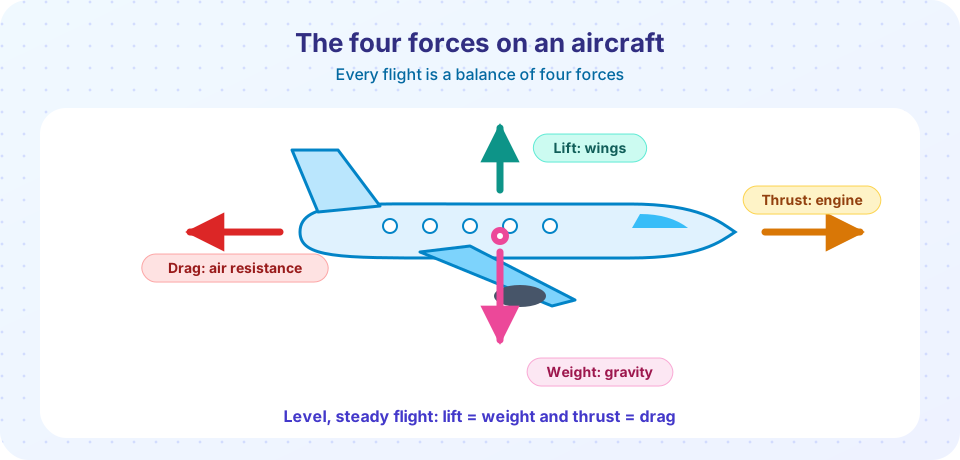
Four forces act on every aircraft: lift, weight, thrust and drag. If you can write the balance between them, you can already answer real design questions: how fast must a plane fly to stay up? How much thrust does it need to climb? Why does it need a longer runway on a hot day?
In this lesson you set up the force balance, meet the lift equation and use it to find the stall speed of a typical airliner.
What you will learn
- What each of the four forces is, where it comes from and which way it points
- The force balance for level, steady flight and for a steady climb
- The lift equation
L = 1/2 rho V^2 S CLand the meaning of each symbol - How to find the lift coefficient needed at a given speed and the stall speed
Key terms
Lift is the aerodynamic force perpendicular to the oncoming air.
Drag is the aerodynamic force parallel to the oncoming air, opposing motion.
Thrust is the force produced by the propulsion system.
Lift coefficient (CL) is a dimensionless number that measures how effectively a wing shape produces lift at a given angle.
Dynamic pressure (q) is 1/2 rho V^2, the pressure of the moving air.
The four forces
Weight W = m g pulls straight toward the center of the Earth through the aircraft's center of gravity. Its direction is always vertical.
Lift L is produced mainly by the wings. It is defined as perpendicular to the relative wind, which is the airflow the aircraft sees. In level flight that means upward. Lift is not "air pushing up from below": the wing deflects a large mass of air downward, and by Newton's third law the air pushes the wing up. Equally, pressure is lower on the top of the wing than on the bottom. Both descriptions are the same physics seen from different angles; you will look at it in lesson 12.
Thrust T comes from engines. It usually points roughly along the fuselage.
Drag D is the aerodynamic resistance, parallel to the relative wind and pointing backward. It comes from skin friction, pressure differences and the cost of making lift. Chapter 3 splits it into parts.
Balance in level, steady flight
"Steady" means no acceleration. By Newton's first law the forces cancel:
- Vertical:
L = W - Horizontal:
T = D
Two consequences follow. First, if you fly slower, the wing must make the same lift with less dynamic pressure, so it needs a bigger angle of attack, and therefore a bigger lift coefficient. There is a limit (the stall), which fixes a minimum speed. Second, the thrust needed in cruise equals the drag. Reducing drag is the main way to save fuel.
For a steady climb at angle gamma to the horizontal (small gamma = shallow), the balance rotates with the flight path:
- Perpendicular to the path:
L = W cos(gamma) - Along the path:
T = D + W sin(gamma)
The extra thrust W sin(gamma) is what lifts the aircraft's weight uphill. A glider has T = 0, so it descends at the angle where D = W sin(gamma), which is the idea behind glide ratio (chapter 4).
The lift equation
Aerodynamicists package everything about the wing into one number, so the lift follows from a standard formula:
L = 1/2 · rho · V² · S · CL
rhois the air density (kg/m³).Vis the true airspeed (m/s).Sis the wing reference area (m²).CLis the lift coefficient, dimensionless, set by the wing shape and the angle of attack.
Drag has the same form, D = 1/2 rho V² S CD.
Worked example: an airliner in cruise
Suppose an airliner has mass 70,000 kg and wing area 122 m². At 11 km, rho = 0.3639 kg/m³, and it cruises at V = 230 m/s.
- Weight:
W = 70,000 × 9.80665 = 686,466 N. - Dynamic pressure:
q = 0.5 × 0.3639 × 230² = 9,625 Pa. - Required
CL = W / (q S) = 686,466 / (9,625 × 122) ≈ 0.585.
A lift coefficient of 0.58 is comfortable, far below the maximum of about 1.3 to 1.5 for a clean wing.
Stall speed
Every wing has a maximum lift coefficient, CL_max. Beyond it, airflow separates from the top surface and lift collapses (a stall). Setting L = W at CL_max gives the slowest steady speed:
V_stall = sqrt( 2 W / (rho S CL_max) )
With flaps extended, CL_max rises to perhaps 2.5 or 3, which is why landing speeds can be low. With the figures above at sea level (rho = 1.225) and CL_max = 2.5: V_stall = sqrt(2 × 686,466 / (1.225 × 122 × 2.5)) ≈ 60.6 m/s, or about 118 knots. Airliners fly the final approach at roughly 1.2 to 1.3 times the stall speed, for a safety margin.
Try it
Press Run (or Ctrl + Enter) to see the result here.
Program input · what you'd type while the program runs
Type the answers before you press Run, one per line. Each time the program reads a line (with input()), it gets the next line from this box.
Press Run (or Ctrl + Enter) to see the console output here.
No output.
Common misconceptions
"Lift is only caused by air traveling faster over the top because it has farther to go." The equal-transit-time story is wrong: air over the top of a wing arrives at the trailing edge well before air under it. The lift comes from the wing turning the flow downward and from the pressure difference that results.
"Thrust holds the aircraft up." In level flight thrust only balances drag. The wing balances the weight.
"Heavier aircraft need more thrust at all times." Weight needs more lift, which brings more induced drag, so the thrust needed rises, but not in simple proportion.
Check your understanding
Quick check · 5 questions
of 5 answered You scored / 5 · perfect!
-
1. In steady, level flight, which pair of equalities holds?
Vertical forces cancel (lift and weight) and horizontal forces cancel (thrust and drag). -
2. If an aircraft halves its speed in level flight at the same altitude, the required lift coefficient
L is proportional to V squared times CL, so halving V needs four times the CL. -
3. What does a stall mean?
A stall is an aerodynamic event at high angle of attack, not an engine failure. -
4. In a steady climb at angle gamma, thrust must equal
Along the flight path thrust balances drag plus the component of weight acting back along the path. -
5. Which quantity is NOT in the lift equation?
The lift equation is L = 1/2 rho V^2 S CL, with no thrust term.
Summary
- Lift, weight, thrust and drag balance in steady flight:
L = WandT = Dwhen level. - In a steady climb,
L = W cos(gamma)andT = D + W sin(gamma). L = 1/2 rho V² S CL; slower flight or thinner air needs a larger CL.- The stall speed is
sqrt(2W / (rho S CL_max)); flaps raiseCL_maxand so lower the stall speed.
Next: Chapter 1 review
Track your progress
Create a free account to tick off lessons and pick up where you left off on any device.
of Aerospace Engineering lessons completed