


















Lesson 26 of 45 · Orbital Mechanics
Chapter 5 Review: Orbits on One Page
One-page recap of orbital mechanics: Kepler's laws, vis-viva, orbit energy and Hohmann transfers, with a calculator and a ten-question review quiz.
You now have the four core ideas of orbital mechanics: orbits are ellipses with a focus at the central body; energy sets the shape and size; vis-viva gives speed from position; and burns at the right place move you to a new orbit. This review puts them on one page, shows how they connect, and tests you with a longer quiz.
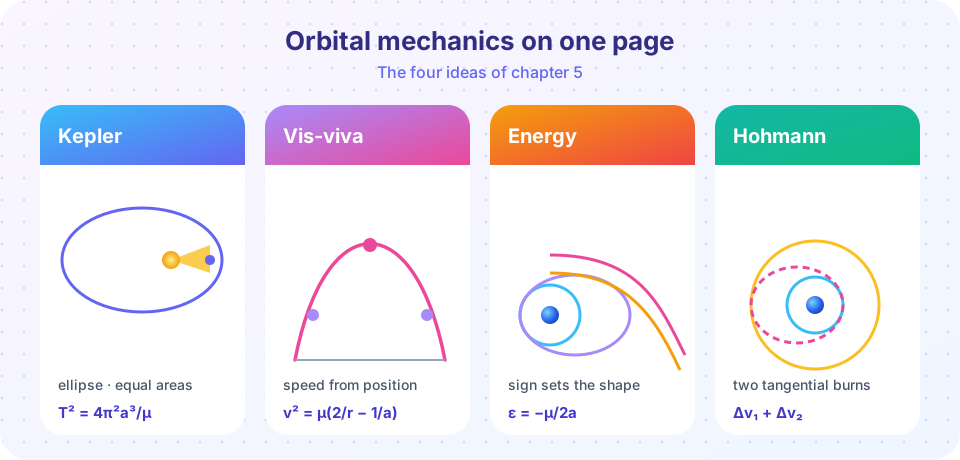
The chapter in a table
| Idea | Key formula | One number to remember |
|---|---|---|
| Circular orbit | v = √(μ/r), T = 2π√(r³/μ) |
400 km: 7.67 km/s, 92.6 min |
| Kepler 1 and eccentricity | r_p = a(1 − e), r_a = a(1 + e) |
e = 0 circle, e → 1 very elongated |
| Kepler 2 | r_p v_p = r_a v_a |
v_p/v_a = (1 + e)/(1 − e) |
| Kepler 3 | T = 2π√(a³/μ) |
GEO radius 42,164 km, T = 23 h 56 min |
| Vis-viva | v² = μ(2/r − 1/a) |
speed from r and a only |
| Energy | ε = −μ/(2a) = v²/2 − μ/r |
ε < 0 bound, ε = 0 escape, ε > 0 hyperbola |
| Escape speed | v_esc = √2 · v_circ |
11.18 km/s at Earth's surface |
| Hohmann | a_t = (r₁ + r₂)/2, two tangential burns |
LEO to GEO: 3.89 km/s, 5.28 h |
How the pieces connect
- Geometry (Kepler) tells you the orbit is an ellipse and that the period depends on
a. - Energy says the orbit's
ais fixed byε, so to change the size of an orbit you change energy. - Vis-viva turns
aandrinto speed, so you know the speed before and after any burn. - Burns change
vand thereforeε. The Hohmann transfer is the pair of burns that does it cheapest:Δv = |v_after − v_before|at each end of the transfer ellipse.
Whenever a problem seems hard, follow that chain: find a for each orbit, compute speeds with vis-viva at the point of the burn, subtract.
Common misconceptions
"Eccentricity changes the period." Only a does.
"Escape needs a straight-up launch." Escape needs enough energy, in any direction that clears the planet.
"Hohmann is always optimal." It is optimal for two coplanar tangential impulses between circles. Bi-elliptic, low-thrust or gravity-assist paths can beat it in other situations.
Try it
Press Run (or Ctrl + Enter) to see the result here.
Program input · what you'd type while the program runs
Type the answers before you press Run, one per line. Each time the program reads a line (with input()), it gets the next line from this box.
Press Run (or Ctrl + Enter) to see the result here.
Program input · what you'd type while the program runs
Type the answers before you press Run, one per line. Each time the program reads a line (with input()), it gets the next line from this box.
Check your understanding
Quick check · 10 questions
of 10 answered You scored / 10 · perfect!
-
1. A circular orbit has radius r. Which speed corresponds to exactly escaping from that radius?
Escape speed is √2 times the circular speed, √(2μ/r), the parabolic case of vis-viva. -
2. Two orbits have the same semi-major axis but different eccentricities. Which statement is true?
T = 2π√(a³/μ) and ε = −μ/(2a) depend only on a. -
3. A satellite is at periapsis. It is moving at 9 km/s at r = 7,000 km. At apoapsis r = 28,000 km. What is its speed there?
Angular momentum is constant at the apsides: v_a = v_p · r_p / r_a = 9 × 7,000 / 28,000 = 2.25 km/s. -
4. Which orbit has negative specific energy?
Bound orbits (circles and ellipses) have ε = −μ/(2a) < 0. -
5. The first Hohmann burn raises the orbit's
Burn 1 is applied at the inner circle and raises the opposite side of the orbit to the target radius; burn 2 then raises the periapsis. -
6. Which is cheaper in Δv: changing inclination by 30° at LEO speed (7.7 km/s) or at GEO transfer apogee speed (1.6 km/s)?
Δv = 2v sin(Δi/2) is proportional to v, so low speed is cheaper. -
7. Why does a higher circular orbit have a longer period even though the satellite gained speed to reach it?
Circular speed is √(μ/r), which falls with radius, and the path is longer, so T = 2πr/v grows. -
8. A GEO transfer orbit has perigee 300 km and apogee 35,786 km altitude. Its speed is largest at
Speed is largest at the closest point (about 10.15 km/s here) and smallest at the farthest (about 1.61 km/s). -
9. Which statement about the Oberth effect is correct?
Energy gain is about v·Δv, so the same Δv adds more energy at high speed, such as at periapsis. -
10. For Earth, what is the radius of the geostationary orbit?
The radius from Earth's center is about 42,164 km; the altitude above the equator is 35,786 km.
Summary
- Kepler's laws give orbit geometry;
Tdepends onaalone. - Energy
ε = −μ/(2a)sets size, and its sign sets bound or escaping. - Vis-viva
v² = μ(2/r − 1/a)gives speed anywhere; burns addΔvwhere it is cheapest. - A Hohmann transfer is two tangential burns; know when plane changes and bi-elliptic paths matter.
Track your progress
Create a free account to tick off lessons and pick up where you left off on any device.
of Aerospace Engineering lessons completed