


















Lesson 30 of 45 · Rocket Propulsion
Staging: Dropping the Dead Weight
Learn why rockets use stages, how to add stage delta-v values, why three stages is a sweet spot, and how serial and parallel staging differ, with worked mass numbers.
The rocket equation has a harsh message: every kilogram of empty tank you carry to orbit is a kilogram that needed fuel to push it there, and that fuel needed more fuel. The practical cure is simple. When a tank is empty, throw it away. A rocket divided into stages does exactly that: each stage burns its propellant, then separates, so the next stage no longer lifts the dead weight. Nearly every orbital launcher in history has used this trick, from the first Soviet R-7 to the Saturn V.
What you will learn
- Explain why discarding empty stages increases the final speed.
- Calculate stage-by-stage Δv and add the results.
- Compare a two-stage rocket with a single stage of the same hardware.
- Describe serial (tandem) and parallel (strap-on) staging.
- See why returns diminish after about three stages.
Key terms
Stage: a self-contained rocket section with its own tanks and engines. Tandem (serial) staging: stages stacked one above the other and fired in sequence. Parallel staging: strap-on boosters that burn alongside the core stage. Payload ratio of a stage: the mass above the stage divided by the stage's initial mass. Hot staging: igniting the next stage's engines just before separation.
Adding up stage Δv
Each stage is a small rocket that gets its own rocket-equation. The total is the sum:
Δv_total = Σ Isp_i · g₀ · ln( m₀,i / m_f,i )
Here m₀,i is the mass at the start of stage i's burn (including everything above it) and m_f,i is the mass at its burnout, before the empty stage is dropped.
Worked example
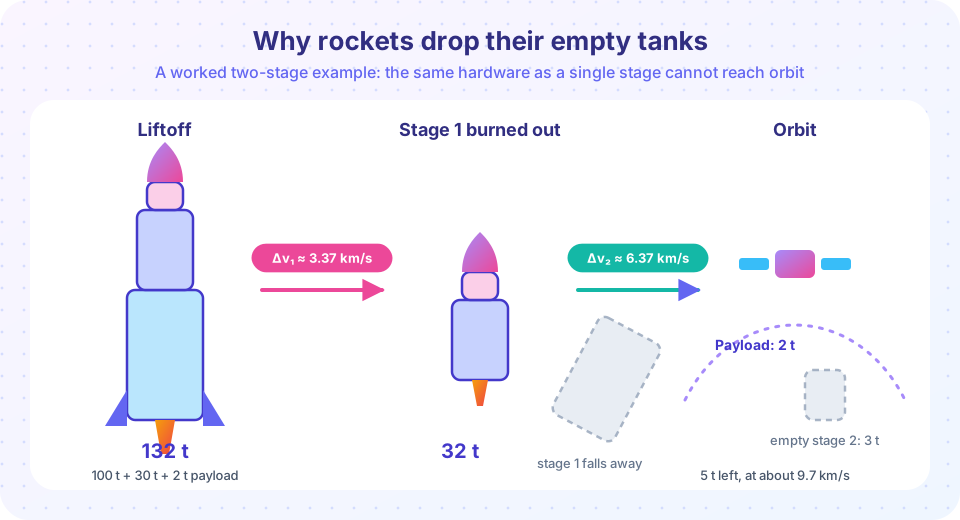
A rocket carries a 2 t payload. Stage 2 has 3 t of structure and 27 t of propellant; stage 1 has 10 t of structure and 90 t of propellant. Engines: stage 1 Isp = 300 s, stage 2 Isp = 350 s.
| Stage | Start mass m₀ |
End mass m_f |
Ratio | Δv |
|---|---|---|---|---|
| 1 | 2 + 30 + 100 = 132 t | 132 − 90 = 42 t | 3.14 | 300 × 9.80665 × ln 3.14 ≈ 3.37 km/s |
| 2 | 2 + 30 = 32 t | 32 − 27 = 5 t | 6.4 | 350 × 9.80665 × ln 6.4 ≈ 6.37 km/s |
Total: about 9.74 km/s. Now keep the same 13 t of structure and 117 t of propellant but build them as a single stage with Isp = 300 s: m₀ = 132 t, m_f = 15 t, and Δv = 300 × 9.80665 × ln(8.8) ≈ 6.40 km/s. The two-stage version gets 3.3 km/s more from the same hardware, enough to turn a rocket that cannot reach orbit into one that can.
Why does it work? After stage 1 burns out, 10 t of empty structure and tankage is shed. Stage 2 then accelerates only 5 t at burnout, so its mass ratio is large (6.4) even though it carries only 27 t of propellant.
The law of diminishing returns
Suppose every stage has the same Isp and structure fraction ε, and the Δv is shared equally among N stages. Each stage then has payload ratio λ₁ = (e^(−Δv/(N·vₑ)) − ε)/(1 − ε), and the total payload ratio is λ₁^N. For Δv = 9.4 km/s, Isp = 350 s, ε = 0.08:
| Stages | Δv per stage | Payload fraction of liftoff mass |
|---|---|---|
| 1 | 9.4 km/s | impossible (negative) |
| 2 | 4.7 km/s | about 3.6% |
| 3 | 3.13 km/s | about 4.3% |
| 4 | 2.35 km/s | about 4.5% |
Going from one to two stages is the difference between impossible and possible. Going from three to four adds little payload but another set of engines, separation mechanisms, and failure modes. That is why most launchers have two or three stages. Real stages also use different Isp and structure, and the best split of Δv is not equal. Chapter 9's project optimizes it.
Serial and parallel staging
- Tandem: stages stacked in a column, fired one after the other (Saturn V had three: S-IC, S-II, S-IVB). Simple aerodynamics, simple load path.
- Parallel: boosters strapped to a core stage and fired at liftoff, then dropped. The Space Shuttle's solid boosters, the Ariane 5 boosters and the side cores of Falcon Heavy are examples. High thrust at liftoff where the rocket is heaviest.
- Mixed: parallel boosters plus a tandem upper stage is the most common modern layout.
Staging has costs: separation systems can fail, a stage that does not light is a mission loss, and every stage needs its own tanks, plumbing and engines. Since 2015, SpaceX and others have shown that first stages can fly back and land to be reused, which changes the economics: expendable launchers throw away their most expensive part, and reusability tries to avoid that.
Common misconceptions
"More stages is always better." Each added stage yields less, and adds failure points and mass for separation hardware.
"Staging makes the engines more efficient." Engine Isp is unchanged. Staging only removes mass that is no longer useful.
"Stages separate when they run out of fuel and fall away harmlessly." Spent stages are dropped on carefully planned trajectories (downrange, into the ocean) or de-orbited to avoid hazards.
Try it
Press Run (or Ctrl + Enter) to see the result here.
Program input · what you'd type while the program runs
Type the answers before you press Run, one per line. Each time the program reads a line (with input()), it gets the next line from this box.
Press Run (or Ctrl + Enter) to see the result here.
Program input · what you'd type while the program runs
Type the answers before you press Run, one per line. Each time the program reads a line (with input()), it gets the next line from this box.
Check your understanding
Quick check · 5 questions
of 5 answered You scored / 5 · perfect!
-
1. What is the main benefit of staging?
Staging does not change engine efficiency; it shortens the list of things the later propellant has to push. -
2. A stage starts at 40 t and burns out at 10 t (before dropping its empty tanks). Isp = 320 s. What is its Δv? (g₀ = 9.80665 m/s²)
Δv = 320 × 9.80665 × ln 4 = 3,138 × 1.386 ≈ 4.35 km/s. -
3. Which rocket arrangement burns boosters beside the core stage?
Strap-on boosters work in parallel with the core and are discarded first. -
4. How do the Δv values of the stages combine?
Each stage has its own rocket equation; the total change in velocity is the sum. -
5. Why do few launchers use more than three stages?
Payload fraction improves ever more slowly with extra stages, while engines and separation systems add cost and failure modes.
Summary
- Staging discards empty structure; total Δv is the sum of each stage's
Isp · g₀ · ln(m₀/m_f). - In the worked example, two stages deliver 9.74 km/s while the same hardware as one stage delivers 6.40 km/s.
- Payload gains shrink with each extra stage, so two or three stages are typical.
- Boosters can be added in parallel for liftoff thrust; reusability recovers stages instead of dropping them.
Track your progress
Create a free account to tick off lessons and pick up where you left off on any device.
of Aerospace Engineering lessons completed