


















Lesson 32 of 45 · Spacecraft Systems
Spacecraft Systems: The Big Picture
Chapter 7 overview: the payload and bus, the six spacecraft subsystems, the space environment they must survive, and how mass and power budgets tie them together.
Once a spacecraft separates from its rocket it is on its own. There is no air to breathe or to cool it, no mechanic to fix it, and often no way to see it except through a radio link that may take minutes or hours to cross the distance. Everything it needs must be built in and must work, often for years, without maintenance. A spacecraft is therefore a team of cooperating subsystems: some produce power, some keep temperatures livable, some point the vehicle, some talk to Earth, and one, the payload, is the reason for the whole mission.
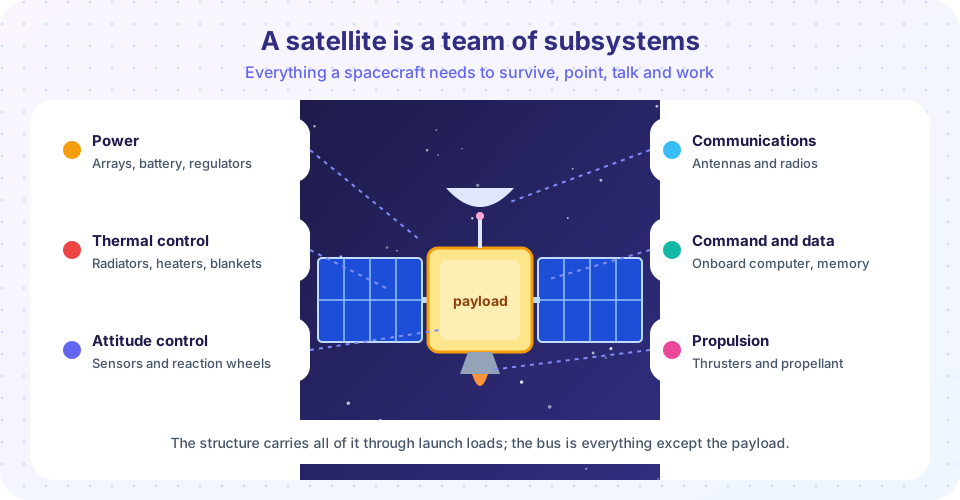
The spacecraft team
Space is harsh
Budgets rule
Margins protect against surprises.
What you will learn
- Distinguish the payload from the bus.
- Name the subsystems and what each is responsible for.
- Describe the hazards of the space environment.
- Build a simple mass and power budget with margin.
- See how the rest of the chapter fits together.
Key terms
Payload: the instruments or equipment that perform the mission (a camera, a transponder, a telescope). Bus: everything that supports the payload: power, thermal, attitude, communications, data handling, structure. Redundancy: duplicate components so a single failure does not end the mission. Safe mode: a minimal survival state that a spacecraft enters automatically when it detects a fault. Margin: extra mass, power or time kept in reserve in a budget.
The payload and the bus
Every mission starts with a payload: a camera that photographs the ground, a radio relay for television, a telescope, a sensor that measures the atmosphere. The payload defines what the spacecraft is for. The bus exists to keep the payload alive, powered, pointed and connected. Mission designers often say that the bus is the cost of doing business, and good design keeps it small so most of the mass is useful payload. Hubble Space Telescope, launched in 1990 into a low orbit around 540 km, is a good picture of the arrangement: an optical telescope payload and instruments, wrapped in a bus of solar arrays, reaction wheels, gyroscopes, communication antennas and computers.
The subsystems
| Subsystem | Job | Typical hardware |
|---|---|---|
| Electrical power (EPS) | Generate, store and distribute electricity | solar arrays, batteries, regulators; radioisotope generators far from the Sun |
| Thermal control (TCS) | Keep components within temperature limits | blankets, radiators, heaters, heat pipes, coatings |
| Attitude determination and control (ADCS) | Know and control which way the spacecraft points | star trackers, gyroscopes, reaction wheels, magnetorquers |
| Telemetry, tracking and command (TT&C) | Radio link with the ground | antennas, transmitters, receivers |
| Command and data handling (C&DH) | The computer: run software, store data, manage faults | flight computers, memory, buses |
| Propulsion | Orbit maintenance and maneuvers | thrusters, tanks, valves |
| Structure and mechanisms | Carry launch loads and deploy parts | frames, panels, hinges, latches |
Subsystems are tightly linked. More power consumption means more heat to remove. Larger solar arrays change how the vehicle must be pointed. Pointing precision changes how well an antenna can reach Earth. Systems engineers keep the whole picture consistent through budgets and interface documents.
The environment
- Vacuum. No air means heat can only leave by radiation, which is slow, and lubricants and materials can outgas.
- Thermal extremes. A surface in full sunlight in Earth orbit can be well above 100 °C, while a shaded surface drops far below zero. A spinning or well-insulated design smooths this out.
- Radiation. Trapped particles in the Van Allen belts, solar flares and cosmic rays cause total dose damage and single-event upsets in electronics. Designers use shielding, error-correcting memory and radiation-tolerant parts.
- Micrometeoroids and debris. Orbital debris travels at several kilometers per second relative to a satellite, so even a fleck of paint can damage a window.
- Launch. Vibration and acoustic loads during launch are often the toughest mechanical test, which is why spacecraft are shaken on test tables before flight.
- Microgravity. Fluids do not settle; propellant tanks need special devices to deliver propellant to the engine.
Budgets and margins
Mass and power are the two currencies of spacecraft design. Each subsystem estimates its mass and its power use in each mode (sunlit, eclipse, communicating, idle). The sums must fit within what the launcher can lift and what the solar arrays can produce. Because early estimates are optimistic, teams add margin, often a substantial percentage early in the design, which shrinks as hardware is built and measured. Running out of margin late in a project is a classic sign of trouble.
Common misconceptions
"Space is cold, so spacecraft need heaters only." In sunlight, spacecraft often overheat; the thermal system must reject heat as often as it adds it.
"A satellite can be fixed from the ground." Software can be changed and many faults worked around, but hardware cannot be repaired. Redundancy and testing are the substitute for maintenance.
"The payload is the biggest part." On many spacecraft the bus has more mass than the payload.
Try it
Press Run (or Ctrl + Enter) to see the result here.
Program input · what you'd type while the program runs
Type the answers before you press Run, one per line. Each time the program reads a line (with input()), it gets the next line from this box.
What each lesson covers
- Power and thermal control: solar arrays, batteries, heat balance.
- Attitude determination and control: sensors, wheels and torques.
- Communications: the link budget in decibels.
- Chapter review.
Check your understanding
Quick check · 5 questions
of 5 answered You scored / 5 · perfect!
-
1. What is the difference between the payload and the bus?
The payload performs the mission. The bus provides power, pointing, heat control, communications, computing and structure. -
2. Which is the only way a spacecraft in vacuum can lose heat to its surroundings?
With no air, convection and conduction to the surroundings are impossible. Heat leaves by infrared radiation. -
3. A satellite that slowly tumbles and loses power in a repeating pattern most likely has a problem with
Poor pointing means the solar arrays face away from the Sun and the antenna loses the ground. -
4. Why do designers add margin to mass and power budgets?
Margin protects against surprises as the design matures. -
5. Which environment hazard causes single-event upsets in electronics?
A single energetic particle can flip a memory bit or trigger a latch-up in a chip.
Summary
- A spacecraft is a payload (the purpose) plus a bus (power, thermal, attitude, communications, data handling, propulsion, structure).
- Vacuum, thermal extremes, radiation, debris and launch loads drive the design.
- Redundancy and safe mode replace maintenance.
- Mass and power budgets with margin keep the subsystems consistent.
Track your progress
Create a free account to tick off lessons and pick up where you left off on any device.
of Aerospace Engineering lessons completed