


















Lesson 24 of 45 · Orbital Mechanics
Vis-Viva, Energy and the Shape of Orbits
Use the vis-viva equation to find orbital speed at any point, link energy to orbit shape, and compute escape speed with worked examples and plots.
Kepler told us that speed changes around an ellipse. The vis-viva equation tells us exactly how much. It comes from a single idea, conservation of energy, and it is probably the most-used formula in mission design: give it the distance from the central body and the size of the orbit, and it returns the speed. It also shows how orbit shape follows from a single number, the specific energy.
What you will learn
- Define specific orbital energy and show it is constant along an orbit.
- Use the vis-viva equation to compute speed at any radius.
- Match orbit type (circle, ellipse, parabola, hyperbola) to eccentricity and energy.
- Compute circular, escape and hyperbolic excess speeds.
- Explain why burns are most effective at periapsis (the Oberth effect).
Key terms
Specific energy (ε): energy per unit mass, ε = v²/2 − μ/r; negative means bound.
Vis-viva: "living force", Leibniz's old name for kinetic energy; the equation v² = μ(2/r − 1/a).
Escape speed: the least speed at distance r that lets a body leave to infinity, √(2μ/r).
Hyperbolic excess speed (v∞): the speed an escaping body still has far away.
C3: characteristic energy, v∞², in km²/s²; mission planners use it to specify how hard a departure is.
Energy on an orbit
Per kilogram of satellite, kinetic energy is v²/2 and gravitational potential energy is −μ/r (zero at infinity, negative closer in). Their sum is the specific orbital energy:
ε = v²/2 − μ/r
In the two-body model nothing adds or removes energy, so ε is constant along the whole orbit. Evaluate it at any special point: for a circle of radius a, v² = μ/a, so ε = μ/(2a) − μ/a = −μ/(2a). The same relation holds for any ellipse with semi-major axis a:
ε = −μ / (2a)
Solving v²/2 − μ/r = −μ/(2a) for v gives the vis-viva equation:
v² = μ (2/r − 1/a)
Check it against two cases. On a circle r = a, so v² = μ(2/a − 1/a) = μ/a, the circular speed. At periapsis r = a(1 − e); at apoapsis r = a(1 + e); both agree with the angular-momentum result v_p/v_a = (1 + e)/(1 − e) from the Kepler lesson.
Worked example: a transfer orbit
Take the orbit that links a 300 km parking orbit to geostationary altitude: periapsis radius r_p = 6,678 km, apoapsis radius r_a = 42,164 km. The semi-major axis is a = (r_p + r_a)/2 = 24,421 km. Then
v_p = √(μ (2/r_p − 1/a)) = √(3.986×10¹⁴ × (2/6.678×10⁶ − 1/2.4421×10⁷)) ≈ 10.15 km/s
v_a = √(μ (2/r_a − 1/a)) ≈ 1.61 km/s
The satellite is more than six times faster at the bottom than at the top, and r_a/r_p = 6.31 matches v_p/v_a.
The four shapes, one rule
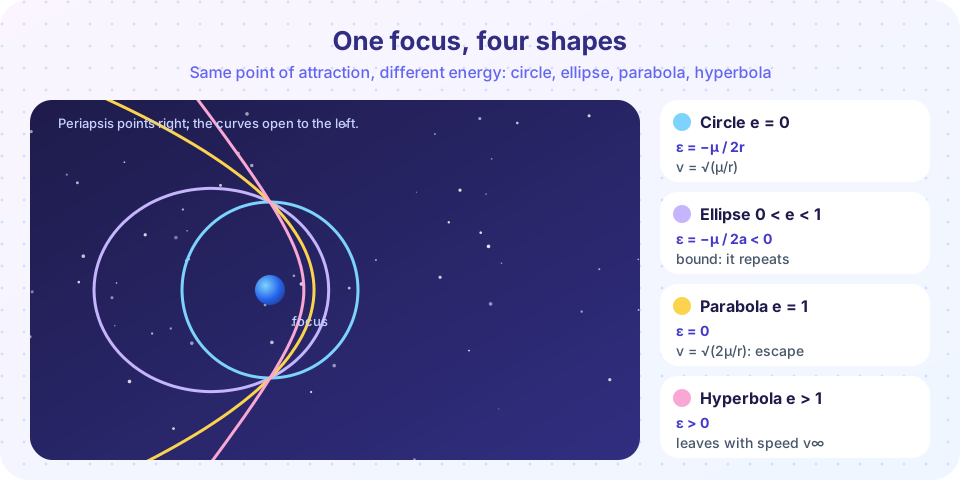
The sign of ε decides the orbit type, as in the picture.
| Orbit | Eccentricity | Energy | Speed condition |
|---|---|---|---|
| Circle | e = 0 | ε = −μ/(2r) < 0 | v = √(μ/r) |
| Ellipse | 0 < e < 1 | ε = −μ/(2a) < 0 | bound, repeats |
| Parabola | e = 1 | ε = 0 | v = √(2μ/r), exactly escape |
| Hyperbola | e > 1 | ε > 0 | escapes with leftover v∞ |
A parabola is the borderline between "returns" and "leaves": a → ∞, so the 1/a term vanishes and v = √(2μ/r). This is the escape speed, always √2 ≈ 1.414 times the local circular speed. From the surface of Earth that is 11.18 km/s; from a 200 km orbit (circular speed 7.78 km/s) it is 11.01 km/s. Going beyond escape speed yields a hyperbola. Far from the planet the remaining speed is
v∞² = v² − 2μ/r (and C3 = v∞²)
A spacecraft that must depart Earth for Mars needs about v∞ = 2.94 km/s (C3 ≈ 8.7 km²/s²), as the project in chapter 9 shows. For a hyperbola a is negative and ε = −μ/(2a) = v∞²/2.
Why burns work best at periapsis
When the engine adds a small Δv along the velocity vector, the energy gain per kilogram is
Δε = v·Δv + ½ Δv² ≈ v·Δv
The same Δv yields more energy when the speed is already high. In the transfer orbit above, 100 m/s at periapsis (10.15 km/s) adds about 1.02 MJ/kg, six times more than the same 100 m/s at apoapsis (1.61 km/s). This is the Oberth effect, named after Hermann Oberth, a pioneer of rocketry. It is why probes depart planets with a long burn near periapsis instead of far away.
Common misconceptions
"Escape speed means going straight up at that speed." Direction does not matter: escape speed applies to any direction (as long as it misses the planet), because energy, not direction, decides.
"Escape speed is the speed you need to orbit." Orbit needs √(μ/r); escape needs √2 times more.
"An engine burn changes only speed." A burn changes speed and therefore the whole orbit: its energy, size and period all change, and the point of the burn stays on the new orbit.
Try it
The first TryIt runs vis-viva on the transfer orbit. The second plots speed against distance for each orbit type. The third compares the energy of the same burn at two places.
Press Run (or Ctrl + Enter) to see the result here.
Program input · what you'd type while the program runs
Type the answers before you press Run, one per line. Each time the program reads a line (with input()), it gets the next line from this box.
Press Run (or Ctrl + Enter) to see the result here.
Program input · what you'd type while the program runs
Type the answers before you press Run, one per line. Each time the program reads a line (with input()), it gets the next line from this box.
Press Run (or Ctrl + Enter) to see the result here.
Program input · what you'd type while the program runs
Type the answers before you press Run, one per line. Each time the program reads a line (with input()), it gets the next line from this box.
Check your understanding
Quick check · 5 questions
of 5 answered You scored / 5 · perfect!
-
1. The vis-viva equation is
From ε = v²/2 − μ/r = −μ/(2a). On a circle r = a it reduces to v² = μ/a. -
2. A satellite has positive specific orbital energy. Its path is
Positive energy means more than escape speed: the body leaves and keeps a hyperbolic excess speed. Zero energy is the parabola. -
3. The escape speed at a given radius compared with the circular speed there is
√(2μ/r) divided by √(μ/r) equals √2, about 1.414. -
4. Why is a burn at periapsis more efficient for raising energy than the same Δv at apoapsis?
Δε ≈ v·Δv. The Oberth effect follows directly from this. -
5. A transfer orbit has r_p = 7,000 km and r_a = 21,000 km. How many times faster is the satellite at periapsis than at apoapsis?
v_p / v_a = r_a / r_p = 21,000 / 7,000 = 3.
Summary
- Specific energy
ε = v²/2 − μ/ris constant on an orbit and equals−μ/(2a). - Vis-viva:
v² = μ(2/r − 1/a)gives speed anywhere on any conic. - Circle and ellipse are bound (
ε < 0), the parabola hasε = 0(escape speed√(2μ/r)), and the hyperbola hasε > 0with leftoverv∞. - Burn energy gain is about
v·Δv: burn where you are fastest.
Track your progress
Create a free account to tick off lessons and pick up where you left off on any device.
of Aerospace Engineering lessons completed