


















Lesson 5 of 45 · Getting Started
Chapter 1 review: getting started
Review the field of aerospace engineering, the standard atmosphere, units and the four forces of flight with a recap table, calculators and a 9-question quiz.
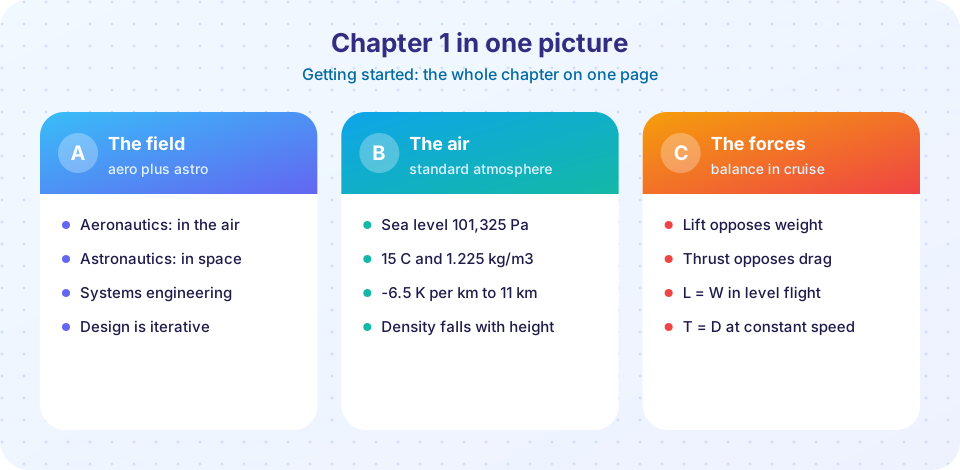
You have covered the ground rules of aerospace engineering: what the field is, the air that vehicles fly through, the units that describe them and the four forces that every flight must balance. This review pulls them together in one page, lets you test yourself and gives you two calculators to experiment with.
What you will learn
- How the four lessons of chapter 1 fit together
- Which equations to memorize and which to look up
- Where your understanding is solid, using a 9-question quiz
Recap table
| Lesson | Big idea | Key numbers or equations |
|---|---|---|
| Course map | Nine chapters, air then space | Aeronautics and astronautics |
| What aerospace engineers do | Disciplines, design stages, trade studies | Mass is the shared budget |
| The atmosphere and units | ISA model | 288.15 K, 101,325 Pa, 1.225 kg/m³, 6.5 K/km |
| The four forces of flight | Force balance and lift equation | L = W, T = D, L = 1/2 rho V² S CL |
Connecting the pieces
The atmosphere supplies rho and the speed of sound. The lift equation consumes rho, so a thinner atmosphere forces either higher speed or a larger lift coefficient. The same density also governs engine thrust, which you will meet in chapter 3. The force balance then tells you the thrust needed, the stall speed and the climb capability. Everything later in the course is built on this chain: atmosphere, aerodynamic forces, force balance, performance.
A good habit is to run a quick sanity check on every answer:
- Is the unit right? (A lift of 686,466 N, not 686,466 kg.)
- Does the trend make sense? (Thinner air means a higher required speed.)
- Is the size plausible? (An airliner stall speed of 7 m/s would be absurd.)
Try it
Press Run (or Ctrl + Enter) to see the console output here.
No output.
Press Run (or Ctrl + Enter) to see the result here.
Program input · what you'd type while the program runs
Type the answers before you press Run, one per line. Each time the program reads a line (with input()), it gets the next line from this box.
Check your understanding
Quick check · 9 questions
of 9 answered You scored / 9 · perfect!
-
1. Which description of astronautics is correct?
Astronautics concerns space vehicles and missions. -
2. Which is NOT part of the ISA sea-level definition?
The ISA has no wind: only temperature, pressure and density are fixed. -
3. The ISA tropopause is at about
Temperature stops falling at 11 km, where it is 216.65 K. -
4. A requirement is useful because it is
Measurable requirements can be checked by test or analysis. -
5. What is the speed of sound at 11 km (216.65 K)?
a = sqrt(1.4 x 287.053 x 216.65) is about 295.1 m/s. -
6. In level steady flight, thrust equals
Horizontally the forces cancel, so T = D. -
7. If air density halves and everything else is the same, the required CL in level flight
L = 1/2 rho V^2 S CL must still equal W, so CL doubles. -
8. Why are stall speeds quoted for flaps extended lower than clean?
Higher CL_max means the wing can carry the weight at a lower speed. -
9. 1 knot is about
A knot is one nautical mile per hour, 1,852 m / 3,600 s, about 0.514 m/s.
Summary
- Aerospace engineering is a team subject built on requirements, trade studies and mass budgets.
- The ISA fixes sea-level values and a 6.5 K/km lapse rate in the troposphere; speed of sound depends on temperature.
- Four forces balance in steady flight, and
L = 1/2 rho V² S CLlinks them to wing size, speed and density. - Always check units, trend and size of an answer.
Track your progress
Create a free account to tick off lessons and pick up where you left off on any device.
of Aerospace Engineering lessons completed