


















Lesson 9 of 45 · History and Vehicle Types
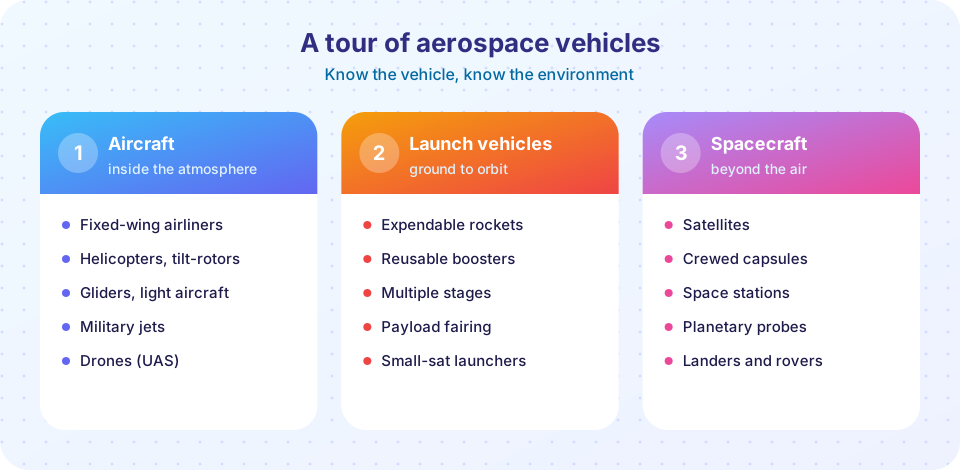
A tour of aerospace vehicles
Tour the families of aerospace vehicles, from airliners and helicopters to launch vehicles, satellites and probes, and how each is shaped by its environment.
A paper glider, an airliner and a Mars rover look like they have nothing in common. What unites them is that each is designed around the environment it must survive. An aircraft lives in air, so its shape is about lift and drag. A rocket must fight gravity, so its design is about thrust and mass. A spacecraft lives in vacuum, so it worries about heat, power and radiation instead of air. This lesson sorts vehicles into families and shows the numbers that set them apart.
What you will learn
- The main families of aircraft, launch vehicles and spacecraft
- The speed regimes of flight and the orbit classes of space
- How the environment drives the design
- How mass and speed differ by orders of magnitude between families
Key terms
Fixed-wing aircraft is an aircraft whose wings are rigid and lift comes from forward motion.
Rotary-wing aircraft is an aircraft, such as a helicopter, whose lift comes from rotating blades.
Launch vehicle is a rocket that carries a payload to space.
Payload is whatever the vehicle carries to do its job: passengers, cargo or instruments.
Aircraft
Aircraft are held up by the air. The main families:
- Fixed-wing aircraft. Airliners, business jets, light aircraft, fighters, gliders. Efficient in cruise; need runways.
- Rotary-wing aircraft. Helicopters generate lift by spinning blades, so they can hover and land anywhere, but they are slower and use more power per kilogram lifted. Tilt-rotors (such as the V-22) turn their rotors forward in cruise.
- Lighter-than-air. Balloons and airships.
- Uncrewed aircraft systems (UAS). Drones range from palm-sized quadcopters to long-endurance aircraft with wingspans of tens of meters.
Aircraft are also grouped by speed regime, based on Mach number: subsonic (below about 0.8), transonic (about 0.8 to 1.2), supersonic (1.2 to 5) and hypersonic (above 5). Each regime needs a different wing shape, because shock waves appear near Mach 1 and heating becomes severe above Mach 5.
Launch vehicles
A launch vehicle spends most of its mass on propellant. A medium rocket such as the Falcon 9 weighs roughly 550 tonnes at liftoff, yet puts only a few tens of tonnes into low Earth orbit. Almost all of the rest is fuel, oxidizer and structure.
- Expendable rockets are discarded after one flight.
- Reusable boosters return to land or a ship.
- Staged rockets drop empty tanks and engines on the way up. Chapter 6 shows why staging pays off.
- Small-satellite launchers carry a few hundred kilograms at lower cost.
The environment for a launcher is intense but short: a few minutes of high vibration, loud noise, heavy acceleration and aerodynamic pressure.
Spacecraft
Spacecraft are built for long exposure to vacuum, radiation and extreme temperature swings.
- Satellites. Communications, navigation, weather, Earth observation, science.
- Crewed spacecraft. Capsules such as Soyuz, Orion and Crew Dragon, plus the Shuttle in the past. They need life support and heat shields for re-entry.
- Space stations. Large, long-lived habitats such as the ISS.
- Interplanetary probes. Voyager, Mars orbiters and landers, comet missions. They have to survive for years without repair.
- Landers and rovers. Descend through an atmosphere or fire engines to touch down, then operate on the surface.
Satellite orbits fall into classes you will use in chapter 5: LEO (up to about 2,000 km), MEO (such as GPS at 20,200 km), GEO (35,786 km, period 24 hours) and HEO (highly elliptical).
How the environment shapes design
| Environment | Main design driver | Typical solution |
|---|---|---|
| Air | Lift and drag | Wings, streamlined body, engines that breathe air |
| Ascent through air and gravity | Thrust-to-weight and mass fraction | Staged rockets with light tanks |
| Vacuum in orbit | Heat, power, attitude | Radiators, solar arrays, reaction wheels |
| Re-entry | Heating | Ablative or tiled heat shield |
Try it
Press Run (or Ctrl + Enter) to see the result here.
Program input · what you'd type while the program runs
Type the answers before you press Run, one per line. Each time the program reads a line (with input()), it gets the next line from this box.
Common misconceptions
"A rocket is mostly engine." Roughly 90 percent of a launch vehicle's liftoff mass is propellant, and the engines are a small fraction.
"Spacecraft use wings." In vacuum wings do nothing. Space vehicles that fly back, such as the Shuttle, use wings only during the atmospheric part of re-entry.
Check your understanding
Quick check · 4 questions
of 4 answered You scored / 4 · perfect!
-
1. Which vehicle can hover and land without a runway?
Rotor blades give lift even with no forward speed. -
2. Hypersonic flight means a Mach number above
Hypersonic flow begins near Mach 5, where heating becomes severe. -
3. Most of a launch vehicle's liftoff mass is
Propellant is typically about 90 percent of the liftoff mass. -
4. Which orbit has a period of 24 hours at 35,786 km?
A geostationary orbit matches Earth's rotation.
Summary
- Aircraft, launch vehicles and spacecraft are shaped by air, gravity and vacuum respectively.
- Aircraft are fixed-wing, rotary-wing, lighter-than-air or uncrewed, and grouped by speed regime.
- Launchers are mostly propellant; spacecraft balance heat, power and attitude.
- Orbits come in LEO, MEO, GEO and HEO classes.
Next: Chapter 2 review
Track your progress
Create a free account to tick off lessons and pick up where you left off on any device.
of Aerospace Engineering lessons completed