


















Lesson 15 of 45 · Aircraft Structures and Propulsion
Aircraft propulsion
Understand the thrust equation, propulsive efficiency, bypass ratio, turbojets, turbofans, turboprops and piston engines, and how fuel consumption follows from efficiency.
To move forward, an aircraft must throw something backward. That is all propulsion is: Newton's third law applied to a stream of air. A propeller throws back a large mass of air slowly; a turbojet throws back a smaller mass quickly. The big surprise, which shapes every modern airliner, is that slow and large is much more efficient than fast and small. This lesson shows why, using a single equation.
What you will learn
- The thrust equation and what each term means
- Why propulsive efficiency favors large mass flow at low exhaust speed
- The main engine types and the speed range for each
- How fuel consumption (TSFC) follows from overall efficiency
Key terms
Thrust is the net force the engine applies to the aircraft.
Mass flow (mdot) is the mass of air passing through the engine each second.
Bypass ratio is the mass of air bypassing the core divided by the mass through the core.
Propulsive efficiency is the fraction of the jet's kinetic energy that does useful work pushing the aircraft.
TSFC is thrust-specific fuel consumption: fuel mass flow per unit thrust.
The thrust equation
An engine takes in air at the flight speed V0 and ejects it at a higher speed Ve. The change in momentum per second is the thrust:
T = mdot (Ve - V0)
(A pressure term (pe - p0) Ae is added when the exhaust is not at ambient pressure, and the added fuel mass is small enough to ignore here.) Two numbers matter, the mass flow and the velocity increase. To get 35 kN at V0 = 250 m/s you could use mdot = 100 kg/s with Ve = 600 m/s, or mdot = 350 kg/s with Ve = 350 m/s.
Propulsive efficiency
The engine's power must do two things: push the aircraft and speed up the jet. Useful power is T V0. The jet's leftover kinetic energy is wasted. The result, the Froude efficiency, is
eta_p = 2 / (1 + Ve / V0)
At V0 = 250 m/s: Ve = 600 gives eta_p = 0.59 and Ve = 350 gives eta_p = 0.83. The second engine wastes far less energy in the jet. To make the same thrust at a lower exhaust speed you need more air. That is exactly why modern airliners use high-bypass turbofans, with a huge fan in front pushing a large mass of air around the core.
Engine types
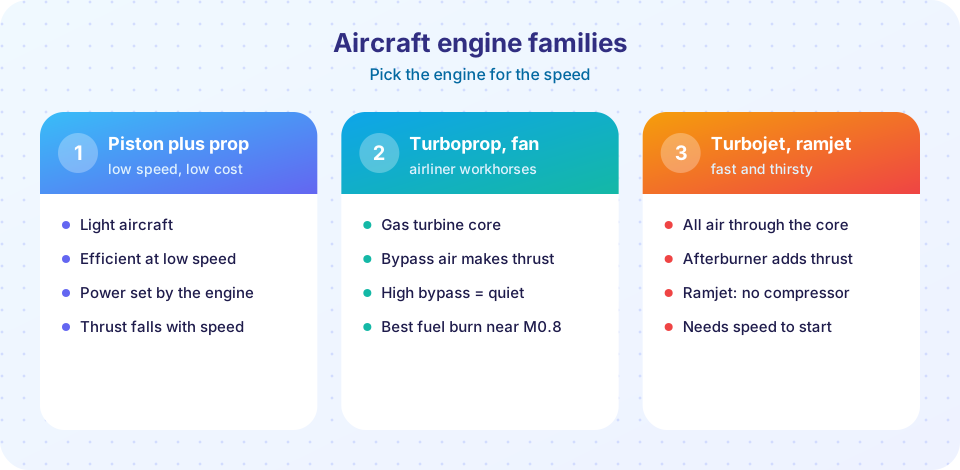
Piston engine and propeller
A piston engine delivers shaft power P, and the propeller converts it to thrust: T = eta_prop P / V0. The thrust is highest when the aircraft is slow and falls as speed rises. Propellers are very efficient (up to 85 or 90 percent) at low speed, but as the blade tips approach Mach 1 the efficiency collapses, so propeller aircraft cruise below about 600 km/h. They are used for light aircraft.
Turboprop
A gas turbine drives a propeller through a gearbox. It has the efficiency of a propeller and the power-to-weight of a turbine. Regional aircraft and cargo aircraft use turboprops, which cruise efficiently at 450 to 600 km/h.
Turbofan
A gas turbine core drives a large fan. Most of the thrust comes from the fan air that bypasses the core. The bypass ratio (BPR) has grown: about 1 on early 1960s engines, 5 to 6 on the CFM56 of the 1980s, about 9 to 10 on current large engines and above 12 on geared turbofans. High bypass means a low jet speed, higher propulsive efficiency, lower fuel burn and less noise.
Turbojet
All the air passes through the core, and the jet leaves very fast. It is noisy and inefficient at subsonic speed, but ideal when the aircraft is fast. Supersonic aircraft use afterburners, burning extra fuel in the exhaust, for short bursts of high thrust.
Ramjet and scramjet
A ramjet has no compressor: the aircraft's speed "rams" the air into the engine, so it works only at high speed (from about Mach 1.5, best at Mach 2 to 4) and must be accelerated by another system. A scramjet burns fuel in supersonic airflow and is a research subject for hypersonic flight above Mach 5.
Fuel consumption
Overall efficiency is the product eta_o = eta_th eta_p, with eta_th the thermal efficiency (heat converted to jet power, around 0.4 to 0.5 in modern engines). Fuel flow per unit thrust is
TSFC = V0 / (eta_o · Hf)
where Hf = 43 × 10⁶ J/kg is the heating value of jet fuel. With V0 = 250 m/s and eta_o = 0.4, TSFC = 250 / (0.4 × 43×10⁶) = 1.45 × 10⁻⁵ kg/(N·s), which is 14.5 mg per newton per second, or about 0.51 lb of fuel per hour per lbf of thrust, a common figure for airliners.
Try it
Press Run (or Ctrl + Enter) to see the result here.
Program input · what you'd type while the program runs
Type the answers before you press Run, one per line. Each time the program reads a line (with input()), it gets the next line from this box.
Press Run (or Ctrl + Enter) to see the console output here.
No output.
Common misconceptions
"Jet engines push against the air behind them." Thrust is the reaction to accelerating air backward; rockets prove it by working in vacuum.
"Bigger engines always burn more fuel." For the same thrust, a bigger-bypass engine burns less, because of its higher propulsive efficiency.
"A turbofan's fan is just a cooling fan." In a high-bypass engine, the fan produces most of the thrust: 80 percent or more.
Check your understanding
Quick check · 5 questions
of 5 answered You scored / 5 · perfect!
-
1. Thrust of an air-breathing engine is approximately
Thrust equals the rate of change of momentum: mass flow times the increase in speed. -
2. A jet with Ve = 500 m/s flies at 250 m/s. Its propulsive efficiency is
2 / (1 + 500/250) = 2/3 = 0.67. -
3. Why do airliners use high-bypass turbofans?
More mass flow at lower exhaust speed wastes less kinetic energy. -
4. A ramjet works only at
It relies on the ram effect of the incoming air, so it needs supersonic speed to start. -
5. Which has higher thrust at low speed?
Propellers deliver the highest thrust when the aircraft is slow.
Summary
- Thrust is
mdot (Ve - V0); more air at lower exhaust speed is more efficient:eta_p = 2/(1 + Ve/V0). - Propellers suit low speed, turbofans suit airliner speeds, turbojets and ramjets suit high speed.
- Bypass ratio has risen from about 1 to above 10, cutting fuel burn and noise.
TSFC = V0 / (eta_o Hf), so better efficiency directly saves fuel.
Next: Chapter 3 review
Track your progress
Create a free account to tick off lessons and pick up where you left off on any device.
of Aerospace Engineering lessons completed